The journey towards the end of life

Posted on
Jenni McMullan cared for her beloved husband Brian while he battled brain cancer. She outlines her journey to assist him to die with love and dignity and why she has become an advocate for palliative care.
If the “journey of a thousand miles begins with a small step” then the end-of-life journey of someone you love begins with a thousand tears.
In September 2005 our daughter, Elizabeth, gave birth to a precious baby girl, Lucy. What absolute joy it was to see the continuation of our family and we celebrated Lucy’s arrival as one of nature’s miracles.
Only four short days later my husband Brian was diagnosed with multiple brain tumours. We were plunged from great elation on a safe delivery to the depths of shock. Diagnosis was the first step on the journey of a thousand miles.
Three brain operations followed over four days to remove multiple tumours and Brian haemorrhaged into the brain twice. He aspirated into the lung, was intubated and his left side shut down. He spent five days in intensive care and came within a whisker of not pulling through.
I have the poignant memory of him lying in ICU with tubes everywhere and, just briefly, cradling Lucy in his arms. She seemed to bring him peace. Radiation of the brain followed, and we faced Christmas 2005 with hopeful optimism. As we looked forward to 2006, the words of John Lennon Christmas song percolated in my head—”Let’s make it a good one, without any fear’.
But it was not to be. By February 2006, metastasis appeared in the bowel, and Brian was accepted on a trial immunotherapy program being run by the University of Newcastle whereby the tumour was excised and converted to a vaccine to raise the body’s own immunological response to the cancer. Again, there was hope.
Surgery took place, the tumour was flown to Newcastle and the conversion started. Everything went well in the first three weeks but by the fourth week the vaccine developed bacteria and could not be used. Throughout this period, I was the breadwinner, so I maintained a full-time job at senior levels in Government. Wonderful friends popped in during the day, neighbours cooked meals and our two daughters, Elizabeth and Kathryn, were solid rocks of support.
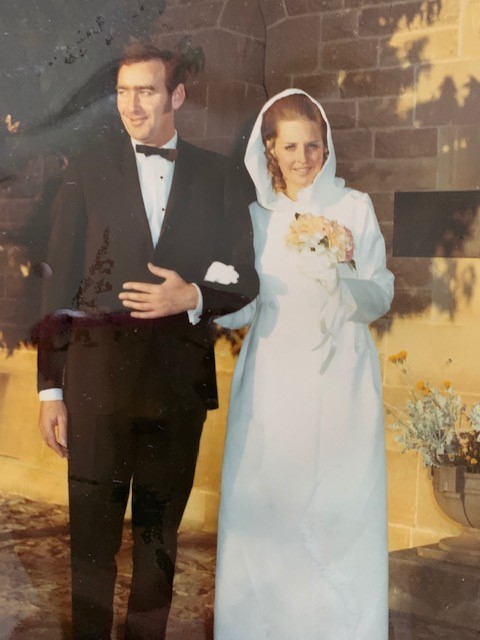
Brian and Jenni on their wedding day, 5 December 1969.
Then Brian developed six tumours in the spine and one in the aorta and he was admitted to Clare Holland House for pain management. It was my first exposure to palliative care. Up to that point, we had been managing his pain with Panadol. If only I had known sooner about the support that palliative care can provide. What a difference it would have made for Brian.
Volunteers could have come to the house to provide him with support and company, and various tests could have been arranged at home rather than him struggle to pathology outlets. The support was there but I didn’t know about it.
Once he settled into Clare Holland House things changed. It was as though he gave himself permission to die. The nursing and volunteer staff were wonderful and lived by the mantra of Dame Cicely Saunders, founder of St Christopher’s Hospice London, who said “You matter because you are you. You matter to the last moment of your life and we will do all we can to help you to die peacefully but also to live until you die.”
We had three small parties while Brian was in Clare Holland House: one to celebrate Easter, one to celebrate ANZAC and one ‘just because’ we could. He passed away, surrounded by his family—his petticoat government as he called us—on 30 April 2006.
I helped the medical staff lay Brian out. Candles were lit in the room, warm water was brought in and I helped prepare his body. I was tremendously moved by the young nurse, Sam, who I assisted.
Sam was keenly aware of the pain Brian had been in with the tumours down his spine, so when Sam hooked Brian by the shoulder and gently leaned him forward so I could wash Brian’s back, Sam whispered in Brian’s ear “It’s OK mate, it won’t hurt now.” Such compassion from such a young man brought tears to my eyes.
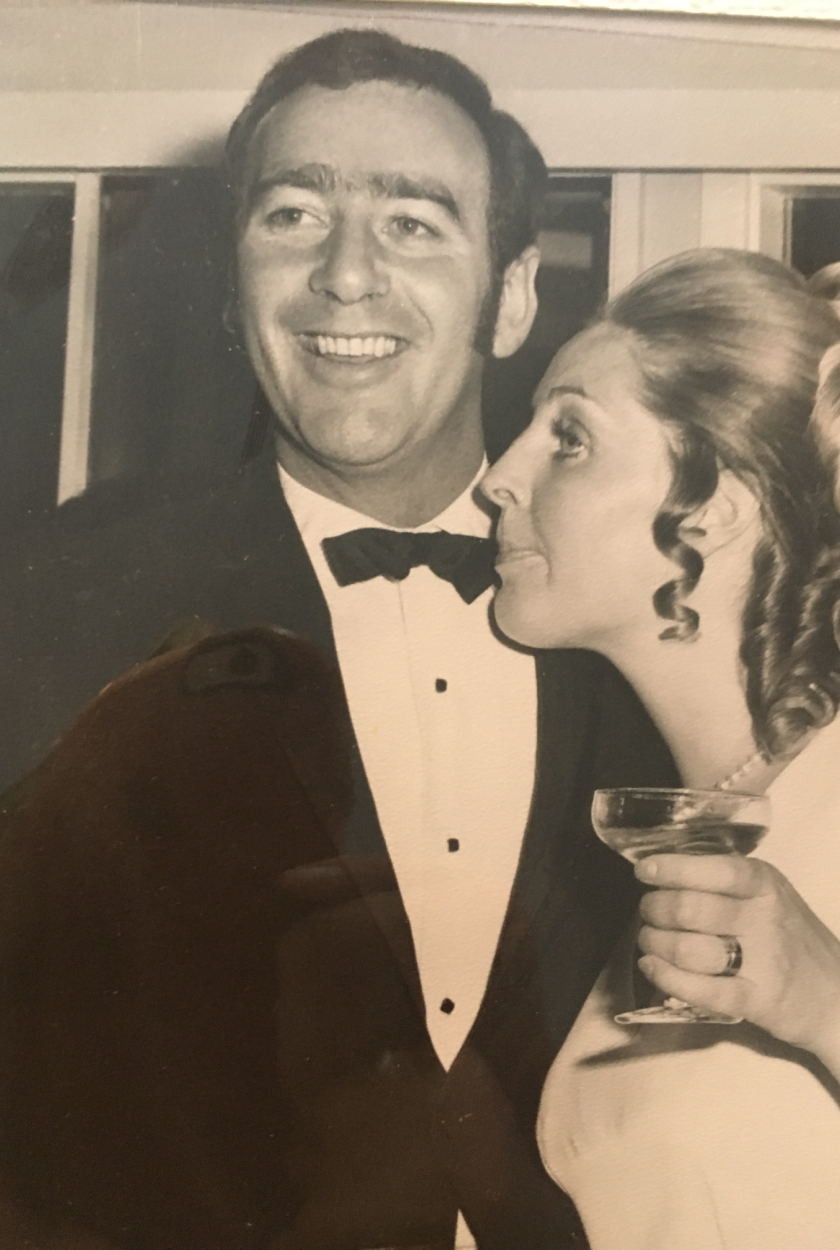
Brian and Jenni at their wedding.
Following Brian’s death, I took on as a grieving project the elimination of the four-bed ward at the hospice, replacing it with four single rooms each with their own facilities. It took one year and one day from pitching the idea to Chief Minister Jon Stanhope to the new rooms being opened. Now, no one who is admitted to the hospice loses their privacy at a time as they are also losing their life.
But the journey did not stop there. Following a stint in Melbourne for work, I returned to Canberra and joined the Board of Palliative Care ACT. This is a wonderful organisation which provides support not only to people who are at the end of life, but also to their carers.
Latest research shows that seventy per cent of people want to die at home but for a variety of reasons fewer than twelve percent manage to do so. One big contributing factor is carer fatigue and isolation.
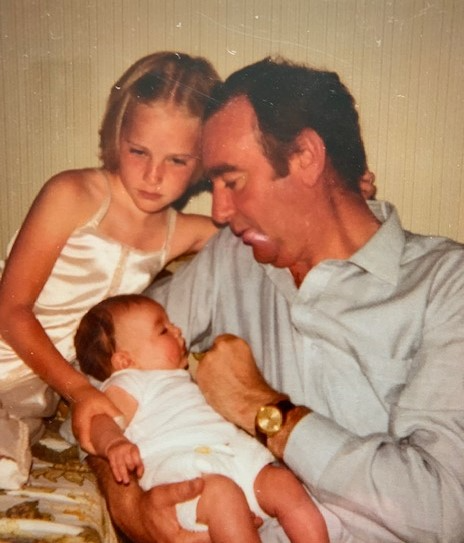
Brian and his daughters, 1979.With this in mind, Palliative Care ACT took on the task three years ago of establishing a respite centre where people with a life-limiting illness can stay while their carers take a break.
Called “Leo’s Place” it opened in January 2021 and provides a ‘home away from home’ where people can relax, read, have visits from family members and friends, enjoy sunshine on the deck and be provided with beautiful meals.
As a carer, if Leo’s Place had existed in 2006, I would have felt great comfort in knowing that someone was with Brian during the day.
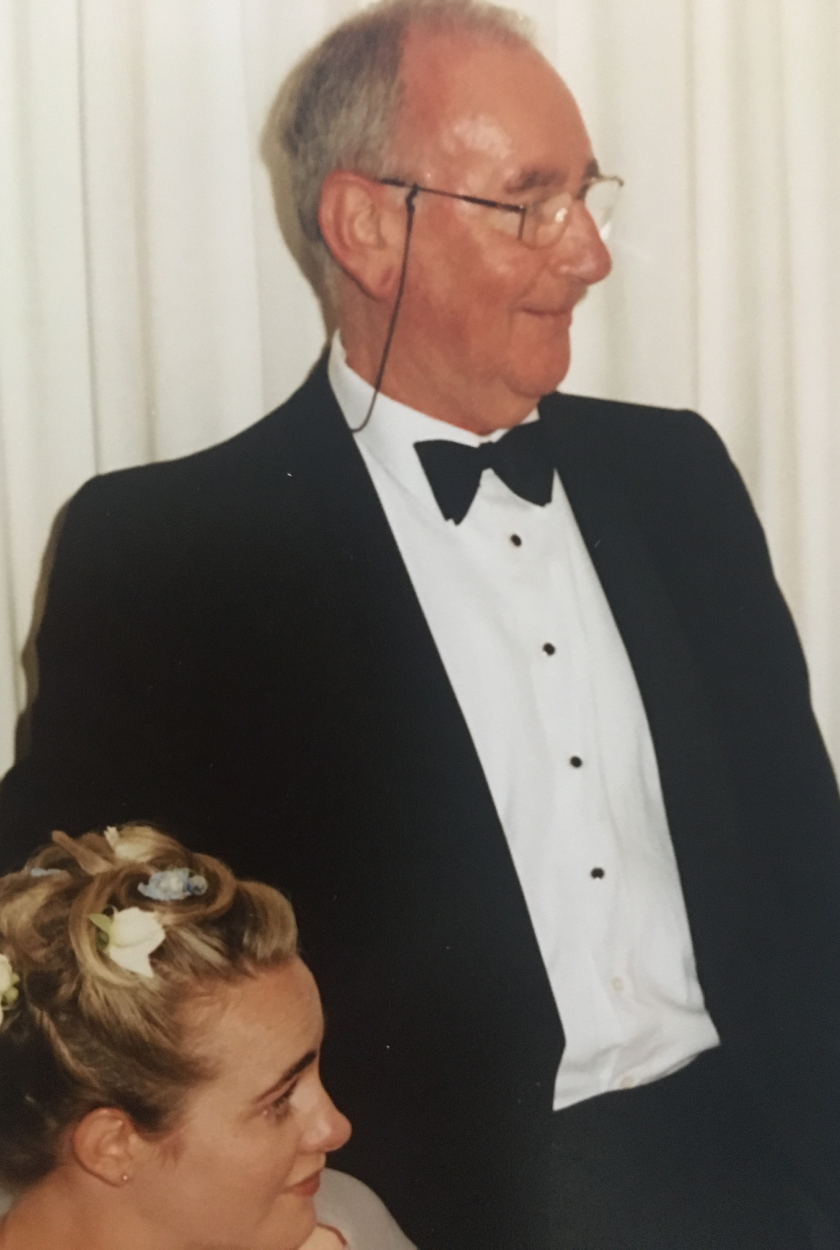
Brian and Elizabeth at Elizabeth’s wedding, 2001.
I cannot speak highly enough of the medical staff and the volunteers who choose to care for those who are at the end of their life. It is often a time for people to reflect on their life and, while there is sadness, there is also a privilege in sharing the richness of people’s memories.
Brian’s end of life journey had moments of humour, moments of laughter, and moments of hope. I was supported strongly by my daughters, the palliative care staff and volunteers at Clare Holland House and while there were thousands and thousands of tears, I made that journey of a thousand miles.