How I got here: Emma Grey, author
Posted on
Admit it, we’ve all been there—deep dive stalking social media and LinkedIn profiles, trying desperately to figure out how the hell someone got their dream job.
It seems impossible and yet there they are, living out your career fantasy (minus the itchy business suit). It might seem hard to believe, but once upon a time, they were also fantasising about their future career, and with some hard work, they made it.
Welcome to How I Got Here, HerCanberra’s series that reveals everything you wanted to know about the secrets of career success.
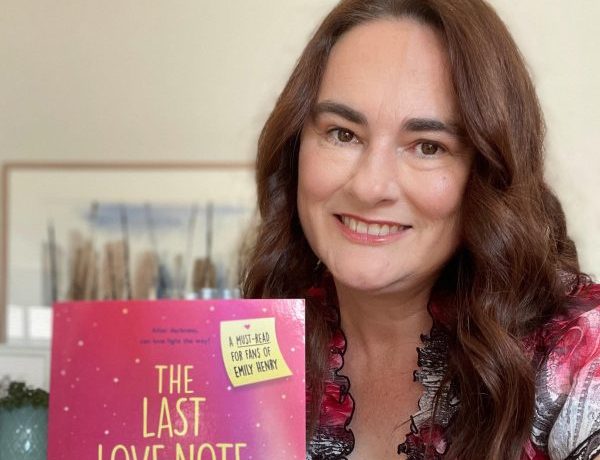
To celebrate the launch of her latest book today, we share Emma Grey’s story of how she got here.
Existential crisis time: Who are you and what do you do?
I never know quite how to answer this question, because I have a varied professional life. But I’m a mum of three and author of five books, including the new rom-com, The Last Love Note.
I wrote that book in the wake of my husband’s death, having been unexpectedly widowed in 2016, at 42. It’s a fictional celebration of our love, an attempt to articulate the magnitude of my loss, and a life-affirming commitment to hope. Excitingly, New York publisher Zibby Owens has just acquired the World English rights from Penguin Random House Australia. So you’ve caught me right in the middle of some ‘dream come true’ career stuff that feels like it’s unfolded in a rush (even if it actually took 30 years).
My two teenage novels began as an attempt to show my Harry-Styles-obsessed, non-reading teen that reading could be fun. Composer Sally Whitwell and I co-wrote a musical, Deadpan Anti-Fan, based on one of the novels, Unrequited. I work as an accountability coach with my business partner and co-author Audrey Thomas. Together we wrote the productivity book, I Don’t Have Time. Throw in copywriting, freelance articles and a passion for photography and life is very full.

Emma’s latest book, The Last Love Note, is published today.
Let’s go back to when you were a kid, have you always dreamed of working in this industry?
I was 14 when I realised most teenagers don’t spend all summer with a notebook and pen in hand, trying to scrawl down a novel. I’d just been introduced to Anne of Green Gables and identified with Anne immediately, as both a romantic and a writer – realising we shared the same drive and ambition to capture stories and be published.
Tell us about when you were first starting out, what set a fire in your belly to get here and how did you do it?
I just wanted to pin daydreams to the page. I was forever inventing stories, imagining scenarios and dialogue and it has always felt like ‘play’ (at least in the initial creation phase).
There’s something about the thrill of the chase with publication—a burning desire, made more intense by the confronting statistics about how rare it is to find traditional publishers, how much rejection it involves to get there and how hard it can be to ‘make it’ as an author, even after publication.
All through, I’ve wrangled writing with other work. A 10-year career in the APS, 10 years and counting with a business. It’s always been about squeezing writing into the nooks and crannies of the day. When you’re 100 per cent invested in the dream, it’s amazing how much time you find.
Recall a time when you wanted to chuck it all in; what did you tell yourself when it got too hard?
I can’t recall ever wanting to chuck it in, which isn’t to say there haven’t been moments of thinking ‘this is really hard’, especially during an intense re-write and several editing rounds of The Last Love Note. The night before the manuscript was due, I drastically restructured the entire book. Was it an inspired move, or was it because I was delirious with COVID at the time? We will never know!
While rejection used to crush me at first (one of my novels was rejected 17 times before I received a two-book deal from HarperCollins) now I embrace it. I have a poster on my wall where I write down everything I send out into the world—every attempt at something and every risk I take, writing-related or not. I’m aiming for 100 rejections (which should mean also tallying up quite a few successes, as it’s largely a numbers game when you’re taking so many risks).
Last year, this approach scored an equal number of failures and successes, which on the surface might seem disappointing. But the successes included book deals with both Penguin Random House and Zibby Books in New York, and finally capturing the Aurora Australis in the camera just south of Canberra (after chasing it fruitlessly for seven years). Without putting so much on the line and repeatedly risking disappointment and failure, those things would never have happened.
What was your biggest break?
It was a Zoom meeting in December with Zibby Owens. My literary agent had sent her The Last Love Note, initially in the hope that she might interview me for her renowned literary podcast, ‘Moms Don’t Have Time to Read Books’.
When she read the book, though, she ‘fell in love with it’ and an hour after our call, she’d sent my Australian publisher an offer for a two-book deal. Breaking into the US market is game-changing, and I’ve completely upsized my career goals now because of it. It all happened around the time supermarkets were recalling the hallucinogenic spinach – for days I kept wondering if I’d scoffed some!
What’s the best piece of advice you’ve ever received?
When my husband Jeff died, my friend Rebecca Sparrow gave me some advice about grief. She had lost her baby daughter, Georgie, and said she’d made a decision then that she would use Georgie’s loss to ‘turn the light up in her life, not down’.
My family embraced this notion. It didn’t mean we weren’t desperately grief-stricken. But we looked for ways to connect with and honour our loss that would open up the world to us, rather than shrink it. Searching for tiny, life-affirming things lit up the darkness. We took more risks because we’d been schooled on the fact that life is so short. We let go of unnecessary angst.
What is it about your industry that you love and what makes you want to pull your hair out?
I’ve been delighted by the support of other Australian authors. I suppose we’re technically each other’s ‘competitors’ but that’s not how it feels at all. It’s a warm, embracing community.
Sometimes I want to pull my hair out at the divide between traditional and self-publishing. I’ve done both, and both approaches have a lot of merit. It’s all about getting words into readers’ hands.
Tell us how you ‘stay in the know’, what media do you consume?
I tend to get all my news via social media links first. But I’ve carefully curated my accounts so that I’m mainly following not only reputable sources, but pages that are not going to drag me into a pit of despair.
Where do you see yourself in five years?
A film deal for The Last Love Note wouldn’t go astray…
I’d love to settle into a rhythm of writing a book each year. It would be brilliant if the musical Sally and I wrote was embraced in high schools (we had such traction with the show until COVID hit) and if its success grew organically from there. Audrey and I are keen to write more books together and continue our “Reinvention Project” workshops and coaching.
I’d love to travel more, but the big dream is to end up with a cosy beach shack and continue to write until I can’t string sentences together any more.
Why should people follow in your footsteps?
It’s escapist fun to invent stories, and the sense of achievement writing ‘The End’ after pouring your heart into 90,000 words or so is unlike anything else I’ve experienced.
But if writing doesn’t appeal, I think finding an outlet we love is essential. It doesn’t matter what it is—just throw yourself into whatever lights you up.
What advice would you give your past self?
I’d tell her: “Something is going to devastate you one day, and you’ll think you won’t survive it. Just get through one day at a time and you will find the courage to shape a new future.”
As Jeff died from a heart attack, I’d also say: Get everyone’s hearts checked. x
The Last Love Note (Penguin Random House) is available now.