How I Got Here: visual artist Kate Vassallo
Posted on
Admit it, we’ve all been there – stalking social media and LinkedIn profiles, trying desperately to figure out how the hell someone got their dream job.
It seems impossible, and yet there they are, living out your career fantasy (minus the itchy business suit). It might seem hard to believe, but once upon a time, they were also fantasising about their future career, and with some hard work, they made it.
Welcome to How I Got Here, HerCanberra’s series that reveals everything you want to know about the secrets of career success.
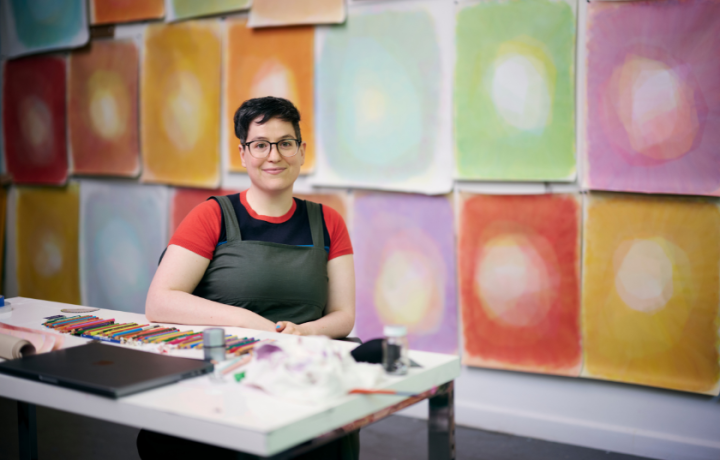
You’re probably familiar with the work of visual artist Kate Vassallo. Commissioned in 2023 by Major Projects Canberra to create an artwork for the Canberra Hospital Expansion, she has also been a finalist in numerous art prizes, including the Bayside Acquisitive Art Prize (2022), Jacaranda Acquisitive Art Award (2022), Adelaide Perry Prize for Drawing (2021, 2022) and Ravenswood Australian Woman’s Art Prize (2017, 2021).
Now showing at Sydney’s N.Smith Gallery, her latest exhibition Soft Modulation brings together a luminous body of paintings shaped by process, repetition and the subtle interplay of colour, tone and texture. We sat down with Kate to find out how she got here.
Existential crisis time: Who are you and what do you do?
I’m a visual artist born and based in Kamberri/Canberra. I work with process-based abstraction and use fairly repetitious methods in the studio, making mainly drawings and paintings. My art is colourful and meticulous, often incorporating geometric forms and rule-based making systems. It is a labour of love that slowly shifts and grows, as I shift and grow as a person. Even though my work is not autobiographical or narrative, making it is a deeply personal process.
Working here in Canberra, I share a studio space at M16 Artspace (Griffith) with my partner and fellow artist James Lieutenant. From this home base, I work on projects and exhibitions around Australia. Currently, I have a solo exhibition I’m really proud of at N.Smith Gallery in Sydney. Titled Soft Modulation, it’s an exhibition of paintings I’ve spent the last 12 months or so making, so it feels like a big milestone. I’m also working on a major public artwork to be integrated into the architecture of the new Shellharbour Hospital under construction in the Illawarra, while preparing for upcoming group exhibitions in Sydney and Melbourne.
Let’s go back to when you were a kid, have you always dreamed of working in this industry?
As a kid, I always loved to scribble and make stuff. Being a true millennial, I was religiously watching Art Attack on TV. Art class was always my favourite thing, but I loved all things creative. My parents were really supportive of this; I took lots of ballet and dance classes, learned music (though I was never very good!) and enjoyed creative writing and drama at school. In high school, I was the kid who drew all over my notebook during class. I think I did always want to be an artist, but honestly, growing up in the ‘burbs in Canberra, I was never really exposed to any ‘creative’ adults. I didn’t really know if being an artist could be a job. But I knew I wanted a creative life and by the time I graduated from high school, my mind was made up that visual art was for me.
Tell us about when you were first starting out, what set a fire in your belly to get here and how did you do it?
I’ve always felt like I have something to prove, and I’m a naturally driven person. Maybe that comes from being the youngest of three daughters? Or a daughter of migrant parents? Who knows! I’ve also always felt strongly that I want to leave the world a better place than I found it. I see a life making art as something that can do this. Art can have such a positive impact on individuals and communities; I really believe it has the ability to change the world for good.
I would also say that being an artist can sometimes feel like more of a compulsion than a choice. I often hear artist friends say similar things: that not making art isn’t really an option. But turning that desire to make it into a career is a very challenging thing!
Recall a time when you wanted to chuck it all in; what did you tell yourself when it got too hard?
Something that might not be that obvious from the outside is that artists have to deal with constant rejection. Opportunities are really competitive and often have extremely low odds. It is not uncommon for grant rounds to fund less than five per cent of applications. Or an art prize you enter could get 1000 submissions, with 40 artworks picked as finalists, let alone a single work chosen as a winner! Especially when I was starting out as a fresh-faced graduate, I invested a lot of time and energy in applying for opportunities and getting knocked back constantly was tough.
But I would say over time that rejection has gotten easier and it starts to feel like an important way to build a thick skin. As an artist, your work is not always going to be everyone’s cup of tea. Just putting yourself out there is opening yourself up to critique and it can feel very vulnerable. It’s important to embrace it; you have to be kind of brave. Sometimes feedback on your work or a rejection will feel harsh at the time, but later on it can shift your perspective in a really positive way.
What was your biggest break?
I would say my biggest break has been being selected as one of the ten artists to exhibit in the exhibition Infinite: Dobell Australian Drawing Biennial 2024 at the Art Gallery of New South Wales. It was my first (and remains my only, so far!) exhibition in that state-level institution. This is a curated exhibition of contemporary Australian artists that the state gallery holds every two years. It’s a show I remember visiting as a young art school student who loved contemporary drawing and just feeling so inspired, walking away thinking ‘I want to do that’.
It is not an open call, meaning a curator (in this case, Anne Ryan) came up with a thematic concept and came to the decision that my artwork would be a good fit. I got to exhibit alongside so many artists that I’ve long admired. It honestly still blows my mind that this happened! It was a really special experience and something that gave me a big confidence boost. I could be really ambitious with the new work I created for the show, which I was really proud of, and to top the whole thing off, the institution ended up acquiring the work for their collection.
What’s the best piece of advice you’ve ever received?
In a conversation with a more experienced artist friend of mine quite soon after I graduated from art school, they said ‘you’ve got to play the long game’. When you’re young, I think you can feel really pressured to want some markers of success really quickly. You can be anxious for recognition or opportunities; you want to be part of the action. But this advice was spot on; there is no rush. An art practice and career as a visual artist is a life’s work. You can’t jump ahead. Your work takes time to develop and opportunities arise when the time is right.
What is it about your industry that you love and what makes you want to pull your hair out?
I think maybe my answer to both of these things is the same. I love the people who make up the visual arts world I live in. The community as a whole are idealistic, honest and have strong principles that they back up with action. It’s so lovely to be surrounded by like-minded people who are always striving for a better world. The flip side of that, though, is that it can sometimes form a bit of a ‘bubble’. It’s a great bubble to be part of, but it can mean you’re disconnected from others. I think it’s important for art to be universally accessible and welcoming to anyone, so it’s really crucial not to close yourself off from the ‘real world’ too much.
Tell us how you ‘stay in the know’, what media do you consume?
I would say my art practice is deeply informed by the creative media I consume, like music, cinema and TV. I feel like a ‘sponge’, soaking in ideas, feelings, atmospheres that can pop out later in the studio. I spend probably too long on social media, but it really is a great way to stay up to date with what artists are making, galleries are showing and generally what’s going on in the arts. But nothing beats seeing art in person, for me, especially visiting a gallery or exhibition. It’s so important to physically experience artworks to really understand them. An artist is always learning; seeing art in person is the ultimate way to learn. As you soak up ideas and grow your knowledge, you grow as a person and an artist.
Where do you see yourself in five years?
It’s a long game, so I won’t get too ahead of myself! I very much see myself still living my best life in Canberra. I’m hopefully busy with lots of art projects that I’m excited about and continuing to push myself to make new things and try new ideas. Perhaps I have some exciting travel planned to visit art museums/exhibitions/events, to keep informing my art practice. I’m really happy with where I’m at right now, so staying the course is the goal for the next few years.
Why should people follow in your footsteps?
A job as an artist is the ultimate freedom. It’s tough at times, but I feel so lucky and privileged to be able to sustain an art practice. It’s all mine; I can make or create exactly what I want. I don’t think there are many careers you can truly say that for. Creating something from scratch for others to engage with is just such a satisfying experience; I don’t think it will ever get old.
What advice would you give your past self?
Don’t sweat the small stuff and have fun! As a fairly driven person, I think I can get really deep into details and push myself a bit too hard at times. It could sometimes feel like nothing was ever good enough. As I’ve grown up, I’ve been able to feel more comfortable and confident in what I’m doing; it has really helped me mellow out. I’m really happy that I’m now able to slow down and enjoy the journey more.
Soft Modulation will run until Saturday 1 August.
Feature image: Pew Pew Studio.