Perceiving and being perceived: living life with PTSD
Posted on
Content warning: This article discusses sexual assault. If you’re currently in distress, please head to 1800RESPECT (1800 737 732) for support.
Before developing PTSD following sexual violence, Hannah Edwards thought she understood it – she had read the literature, after all. But understanding the theory of trauma and living through its daily reality are two entirely different worlds. Here Hannah shares a raw, candid perspective on what navigating life with PTSD really entails, and why empathy remains our strongest tool for support.
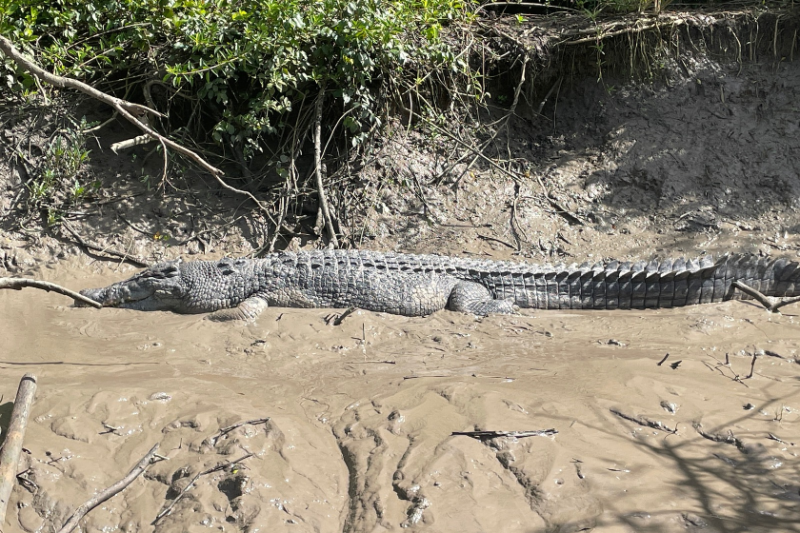
I’m on a boat, cruising down a river. I’m conscious of keeping my body well behind the railing, since it’s a crocodile tour. The people in front of me don’t seem to care; every time our guide points out a crocodile, a woman’s arm shoots over the side to get the perfect shot. I know she will be fine. Those crocs aren’t threatened by us, nor do they think our boat is food, and the cooler weather means they’re lethargic. But multiple times during the tour, I imagine her arm being ripped off by a crocodile. I catastrophise so I can mentally prepare for the worst, because I haven’t always done so, to my regret.
I was diagnosed with PTSD in 2025, though I knew I had it earlier. I figured it out in June 2024, sitting in my car outside my son’s daycare, reading about the process of reporting a sexual assault. I resolved not to report – he has children, I thought, and it would upend their lives. I couldn’t do that to his kids. I’d met them. They were good kids. It was that afternoon my brain caught up to the knowledge my body had long felt: I had been raped by someone I trusted with my life, in January 2024, when I was drunk and distressed.
That realisation put some behavioural “quirks” into context. I had been driving in silence for months, because music was regularly triggering. Artists I had seen live with him, songs I had shared with him, even songs that were completely unrelated. Granted, the silence wasn’t much better – I would rehearse or rehash upsetting conversations and verbally relive the assault in excruciating detail. I compulsively watched the road for a black sedan, because any one of them could have been his. My mind was always on – scanning for threats, reliving the assault; and how he had presented himself as an ally – a friend.
I resolved to talk to him. I hadn’t done so in months by my own choice, but my brain could not quieten. After all, he had presented himself as an ally. Restorative justice is a valid option for many; why not me? I truly believed that he was good.
I reach out, and after some back and forth, we meet for coffee. It was there that I disclose to him:
“…On that night, I don’t feel as though you properly sought my consent”.
I don’t use the words “rape” or “sexual assault”. I have to pick my battles.
His immediate reaction validates everything I thought about him. He apologises. He’s horrified. In person, he validates my experience. In person.
A few nights later, via message, he denies everything. He tells me I’m wrong. He stops short of saying I was lying. It becomes a cycle. Validate in person, dispute over messages, and repeat. I tell him that all I want is genuine acknowledgement, then I’ll leave his life for good – though I don’t tell him that part; he’s long insisted we remain friends. He made me promise we would.
Every time we meet, my entire body feels wrong. I feel a discomfort I have never felt before. Waiting for him to arrive is filled with dread; the moments with him filled with what I can only describe as “survival mode”. Tell jokes, listen to him, smile, make eye contact – but not too much. Make it to the end intact. Spend twenty minutes in my car afterwards, decompressing so I can safely drive.
I raise how his flip-flopping has felt. The tears start the second the topic does. He apologises. He tells me he was worried I was going to “ruin his life”. I say – honestly, at that time – that I had considered reporting it but ultimately couldn’t. At the end, he tries to get me to buy his car. His black sedan. That was the last time I would see him socially.
I’m repeating this story now because I realise towards the end of the crocodile tour that, instead of listening to the tour guide or watching the crocodiles, I had been replaying that exact sequence in my mind. The murky river water became a backdrop to the film I had no choice but to watch. It’s not the first time this has happened, nor will it be the last, because my capacity for presence is limited.
It doesn’t manifest solely in big moments. It’s when my son watches two hours of TV, without breakfast, because I can’t get up. It’s when I’m staring blankly at the tiles in the shower. It’s when not even white noise can drown out my mind at bedtime. It’s exhausting to live like this. It’s utterly relentless.
I book a head spa to treat myself. I’m handed a form to fill out about health conditions. I tick PTSD and anxiety; these are definitely relevant. The man who will be doing my treatment says “You’ve been through a lot, haven’t you? You poor thing.” It comes from a place of kindness but makes me acutely aware that his perception of me has changed. I am a person to pity.
For the first time in ages, the ambience in the treatment room gives me a rare moment of peace. But the treatment progresses to an upper body massage, which moves dangerously close to my neck. My assaults didn’t involve choking, but my body doesn’t care. I think about what I will do if those fingers tighten. On the outside, I look calm; in reality, I am frozen in fear.
It’s March 2026. After a four-month review, I’m told, for a second time, that police are finalising their investigation without charge. There isn’t enough evidence. They invite me to ask questions. When I do, I am accused of trying to “elicit information”. Out of about twenty questions, they answer maybe two. I feel they have decided I am no longer credible. What about the evidence you do have? It isn’t enough.
“The system is broken,” says my victim advocate later. I agree aloud but internally do not. The system isn’t broken. It’s working as designed. I spend the rest of that day on my couch, oscillating between sleep and mindless scrolling.
I sleep a lot in the daytime these days.
People think I will heal. I don’t think there is healing from this. There is only adapting to who I am now, and grieving who I could have been. PTSD feels like grief to me. I miss the person I was. She wasn’t perfect – nobody is. But she loved to cook, watch live music, go to the theatre. She took great joy in her veggie patch. She was the Before. The After is different; she is relearning how to walk, in a world that expects her to be walking already. This is who I am now. I’m not stronger for it. I just feel different.
I have to keep going, at the bare minimum, for my son; I don’t have a choice. I keep a mask on so I do not exhaust those around me – I say something funny, talk about food. I engage. I do my best to be present for my son.
Maybe it will get better. I will never wake up free, but I try to believe in some peace amongst the scars.
It’s the best I can do.