The Analogue Antidote: How knitting, scrapbooking, and crafting are saving us from digital burnout
Posted on
Hobbies once deemed ‘nana-ish’ are making a comeback. But why this sudden surge of analogue pastimes in an AI world? Online Editor Erin Cross investigates.
There’s a certain kind of irony that comes with Googling the term “analogue hobbies”.
The first thing to appear is an AI Overview, curated with definitions, statistics and suggestions as to why you might be looking up the term. Below, the AI bot asks “If you’re looking to disconnect, tell me: What kind of activities you usually enjoy (making things, reading/writing, or collecting)? How much time or budget you want to start with? I can recommend an analogue hobby to pick up.”
Asking Google’s Gemini to help find a screen-free activity feels like the perfect way to sum up the current climate: a world so saturated by AI and technology that people are craving a return to offline, and tactile, pastimes. And when it comes to reducing screentime and picking up crafting supplies, it seems like younger generations – particularly Gen Z and millennials – are leading the charge.
The crafting renaissance: swapping scrolling for stitching
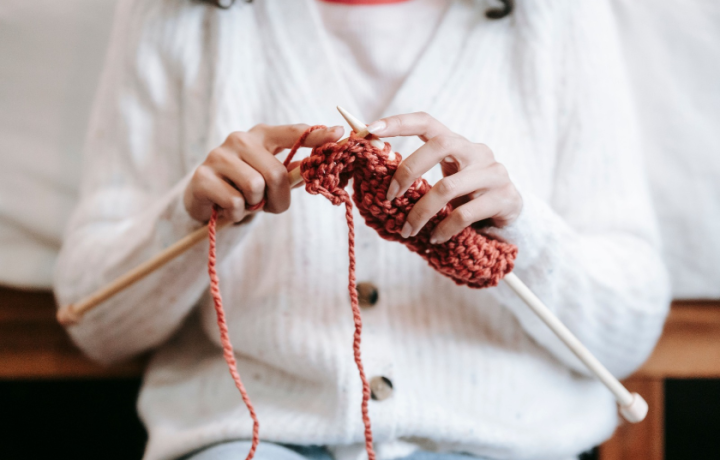
For 31-year-old Canberra local Clementine Evans, arts and crafts bring a unique kind of joy. Like all great love stories, she learned how to knit from her mum at the age of seven. Believing that if she could knit, she could crochet, Clementine began experimenting with the practice during the COVID-19 pandemic. Now, she shares her creations on @clemsyknits_, where she has built a small community.
“I love using it to express myself – making fun things for myself, my apartment, friends and loved ones. It brings me joy when I am told that I have inspired someone to pick up fibre arts and I have seen that a lot recently,” she explains.
“It creates community, something to share, something to do together. I like to think that I am contributing to that in a way.”
As reported by ABC Radio National, Gen Z and millennial Australians are driving the revival of social knitting clubs, crochet, scrapbooking, and junk journalling. Clementine says that she believes the rise in analogue hobbies is because “people are looking for something.”
“I don’t know if I can put my finger on it but with COVID, AI and the state of the world hands-on hobbies like crafting are a seemingly innocent and whimsical way to spend your time, and people need that, are craving that, I think,” she explains.
“I also know that a lot of people are trying to digital detox themselves, and as someone who always needs to be doing something with my hands, crafting is a great substitute for scrolling. Why look at all the cool, pretty things when you could be making them?”
There is a cultural moment that everyone can vividly remember from the COVID-19 lockdowns – the massive surge in home baking. From banana bread to sourdough, it felt like everyone was suddenly using flour and yeast as a form of stress release. Many news outlets covered the phenomenon, reporting that baking had become a meditative and empowering act.
here.wellbeing Clinical Psychologist Jo Cole says that offline activities – like baking – can be a great form of self-care.
“Craft is such a mindful activity – people can find they are able to stay in the moment and focus on the task in front of them, and their busy mind quietens down. You’re learning or developing a new skill, and you have something to show for it at the end,” she explains.
“Participating in activities that are enjoyable and create a sense of achievement are great for our mood. They can help reduce stress and improve sleep too.”
Jo advocates using mindfulness-based approaches and expressive arts in therapy. She frequently works with clients to express their feelings through drawing, painting, journaling, poetry, craft, and creative writing, she sees the rise in analogue hobbies as a clear pushback “against the tendency for all our activities to be tied to a screen like a phone or a computer.”
It acts as an antidote to digital burnout – the fatigue of having the entire world constantly at our fingertips.
Digital burnout and the search for calm
While the COVID-19 pandemic transformed public health, economies, and societies worldwide, the return to “normal” has been anything but smooth.
Data shows that when it comes to mental health, there has been no substantive improvement since 2020 to pre-pandemic levels. Driven by the rise generative AI, geopolitical conflicts, and economic uncertainty, psychological distress rates remain elevated compared to a decade ago. According to the report Psychological distress in young people in post-COVID Australia, anxiety and pessimism persist, with more young people feeling negative about the future than ever before.
When it comes to social media, constant connectivity only amplifies the crisis.
“Social media and online games get and hold our attention through reinforcement, and create spikes of dopamine, where we get rewarded for scrolling or staying online by getting ‘likes’, messages, and personalised new information,” Jo explains.
“The added stress we can experience from hearing so much about negative things – such as other people’s upsetting experiences, or war in other countries – can affect our nervous system to always be on alert and looking for threats.”
“We can improve our attention and focus somewhat with more mindful activities and reduce our stress levels by choosing which information to pay attention to, and how much by reducing our ‘doomscrolling’ habit.”
Lisa, the owner of The Knit Collective, rediscovered her love for knitting while searching for a screen-free way to keep her hands busy.
“I first learned when I was a kid. My Granny taught me, and my mum used to knit all our jumpers, mine and my siblings’, which sadly she never kept,” Lisa shares.
“I find it very hard to sit still, and I need something to do with my hands. Usually that’s the phone, and I didn’t like that, especially with the kids noticing how much I was on it…I bought a kit, worked through my first project in years, and properly fell for it. I became quite obsessed.”
Lisa is now helping others slow down their minds and tap into their creativity. Selling knitting kits online, she has also noticed a surge in interest around analogue hobbies.
“I’m a knowledge worker, so most of my day is at a computer, and I know a lot of people are the same. When you’re not at work, you’re on your phone, and you use the internet for everything. I think people are looking to switch off from that,” says Lisa.
“We love a lot of what modern technology has given us, but we also mourn some of the connection we’ve lost, and the feeling of making something with your own hands. There’s nothing quite like it.”
But there’s more to analogue hobbies that mindfulness and creativity – it’s also linked to another cultural movement shaping society: community as currency.
Crafting community in a digital world
From the Scrap Society to Good Omen Goodeze and Crafternoons at Café Stepping Stone, craft clubs in Canberra are also experiencing a boom. Acting as ‘third spaces’ – a place defined as not home and not work, but somewhere in-between – they’re places where community naturally happens.
After largely disappearing in the early 2020s, third spaces are seeing a resurgence as people actively seek real-world connection through social clubs and creative groups.
“We’ve all seen discussions online about people yearning for third spaces, needing to touch grass and human made being the new luxury. We live in a world where almost nothing is completely analogue – I read, but I log it on Goodreads, I knit, but I post it on Instagram,” says Clementine.
“With that being said, spending time making something intentionally with your hands – whether you share it or not – is important.”
For Libby – the owner of Kingston’s newest craft store, The Yarn Barn – community is one of the most important elements of creating. It’s why her store will be a place where people can “come together, learn something new, share stories, make friends or simply sit and have a yarn.”
“I’ve done quite a lot of market research by going to lots of groups, and one that I stumbled on was called the Knitty Committee. It’s a bunch of 20-something girls, and they get together every couple of weeks at the National Library on a Sunday afternoon, and they knit,” she explains.
“The world is moving too fast and people are forgetting to breathe. I think that’s why this there’s this resurgence…There’s a real movement back to what I used to experience as a young person.”
Opening the Yarn Barn is Libby’s dream. Aged 65, she grew up with a ‘very prolific knitter’ as a mother and has tried her hand at various hobbies. From patchwork to painting furniture, she believes that getting offline and using your hands has numerous benefits.
“For a creative person like me, it taps into your serotonin. But even if you’re not naturally creative, the repetitiveness of doing a craft stills your nervous system, and that stills your mind,” says Libby. “Even better if you’re doing it with other people, because this kind of community is very encouraging of each other.”
Jo agrees that analogue hobbies provide a vital framework for connection.
“If you need some quiet time to yourself, they can fill that function, but they can definitely be done together, in pairs or groups, with people you know, or new people you’ve never met,” she explains.
Is the rise of analogue hobbies a full revolt against screens and a tech-driven world? It depends on who you ask. But as you begin to peel back the layers – mindfulness, community, connection and joy – the phenomenon is remarkably simple: it’s a craving to reconnect with our humanity.