Capital Dreams: Fair Dinkum or a Toxic Charade?

Posted on
The concepts “Wild West” and “Canberra” are not a natural fit. But it’s that juxtaposition that comes to mind when Barbara O’Dwyer remembers the excitement and confusion of the Australian Dream half a century ago. Housing loans and optimism saw home ownership in Australia rise from 40 percent in 1947 to over 70 percent in the 1960s and the fledgling national capital was on the cusp of an economic boom that would see its population rise almost tenfold from 40,000 in the 1950s to around 300,000 by the late 1980s.
The post-war National Capital Development Commission, which was responsible for planning the expansion of the city, struggled to keep up as government departments were relocated from Melbourne and Sydney. Initially most of the housing was public, but speculators rushed to fill the growing gap between supply and demand. The “young and the bold” came to Canberra writes Jack Waterford in a 2004 essay for the Griffith Review. Those who were not eligible for a government house had cheap NCDC loans and were easy prey for unscrupulous developers.
“The standards were pretty poor,” O’Dwyer reminisces. “There was no real oversight – my bathroom leaked so badly that I had mushrooms growing in the hall!”
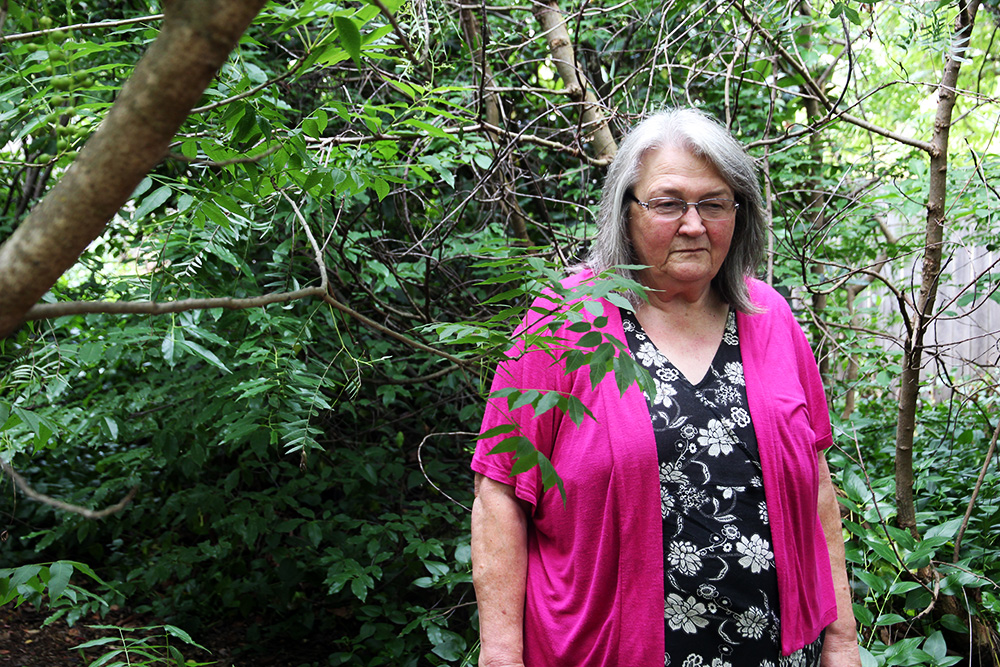
Barbara O’Dwyer in her Garran garden, which she will have to leave behind.
O’Dwyer and her husband bought their house in Garran in 1967. Like many other young couples, they believed that they were finally creating a safe and secure home for their children. One day O’Dwyer saw an advert in the paper for cheap and efficient insulation and believed what she was told about its beneficial qualities. “Whatever I thought I was putting in my ceiling, I didn’t think it was dangerous.”
But it was. It was amosite asbestos, a particularly lethal form of mined asbestos that has a proven link with cancer. Between 1968 and 1979 over 1000 homeowners in Canberra and Queanbeyan had pure loose fill asbestos insulation installed in the ceilings of their homes by Dirk Jansen, locally known as Mr. Fluffy.
O’Dwyer, like hundreds of other people in Canberra alone, must live with the knowledge that she brought danger into the heart of her family. Her retirement years will not be spent tending her garden or reliving happy memories. Instead she lives with uncertainty, frustration, fear and anger. “It’s not just that I am losing my home and that my children could die of a terrible disease because of something I did. I also feel so angry that we haven’t been given specific information and we’re being treated as a nuisance.”
The shared sense of anger, frustration, fear, sadness and guilt is palpable in the Impact Statement compiled by the Fluffy Owners’ Residents and Action Group (FORAG) and enshrined in Hansard on November 27. It is difficult to read without a vertiginous sense of disbelief that the stories told are those of tax-paying, voting citizens of a 21st Century democratic state. What is even more astonishing is how the Commonwealth Government has effectively disowned this narrative, even though the ACT Government did not exist at the time that Jansen was licensed to operate in Australia.
According to Brianna Heseltine, who set up FORAG after learning that she and her family had unwittingly bought a Mr. Fluffy home, the Commonwealth was warned about the specific health risks of Mr. Fluffy asbestos in 1968, and in 1971 the Commonwealth issued a public warning to installers. The danger was even exploited by Jansen’s rivals in Canberra, who advertised their products in 1968 as “free of harmful asbestos.” Yet Jansen was allowed to continue trading for another decade and, says Heseltine, the public health information did not appear to have been shared with the NSW Government.
The use of amosite asbestos was banned in Australia in the early 1980s and following self-government in 1988, the Commonwealth and ACT Governments undertook a $92 million loose-fill asbestos removal programme that ended in 1993. The Commonwealth agreed to foot most of the bill in a 1991 Memorandum of Understanding (MOU) with the ACT government. But in October Federal Employment Minister Eric Abetz rejected any federal liability for the clean-up, or for homes missed in the original remediation programme, and has agreed only to source a 10-year loan to the ACT government to demolish the homes.
Across the border in NSW no coordinated clean-up has ever been undertaken and many people in Queanbeyan are still living in toxic homes. As late as August 2014 Canberra journalist Adam Spence reported that “The prevailing advice from the NSW Government to all homeowners with asbestos insulation is that it presents a minimal risk if the roof space is kept contained and not entered.”
Heseltine is determined to change this. “All those years ago no one in Canberra reached out to help their neighbours in NSW. That’s not what my Australia is about.” In October FORAG submitted a “Request for a Uniform National Response on Mr. Fluffy Asbestos Properties in Australia” to the NSW Joint Select Committee on Loose Fill Asbestos Insulation.”
For decades the issue has been quietly pushed aside and people have been left to die in agonizing pain or to live in death traps with impunity. It was not until late 2011 that homeowners in Downer discovered Mr. Fluffy asbestos and the issue was re-opened. The first that most members of FORAG knew about it was over two years later when, in February 2014 a letter addressed to the “Resident” was sent to each registered Mr. Fluffy home owners “reminding” people that their home had been a part of an asbestos removal programme decades before. Most people ignored the letter, which communicated no sense of urgency. “They couldn’t even be bothered to address us by name,” says O’Dwyer.
It took an article in the Canberra Times a couple of weeks later for people to make the connection between the impersonal letter and the serious risk to their lives. “I literally fainted with shock,” says Heseltine, whose second son had been born just days earlier. “A 1988 report presented to the Commonwealth identified the particular vulnerability of young lungs.”
Heseltine set up FORAG, which now has over 600 members, and began lobbying the ACT Chief Minister Katy Gallagher and senior ACT and Commonwealth Government officials to do something to help the innocent victims of the Mr. Fluffy scandal. It is in no small part thanks to her efforts that the ACT Asbestos Task Force was set up in June and that the Commonwealth has even come to the table with a loan, begrudging though it is.
In a written response to Her Canberra, Gallagher expressed her disappointment with the Commonwealth response. “I’m not happy with the contribution the Commonwealth has made. We asked them for more and I believe their moral responsibility was to give us more, but they weren’t going to budge on this, so we had to accept this offer so we can proceed and give certainty to the families in Mr Fluffy homes.”
It was a sentiment echoed by Federal Member for Canberra, Gai Brodtmann, who has been urging the Commonwealth to “step up on Mr. Fluffy.” “The response of the Commonwealth is disappointing,” she says, “but the important thing is that the announcement of the loan is a step forward.”
For the time being ACT homeowners are being offered a “one-size-fits-all” solution of a voluntary ACT Government buy-out of their home and land. The taskforce will provide homeowners with the market value of their home, ignoring the presence of asbestos, a stamp duty waiver, $10,000 of financial assistance, plus $2,000 for each child and a very simple process to surrender their lease. Those people who opt-out of this will have to live in a financially worthless home which will remain off limits to tradies and will have to have all air ducts and heaters fully sealed. Gallagher has committed to demolish all Mr. Fluffy homes in the ACT so it is unclear what will happen to those, and there are many, who do not want to move and who refuse to opt-in by the June 2015 deadline.
Several FORAG members have reported mental health problems, says Heseltine, and some have even mentioned suicide. “It’s a real concern, particularly for people of advanced years or those who have watched loved ones die of cancer. We have so many questions and no one wants to answer.”
Heseltine would like to see a Royal Commission set up to find those answers. But first she would like to see Commonwealth funding for a flexible solution that addresses individual needs. In the meantime a FORAG member, Chris Georgiou has filed a suit against the Commonwealth Government for negligence in failing to stop Jansen from installing Mr. Fluffy asbestos and in failing to inform homeowners of the danger to their health. Georgiou suffers from mesothelioma, the cancer associated with asomite asbestos. If his case, which was filed in December, is successful, it could open the door to other suits and compensation claims.
But this is about much more than money and land. Home ownership is part of the Australian Dream but Australian citizens have been sold a Commonwealth-backed nightmare – and seen their national government walk away. That’s not fair dinkum by any means, it’s cowardice.
Says O’Dwyer, “As a public servant I was sent abroad to promote justice and accountability in government. And yet in my own home it’s denied to me and my family. My generation helped build Canberra as a city that cared, that took pride in being a community. These are values that are just as important as bricks and mortar. And the Commonwealth is turning its back on those, and on us.”


Leave a Reply