What are microplastics doing in Canberra?
Posted on
Like many people, I’ve become increasingly interested in the small things we can do to improve our health.
Not the miracle cures or the expensive gadgets, just practical, evidence-based changes that make sense.
That curiosity recently led me to microplastics, and unexpectedly, to some fascinating research happening right here in Canberra.
Unlike many wellness trends, this wasn’t another expensive supplement or gadget promising to change my life. It was a question. If tiny pieces of plastic are now being found in our food, water and even human tissue, what does that actually mean for our health?
As it turns out, some Canberra locals are doing some important work to answer that question.
University of Canberra researcher Dr Jurian Hoogewerff is a leading ACT Government-funded researcher who is looking into microplastics in the Upper Murrumbidgee Catchment. His team is investigating where these tiny plastic particles are found in our local environment while developing better ways to detect them.
What struck me wasn’t fear or alarmism. It was perspective.
Dr Hoogewerff compared where we are in our understanding of microplastics today with where climate science was in the 1960s, or research into the link between smoking and cancer in the 1930s. It was a powerful analogy, and I haven’t stopped thinking about it since.
The point isn’t that microplastics are “the new smoking”, or that we already know they will have consequences on the scale of climate change. We don’t. The analogy is about where we are in the evolution of the science: that uncomfortable period when researchers are seeing signals worth paying attention to, but the evidence is still developing and many of the answers remain uncertain.
History tells us that major public health and environmental problems rarely arrive with a neat body of conclusive evidence attached. The link between smoking and cancer emerged over decades. So too did our understanding of climate change. In both cases, early researchers identified concerning patterns long before the science became overwhelming and the risks were broadly accepted.
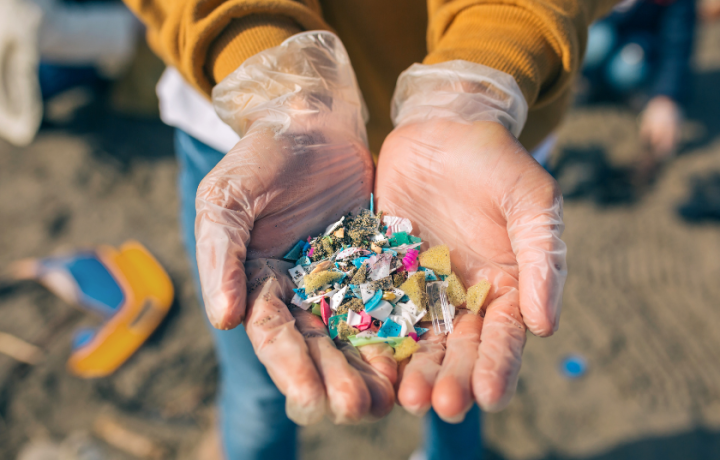
Microplastics may be at a similar point in that journey. We know they are extraordinarily widespread. Scientists are finding them in our environment, our food and water, and increasingly in human tissue. What we don’t yet fully understand is what that exposure means for our health over a lifetime.
And perhaps that’s the real lesson from the smoking and climate change analogy: uncertainty isn’t the same as reassurance. We don’t need to panic, but nor should we assume that because science doesn’t yet have every answer, there is nothing worth paying attention to.
Dr Hoogewerff explains that scientists around the world still don’t have standardised ways of measuring microplastics, particularly the even smaller nanoplastics that are thought to be the most likely to enter cells and tissues. Without consistent testing methods, comparing research and understanding the true scale of the problem becomes incredibly difficult.
In other words, we’re still learning and that uncertainty creates an interesting dilemma. Do we wait another 20 years until every question has been answered? Or do we take a common-sense approach now?
Personally, I have started with my kitchen. I don’t microwave food in plastic. I am slowly swapping plastic containers for glass. I drink filtered tap water instead of bottled water. Think about the plastics that come into contact with your food every day. They’re small changes, but they’re grounded in the precautionary principle rather than waiting decades for the science to catch up.
Plastic chopping boards gradually wear down every time they’re used. Mixing, stirring and storing food in plastic containers can create friction that releases tiny plastic particles. Damaged non-stick cookware can do the same.
The alternatives are hardly revolutionary: glass containers, ceramic bowls, stainless steel cookware and wooden chopping boards.
These aren’t dramatic lifestyle changes. They’re practical ones. That’s something I appreciate.
History tells us that waiting for absolute certainty can sometimes come at a cost. We saw that with smoking. We’ve seen it with climate change. Both started with early warning signs that took decades to translate into public action.
Perhaps the lesson is not to panic. Perhaps it is simply to pay attention.
For me, that doesn’t mean throwing out every piece of plastic in my house overnight. It means making small, practical changes where I can. Swapping plastic containers for glass. Replacing an old plastic chopping board. Being a little more mindful about how I prepare and store food. None of those changes are difficult. If the risks turn out to be smaller than we fear, I’ve lost very little. If they’re as significant as some scientists suspect, those small changes may prove to be among the easiest investments I’ve ever made in my health.