The Canberra-built app helping people be more present in their lives
Posted on
Many of us joke that we’re addicted to our phones, but the joke stops being funny when you find yourself endlessly reaching for your phone without knowing why.
It starts small: a quick scroll when you wake up in the morning, checking social media while waiting for your daily latte, triaging emails while preparing dinner, eating dinner and cleaning up after dinner, followed by doomscrolling before bed. Before you know it, your screen time has taken over your day. And if this sounds familiar, you’re not alone.
It’s exactly what the Canberra-built app PivotIRL is trying to change.
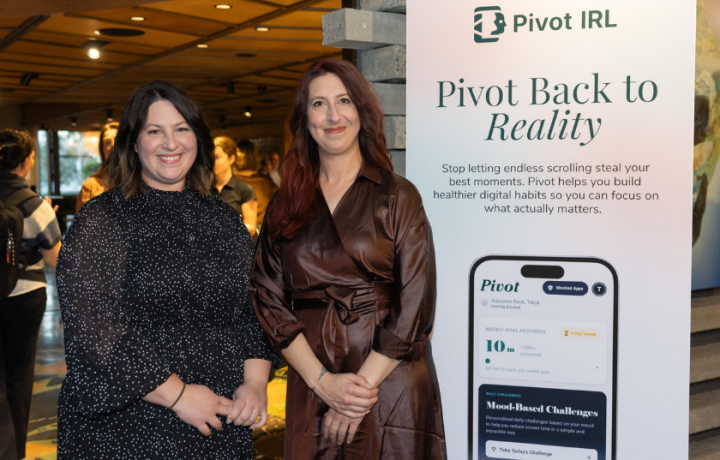
Founded by sisters Tanja and Alannah Catalinac, PivotIRL was created to bridge the gap between intent and action, interrupting the habit of mindlessly scrolling by redirecting people’s energy into actionable offline activities.
Beginning with a moment of ‘self-awareness’, the idea of the app was born from Tanja’s own experience of screen-hopping late at night – jumping between two mobile phones, a laptop and the TV.
“I had finished eating, I picked up my phone to play a game whilst I watched my favourite show in the background,” she recalls.
“It wasn’t a loud moment. It was just this moment of interruption… I realised what I was doing… Why am I seeking two different kinds of stimulation when one’s generally plenty?”
Her sister was experiencing the same habits. So did almost everyone they spoke to and Tanja realised that the pattern was too widespread to dismiss as a quirk.
“The stories were the same, and the issue was becoming so known,” Tanja says.
“When I realised it was becoming a problem for other people, I thought, well, why don’t we just try something different and just get an app?”
It’s something Tanja and Alannah believe the modern world needs. But the benefits of the app extend far beyond lowered screen time.
Research shows that excessive exposure to digital screens can damage health and productivity, with poor sleep, mental health issues, reduced attention spans and poor dietary habits named as some of the negative impacts people experience from spending too much time on digital devices.
In fact, according to a March 2025 Comparitech report worldwide, the average person spends a total of six hours and 38 minutes looking at a screen each day, with three hours and 46 minutes spent on mobile devices alone. Of this time, the report found that two hours and 21 minutes was spent scrolling through social media channels.
It’s this time Tanja and Alannah are hoping to give back to people by taking the psychological tricks that keep us scrolling and reversing their direction.
“The overuse of devices is taking a profound toll on almost every aspect of our daily lives,” explains Tanja.
“PivotIRL is about balance and intention. We wanted to give people enough space to actually make a conscious choice about their screen time.”
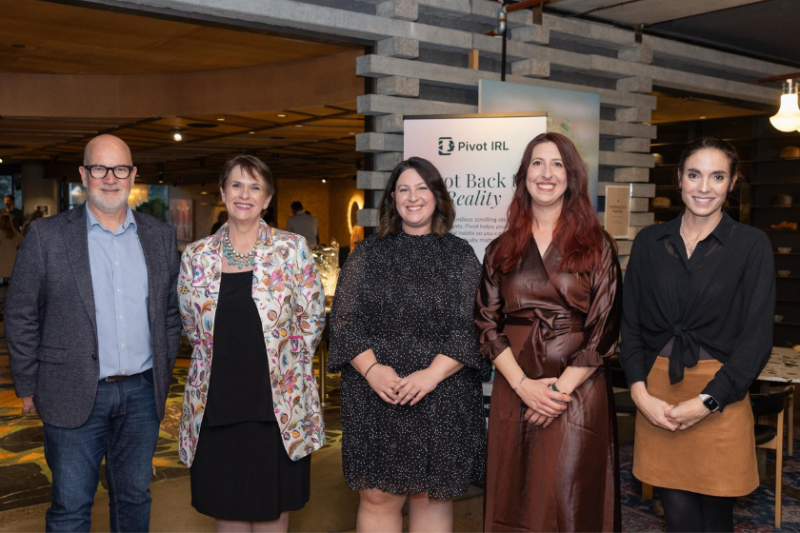
From left to right: Dr. Mark Williams AOM, Professor Amber McKinley, Alannah Catalinac, Tanja Catalinac and Clinical and Forensic Psychologist Lia McInnes.
Using evidence-based insights to encourage people to step away from their screens and be more present in their lives, Tanja and Alannah created the app to use behaviour shifts, awareness triggers, and structured steps to help users take control back from algorithms.
PivotIRL works on behavioural science principles and has a database of over 12,000 activities – ranging from basic sensory techniques like breathing and humming to gardening – along with capped timing for social media usage and even mood check-ins.
Designed as a reset rather than a punishment, Tanja says it’s an approach that’s missing from the current wellness app industry.
“When you reach for a blocked app, we create a cognitive friction point, which creates a pause in that unconscious habit. In that space, we offer real-world suggestions instead,” she explains.
“A lot of existing apps focus heavily on guilt or restriction; they just show you how many hours you wasted or aggressively lock you out. We all know that when a human is told ‘no’ or that they can’t do something, they instinctively want to rebel and do it anyway – it’s like a type of self-sabotage. What was missing was the ‘why’ and the ‘what next’.”
The sisters also decided to build a dedicated research feature straight into the app, which gives users access to behavioural and neuroscience evidence. They say they want people to understand exactly how screens impact their brains and why they feel the way they do.
Instead of just telling people to put their phones down, the aim is to empower them with the knowledge to actually want to make that change.
“Unfortunately, I was diagnosed with PTSD, which ended my policing career. Because of that, I can see why simply blocking an app is not going to work,” explains Tanja.
“Stopping someone from going into a device that they are using as a coping mechanism is going to be potentially dangerous. My thought was we need to redirect the energy, the activity, and the behaviour to something that’s not harmful, that is creative, and that is going to be able to support that person whilst they start strengthening their own ability to resist the reliance on their phones.”
From scrolling to living
The irony of creating an app to lower screen time isn’t lost on the sisters. But they believe that to solve a digital habit, you must meet people exactly where the habit happens: on the device itself.
“If we want to intercept mindless scrolling and help people pivot back to the real world, the intervention has to take place right at the source of the distraction,” says Tanja.
“Our biggest hope is that PivotIRL helps people reclaim their time and mental space. We want to see people engaging more with the physical world again – whether that’s reading a real book, working on a hands-on project, or simply being fully present with their friends and family without a screen sitting in the middle.”
The app is now available to be downloaded on Apple and Android devices. Next, Tanja and Alannah plan on using PivotIRL to tackle the corporate world and education system.
With frameworks and software already in place, they’re looking at trialling the app in schools to help bring balance back to the lives of Australian children.
“Despite the 16-year minimum age [for social media], we need to be honestly realistic about the problem. I know many people who have had their kids sign up with a date of birth that was well and truly past 18, and this was years ago – they were 14, 15 back then,” explains Tanja.
“There are a massive number of kids that have fallen through that crack…it’s not about saying ‘No, you can’t do that’, it’s about teaching them how to use the phone.”
At the end of the day, Tanja and Alannah aren’t trying to tell people to give up technology. Instead, they want people to be more present in real life.
It might be as simple as picking up a book instead of your phone or calling a loved one instead of sending them Instagram reels. Whatever small habits PivotIRL helps people cultivate, the sisters just want people to start living again.
“We are in a loneliness epidemic where device use and overreliance are only perpetuating the issue. PivotIRL seeks to reconnect people with people, provide a feeling of belonging and give people back the control over their devices, not the other way around,” says Tanja.
“Changing our digital habits doesn’t have to be an all-or-nothing battle…This is not just an app – PivotIRL has the science backing of a world-renowned research professor, a neuroscientist and clinical and forensic psychologist. We are building a health and wellbeing intervention to strike at the heart of the problem and give people the opportunity to take a step back into reality and rediscover their real lives.”
For more information or to download the app, visit pivotirl.com.
Photography: Photox and Business Awards Coach.