From Belfast to the big screen: Why Canberra should give the Irish Film Festival a go
Posted on
There’s something about seeing a bit of home on the big screen when it’s on the other side of the world.
I’m originally from Northern Ireland; my da is from Ballycastle, and I’ve spent the past 16 years living in Australia. You don’t always realise how much you miss a place until a familiar accent, a recognisable landscape or a story from home catches you off guard.
That’s part of the appeal of the Irish Film Festival, returning to Canberra’s Palace Electric from Friday 6 until Monday 9 November with its biggest programme in 12 years. But you don’t need an Irish passport, a questionable grasp of the accent or family back across the water to enjoy it. With dark comedy, supernatural horror, music, family drama and documentaries confronting Ireland’s complicated past, there’s something here for just about every film lover.
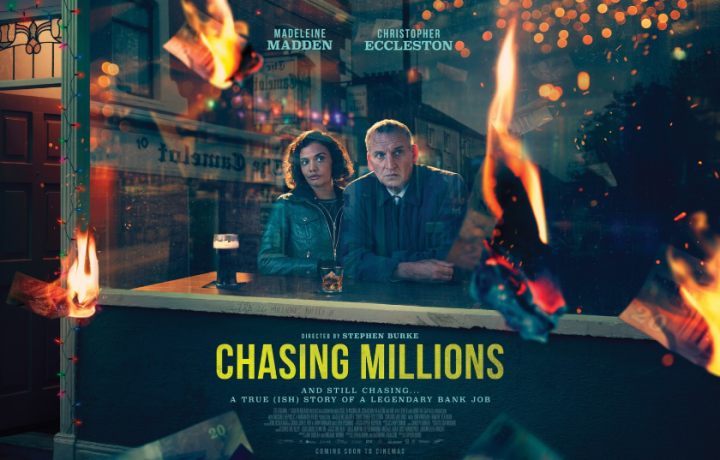
If you’re wondering where to start, Chasing Millions is a pretty good place. Opening the festival with its Australian premiere ahead of its theatrical release on Thursday 19 November, this Irish-Australian co-production takes inspiration from Belfast’s infamous 2004 Northern Bank heist. Veteran detective Crayford, played by Christopher Eccleston, teams up with a young Australian police officer to investigate what became one of the biggest bank jobs in British history. Starring Madeleine Madden, granddaughter of Aboriginal civil rights activist Charlie Perkins, it promises a darkly funny crime caper with a distinctly Northern Irish backdrop.
As someone who grew up not far removed from the history behind the story, I’m particularly interested to see how it approaches Belfast’s past. The city has never been short of stories, and it’s fascinating to see one of its most notorious chapters reimagined through a production bringing Irish and Australian filmmaking together.
For another glimpse of Northern Ireland, Hush-A-Bye Baby offers something altogether different. Set in Derry in 1984, Margo Harkin’s restored drama follows a young woman facing an unwanted pregnancy in a deeply conservative, Church-dominated society. It also features the first screen appearance and soundtrack contribution of a young Sinéad O’Connor. For anyone interested in Ireland’s social history, it’s a fascinating opportunity to revisit a time when the Church held enormous influence over people’s lives.
That willingness to confront the past continues in Testimony, a documentary following survivors of Ireland’s Magdalene Laundries and Mother and Baby Homes as they pursue justice against the Irish government and Catholic Church. It’s not light viewing, but these are stories that deserve to be heard.
Festival director Enda Murray, who has been running the event since 2015, has watched Irish cinema evolve considerably. Having left Ireland in 1985, he remembers films that confronted poverty and the dominance of the Catholic Church. Today, he sees a more confident industry, increasingly willing to examine the past while looking towards the future.
“There is a much more confident vibe to Irish film-making at the moment,” he says.
This year’s programme certainly reflects that, exploring not just where Ireland has been, but the country it has become.
Of course, not everything needs to be heavy. Fréwaka brings supernatural horror rooted in Irish folklore, following a palliative care nurse who encounters something sinister while caring for a paranoid elderly woman in a remote farmhouse. Irish folklore has always had a knack for making the countryside feel a little less welcoming after dark.
For something more musical, Trad follows gifted musician Shóna as she rebels against her mother and her cultural roots, before a group of wandering young musicians takes her on an adventure. Having grown up with Irish music as part of the soundtrack to life, I’m interested in how a new generation makes something of its own from traditions passed down. You don’t need to know your reels from your jigs to appreciate a story about music, family and belonging.
Meanwhile, Horseshoe promises the familiar chaos of four estranged siblings, their late father’s will and the possibility that the whole thing might end in murder. Its premise could describe a fair few family Christmases, Irish or otherwise. BÁITE (The Drowned) heads to Connemara, where a woman fighting to save her family pub becomes caught up in the mystery surrounding a body found in a nearby lake.
The variety is part of the appeal. You can find a story that reminds you of home, discover a corner of Irish history you knew little about, or simply choose a film because its premise sounds intriguing. And unlike scrolling through a streaming service for 40 minutes before giving up and rewatching something familiar, a festival gives you a reason to take a punt on something new.
For Murray, the festival is about more than what happens on screen. He describes it as “a social event for the 21st century emigrant”, bringing Irish people and their friends together across a country where home can feel a very long way away. Having spent 16 years in Australia myself, I understand that appeal. There’s something comforting about finding a little piece of home in an unexpected place, whether through a familiar story, a bit of music or simply hearing an accent you haven’t heard in a while.
This year carries extra significance, with 2026 marking 80 years of diplomatic relations between Australia and Ireland. The Irish Embassy has embraced the festival as part of the anniversary, recognising the role of arts and culture in maintaining connections between the two countries. For Canberra, it’s a fitting reason to welcome the festival back.
Irish cinema is having a moment, and there’s far more to it than the familiar names of Cillian Murphy, Saoirse Ronan and Barry Keoghan. The festival offers a chance to discover stories and talent that might not otherwise make it onto your radar, whether you’re drawn to history, music, comedy or a good scare.
For me, there will always be a particular pull in seeing Northern Ireland represented on screen. Living overseas gives you a different perspective on home, and places and stories you once took for granted can take on new significance. But you don’t need that personal connection to find something worthwhile in these films. The best stories travel, whether they begin in Belfast, Derry or a remote farmhouse haunted by Irish folklore.
So have a look through the programme, pick a film that catches your eye and give it a go. You might find a little bit of Ireland, a story you weren’t expecting, or simply your next great night at the movies.
THE ESSENTIALS
What: The Irish Film Festival
When: Friday 6 to Monday 9 November
Where: Palace Electric, 2 Phillip Law Street, Canberra
Tickets + more information: irishfilmfestival.com.au
Images supplied.