Five minutes with ceramic artist Kelly Austin

Posted on
The collaborative Women in Design exhibition at Craft ACT aims to show the diversity of Australian female makers.
To achive this, the works of artists Kelly Austin, Chelsea Lemon, Lynette Lewis and Zoë Veness have been curated into a four-part exhibition that covers the mediums of woodwork, ceramics, jewellery and sculpture.
We chatted to Tasmanian based ceramic artist Kelly Austin, whose exhibition, A Space for Softness, forms part of the showcase.
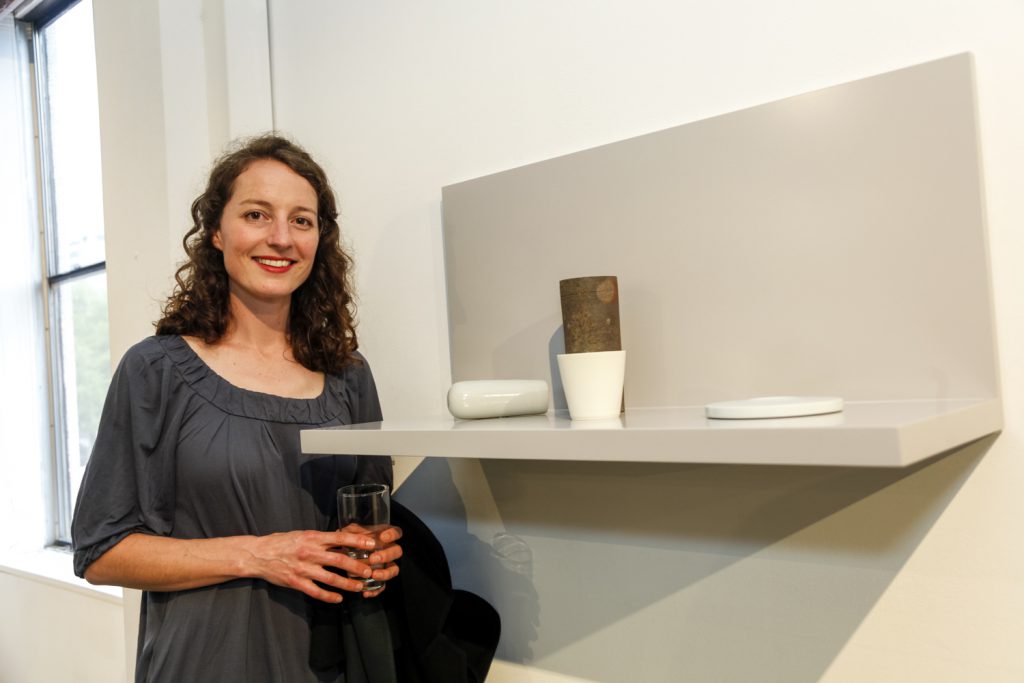
Kelly Austin
What inspired your aesthetic for A Space for Softness?
I have worked with a reduced formal palette for quite a few years now and it’s both an instinctual and conceptual approach. I have fond memories of spending time with my grandfather in his basement, making copper enamelled objects and watching him work with timber. He was a firm believer in modernist principles and that has certainly influenced my aesthetic decisions. Considering the notion of ‘truth to materials’ with this body of work, I’ve explored the aesthetic of polished ceramic, relying solely on glaze for colour and texture.
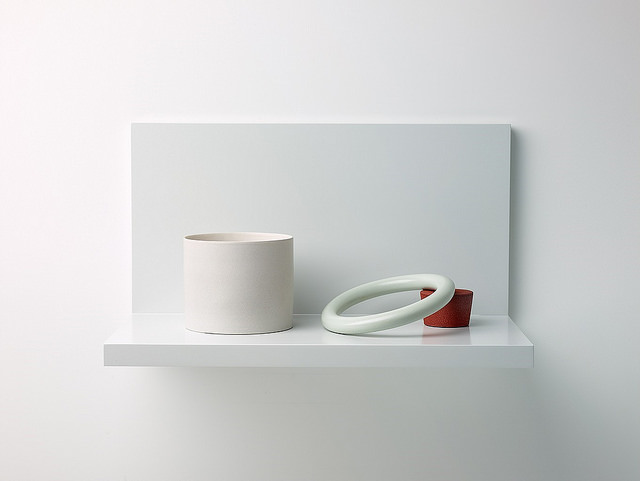
Kelly Austin, stilled composition no.27, 2017, stoneware, porcelain, glaze, wood, acrylic paint.
I have also more closely observed the materials I use during the making process. This includes the soft texture and gentle hues of dried glaze before it’s fired and ‘wadding’ that’s used to support the kiln shelves and posts during firing. I have tried to bring these qualities into the final objects.
My forms are crisp, unwavering and geometric. I’m constantly trying to strip away unnecessary detail and noise. It’s like writing an idea-rich essay in as few words as possible. My intention with the colour palette is to balance the rigidity of the forms with gentle and soft tones. The paintings of Agnes Martin do this eloquently, using pastel pinks and yellows in combination with a graphite structural grid. My forms with stronger colours; brick red and dark grey for example, have texture in the clay that interrupts the colour’s saturation.
How important is it for female artists to showcase together?
There is a spirit of comraderie in an exhibition like this and it’s a special opportunity for female artists to meet others on similar trajectories. It’s motivating and encouraging. Considering the disadvantaged position women have historically had in the art world and the challenges we still face (see National Museum of Women in the Arts for percentages of women being represented by commercial art galleries, public art galleries and museums or major prize winners), the effort of CraftACT to showcase female artists in this way is commendable. Ultimately, I am a strong believer in equality and appreciate exhibiting with both men and women.
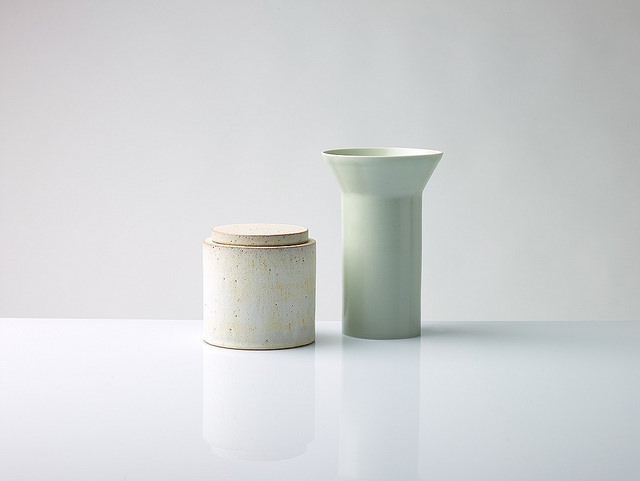
Kelly Austin, stilled composition no.38, 2017, stoneware, porcelain, glaze
How do your, Chelsea, Lynette and Zoe’s exhibits work together in ‘Women in Design’?
What ultimately links all of our works together is a physical engagement with materials.
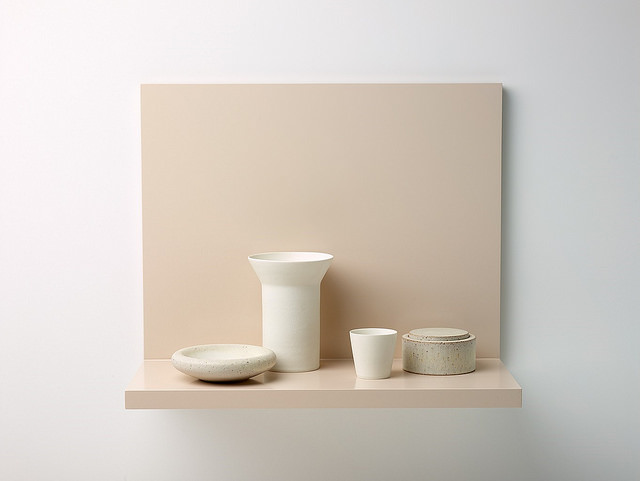
Kelly Austin, stilled composition no.32, 2017, porcelain, stoneware, glaze, wood, acrylic paint.
There is a directness and personal approach we all utilize to transform raw substances into objects with meaning – into material culture! All of the methods we use take dedication to learn, to practice and to master. There is an honouring of traditional craft practices in all of our works, but a simultaneous pushing forward and challenging within our areas of interest.
Can you explain the contrast between the title of your exhibition and the inherent ‘hardness’ of stoneware and ceramics?
‘A Space for Softness’, both the title and the exhibition itself, is a way to create room for a conversation that values quietness and subtlety, minimalism and softness. It is in response to certain aspects of our political world and contemporary art.

Kelly Austin, stilled composition no.30, 2017, stoneware, porcelain, glaze, timber, acrylic paint.
Ceramic is defined as the material which clay becomes after it is taken past a certain temperature. It is culturally created, as this process doesn’t occur without human intervention. As someone who uses the potter’s wheel to create form, my engagement is most intense when the work is still clay. Here, it is soft, malleable and supple. It is also very fragile and requires care if certain resolutions are desired. The soft qualities I’ve just described are a contrast to the hard, permanent and irreversible qualities of ceramic. This duality is what makes ceramics so engaging!
Women in Design and A Space for Softness will both be showing until Saturday 16 December at Craft ACT’s Craft and Design Centre, North Building, 180 London Circuit, Civic. Find more information here.
Photography: Peter Whyte Photography. All images supplied.
Leave a Reply