The $17.5 billion hidden crisis: World-first report hits close to home for Canberra women
Posted on
When Ayla Lorenzo gave birth to her second child in 2021, it didn’t feel like a moment worth celebrating.
Instead, as she was wheeled down the ward – inundated with congratulatory messages from well-meaning nurses and midwives – she couldn’t stop crying from the agony she felt.
Something was deeply, deeply wrong.
“I didn’t get believed until an orthopaedic surgeon said, “Yeah, she’s broken.” That’s when everybody actually believed me, even though I had been telling them from the start that there was something wrong,” she says.
“I advocated for myself… I think that I am one of the lucky ones.”
Ayla is one of the estimated 1.1 million women in Australia living with birth injuries.
On paper, it should have been a straightforward delivery. But as she pushed her son into the world, the pubic symphysis cartilage holding her pelvis together tore away from the bone. Her pubic symphysis “popped” – pubic symphysis diastasis is a rare but devastating birth injury that left her in excruciating pain.
While this second pregnancy was flagged as high-risk, Ayla had no idea something like this could happen. In fact, everything looked well managed and her birthing plan was simple: go in, wait for labour to establish, and deliver her baby under the care of a trusted specialist.
The one variable no one quite accounted for was how fast Ayla gives birth. Her first labour lasted around two hours. Her second took just 45 minutes.
It was also unmedicated, her contractions intensifying so fast it was too late for morphine. The gas also made her violently sick. So as she pushed without pain relief, she felt her cartilage tear away from her bone.
Five years later, her family is still dealing with the lasting physical and psychological trauma.
“I ended up with severe PTSD,” explains Ayla. “I would wake up screaming from all the flashbacks and very, very realistic nightmares. I would be reliving that trauma of my pelvis breaking, and – I don’t know what my brain was doing – I also had the recurring image of someone taking my baby…I would wake up in the middle of the night screaming and crying.”
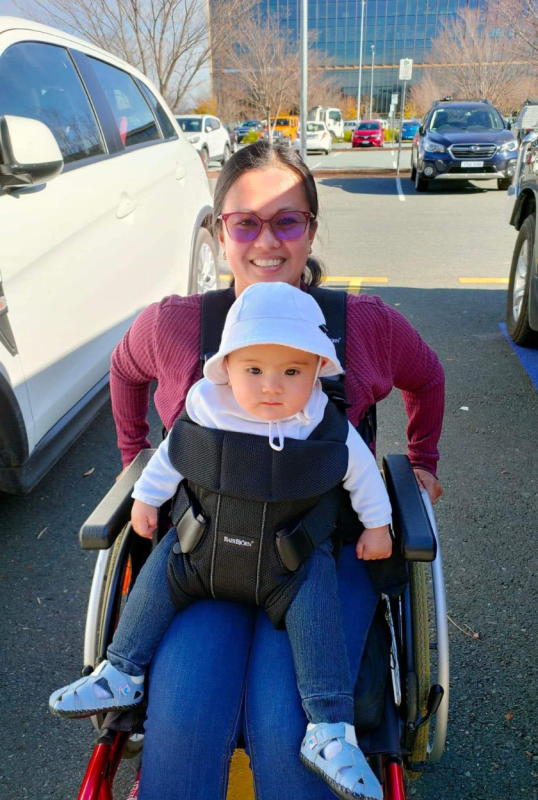
Ayla and her son.
Following the recent release of a world-first report exposing the hidden $17.5 billion cost of birth injuries and trauma, Ayla is speaking out about her own experience to help other women feel less alone.
Released to coincide with Birth Trauma Awareness Week (July 13–19), the report is the first national economic analysis of its kind in the world to comprehensively quantify the scale of the economic burden.
The Report summarises the staggering costs: $8.8 billion in labour market losses, $6.5 billion in wellbeing and burden of disease impacts, $1.4 billion in health system costs, and $792 million in additional household financial costs.
Ayla believes the figures don’t cover the full impact and should be higher.
“Knowing the amount that I’ve spent myself in relation to my physical and psychological injuries that isn’t covered by Medicare or private health insurance, I think it’s quite conservative. But I think it’s a good start to understanding birth trauma.”
The Cost of Birth Trauma in Australia report also states that Australia has no single national dataset capturing the full spectrum of birth injuries or their long-term impacts. With many conditions remaining undiagnosed, under-reported, or inconsistently recorded – in part because women often don’t seek support until well beyond the initial postpartum period – the true financial and personal toll to families is unknown.
For Ayla and her family, their life looks very different to what it did before the birth of her son.
Spending a total of 11 days in hospital, she says that her pain and concerns were initially dismissed by midwifery and nursing staff. Meeting with her obstetrician on the third day and evaluated by an orthopaedic surgeon on day six, it wasn’t until day nine that Ayla received her diagnosis.
But even following her discharge, Ayla still had to fight to be heard.
“If I was supported before my diagnosis came through by the nursing staff, then I don’t think I would have fallen straight into depression – I feel like that would have played a part in being depressed and having PTSD,” she says.
“I wish there was more training in trauma because I didn’t know that this could happen to me with my second child.”
Ayla currently uses a four-wheeled walker to help with mobility and works part time, seeing a physiotherapist weekly to help with her injury. But the impact extends far beyond her.
“My partner stopped working; he became a full-time carer. He was a well-trained professional in his field of work, but now all these years of training is lost because he stopped to stay home and care full time for myself and my children,” Ayla says.
“I cannot imagine the psychological impact it had on my husband to watch me in one of my most vulnerable situations, and he couldn’t do anything about it.”
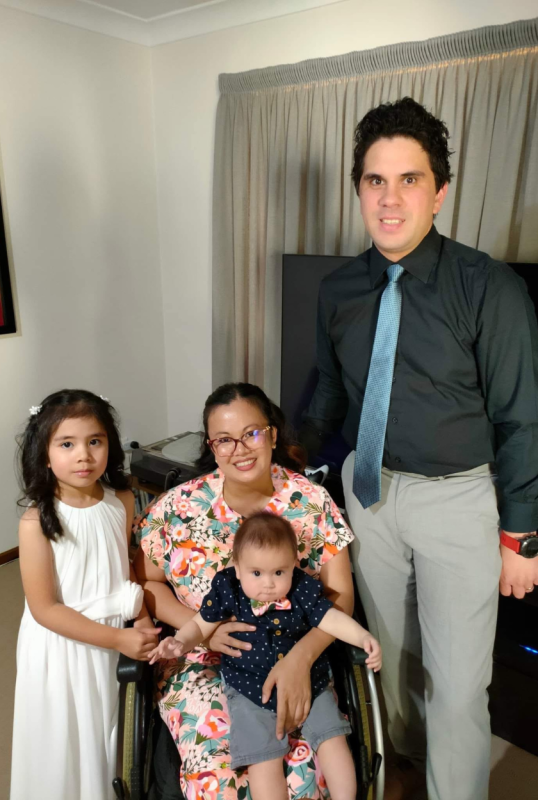
Ayla and her family.
As well as a platform to educate, The Cost of Birth Trauma in Australia report aims to be a catalyst for change.
Birth Trauma Australia, which commissioned the report, is calling for a national response to birth injuries through a National Best-Practice Model for Evidence-based, Consumer-led Perinatal Care.
This includes extending the funded postnatal care period from six to eight weeks to 12 months postpartum as well as expanding access to relevant Medicare-funded postnatal services, the hope is to improve outcomes for women and reduce lifelong impacts of birth injuries as well as ease the significant burden on families, the health system and the Australian economy.
Ayla hopes for the millions of women currently carrying the physical and emotional toll of birth trauma in silence, the report also shows them that they’re not alone.
“My advice is, if your body is not functioning the way it was before having a baby, then it’s not normal. Trauma happens in so many different ways. Everyone has their own story,” she says.
“Trauma doesn’t just affect not only the birthing person, but it affects the whole family.”
For more information about The Cost of Birth Trauma in Australia report visit birthtrauma.org.au.
If you or someone you know needs support, you can contact Birth Trauma Australia on 1800 686 628 or contact Perinatal Support Canberra on (02) 6156 4780.
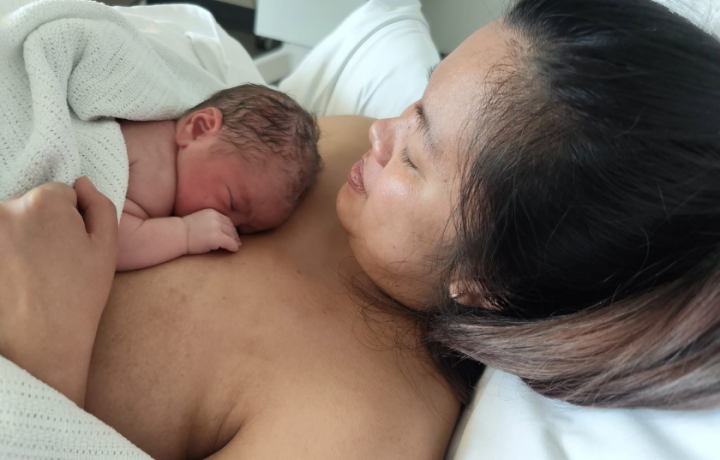
Feature image: One of the few photos Ayla has from the time of her son’s birth. Due to the birth trauma, she couldn’t look at these until he was about three years old.