Bangarra raises its voice before the vote

Posted on
For 33 years, Bangarra Dance Theatre has told the stories of Australia’s First Nations people— enmeshing traditional Indigenous culture with contemporary artistic expression.
And until this year, the award-winning, internationally-recognised company has generally steered clear of politics.
But for Bangarra, 2023 is a year of confronting the Constitution head on. It has issued a clarion call for a ‘Yes’ vote for a First Nations’ Voice to Parliement to the rest of the country.
In what has been a deeply emotional time for the company, its dancers, board and broader family, the political has become professional—and intensely personal.
The name Bangarra comes from a Wiradjuri word meaning “to make fire”. Making fire, telling stories and creating art reflecting Aboriginal and Torres Strait Islander culture has been the company’s core mission since its formation in 1989.
Bangarra chair Phillipa McDermott, a Wakka Wakka and Mulinjali woman, said that as an Indigenous arts company, the performers, other staff members and board had been talking about voice, treaty, and truth-telling since the Uluru Statement from the Heart in 2017.
But this is the year “where the rubber hits the road” in terms of truth-telling and Bangarra felt it was time to make its position on The Voice clear.
“Bangarra’s role in Australia is unique and we have never shied away from that. Telling our stories, telling our truths is our job and our ‘why’, so we felt on this issue it was important for us to lead,” Phillipa said
Through its unique position as an arts company with deep ties to Indigenous communities around the country, Bangarra has always seen the benefits to communities having a say in issues that affect them. A Voice to Parliament is the only way forward.
Phillipa said time and resources had been dedicated to allow for learning and reflection within the company and that the board wanted to ensure that all of the dancers and staff were fully educated on all aspects of the Uluru Statement and how The Voice will work.
“We wanted to take time out and learn more and understand. Everyone is at a different stage of learning and we wanted to encourage conversations with family and with community.”
There was also strong support for a full public statement to allow the company to “feel pride, ownership and to communicate our feelings and our hopes.”
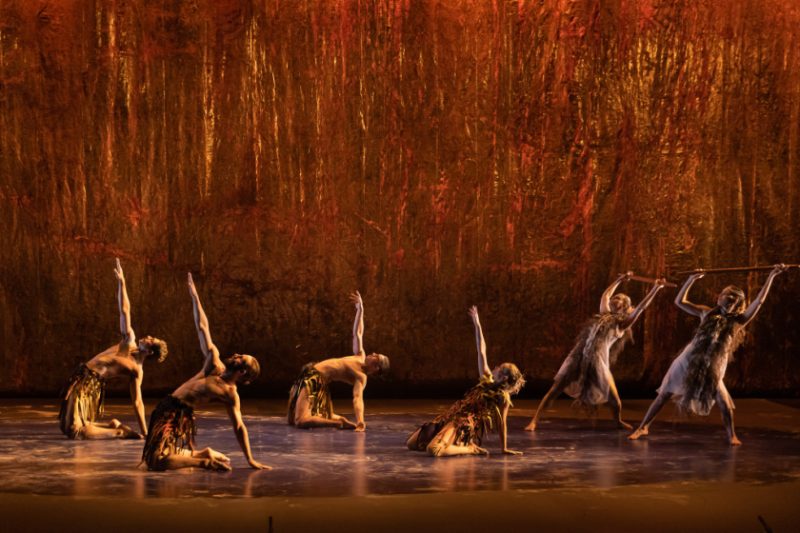
Bangarra Dance Theatres Sandsong, performed at Sydney Opera House, photographer Daniel Boud.
Following the March announcement by the Albanese Government that Australians will be asked whether the Constitution should be altered to “recognise the First Peoples of Australia by establishing an Aboriginal and Torres Strait Islander Voice”, Bangarra put out its own statement.
“Bangarra Dance Theatre fully supports voting ‘Yes’ in the national referendum for the Constitutional Recognition of Australia’s First Peoples. By supporting the vote for ‘Yes’, we not only pay respect to the truth of the past, we state our vision for our future as a nation that values equity and fairness and acknowledges the rights of Indigenous Peoples,” the company said in an unprecedented public declaration.
“We encourage everyone to inform themselves, listen with an open mind, and trust that they are participating in a process that gave us the Uluru Statement from the Heart—a process that has been collaborative, careful and intensely thorough. We also recognise and respect the importance of empowering our Aboriginal and Torres Strait Islander artists and storytellers to define and communicate their individual views on this issue.
“We hope for a peaceful and constructive process towards change, and that the resilience and courage that has underscored the survival of our First Nations Peoples inspires all Australians to step forward and walk together in the spirit of truth, reconciliation, and equality for all.”
At the core of the statement is the desire to translate artistic expression into political action.
The stories the company has told over its 30-year history have awakened a national consciousness to the deep scars of colonial history, and the legacy of unseen trauma left in its wake.
“We attend to this knowing that by carrying Story, we also carry a responsibility to give insight into our experiences, promote understanding, and effect change. But is this enough?”
For incoming artistic director Frances Ring—who assumed the top role this year from outgoing director Stephen Page having made her debut as a Bangarra dancer in 2002—the question pervades every aspect of her life.
The mother of two sons, Frances says it is a time of needing to hold on to hope—hope that her sons encounter less racism over their lifetimes and her people have the right to life expectancies the same length as non-Indigenous Australians. She wants what every mother wants—her kids to have happy, healthy lives, filled with opportunity.
Yuldea—Francis’ debut production as Artistic Director which debuted in Sydney mid-year and was performed in Canberra—could not be more apt, exploring the ”abrupt moment that traditional life collided with the industrial ambition of a growing nation”.
Focussing on the Anangu people of the Great Victorian Desert, Yuldea tells the story of the ancient water soak, Yuldi Kapi, which connected important trading routes and dreaming stories that crossed through the site for thousands of years. Yuldi Kapi was also instrumental in the construction of the Trans-Australian railway extending across the Nullarbor, joining the east coast to the west coast. In 1917, as a result of the industrial pressures placed on the permanent waterhole, the water ran dry.
Now memories lay scattered, along with the Anangu people, who are displaced from their home—remnants of colonial progress, swallowed by sand.
“Within my family lineage lies the stories of forefathers and mothers who lived a dynamic, sophisticated desert life, leaving their imprint scattered throughout Country like memories suspended in time. Their lives were forever changed by the impact of colonial progress,” Frances said.
“The story of Yuldea asks us to look beyond the narrative of our nation’s modernisation to reconcile a fraught history, and to affirm a future that no longer hides behind its truths but grows because of them”.
Phillipa said 2023 would be a momentous year—for Frances, for the dance company, and for the country when it casts its vote this weekend.
“Yuldea is perfectly timed in that sense, it is where two worlds collide and a story of survival. This will be a very special season for Frances and we hope that it will be a new era in Australia.”
Phillipa was hopeful of the right outcome and welcomed the unanimous support for a Yes vote from big business and sport, including companies such as Lendlease NAB, the Commonwealth Bank, ANZ, BHP, Rio Tinto, Wesfarmers and Woolworths, a slew of top law firms, as well as more than 20 sporting codes. But she also noted that the vote would be won or lost on the decision of individuals—not the will of companies or conglomerates.
And of a possible ‘No’ vote being returned, Phillipa says “that’s really something nobody wants to think about. But no matter what happens, we will carry on with our truth-telling.”