Five minutes with Chris Hammer
Posted on
With over 1.5 million copies sold worldwide, Chris Hammer stands as a titan of Australian crime fiction.
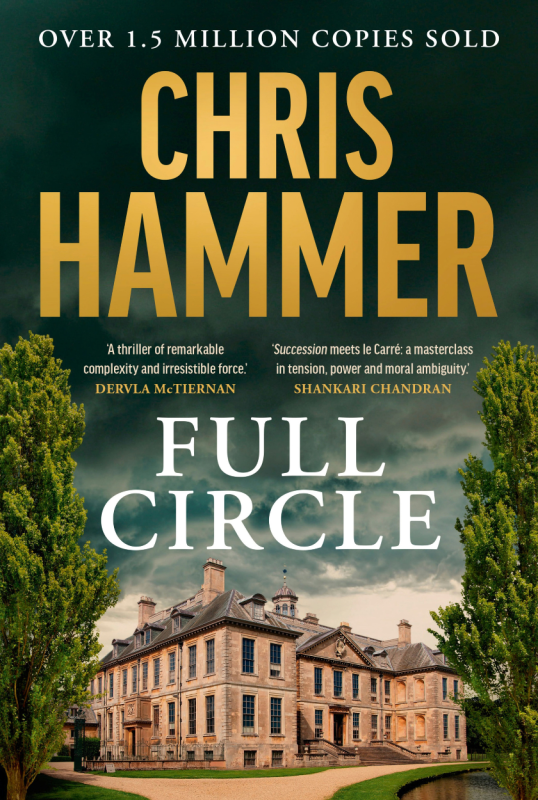
From his explosive 2018 debut Scrublands to recent bestsellers like The Valley and Legacy, the former senior political correspondent has turned three decades of international reporting experience into award-winning, prize-nominated thrillers. Here, we sit down with him to discuss his latest book Full Circle, and how he became one of the country’s most captivating storytellers in both crime fiction and non-fiction.
Please tell us about Full Circle.
Full Circle is a story of corporate greed and dynastic ambition. Two wealthy families come into conflict as they wrestle for supremacy, even as they contend with internal dissent. Into this world ventures Travis Somerland, a former undercover cop seeking redemption following a bungled operation. And then people start dying. Murdered. Just how far are these families and their patriarchs prepared to go to achieve their goals? Think Succession meets The Big Short, with a sprinkling of The Great Gatsby.
This is quite a change of scenery and characters, compared with the more rural crime books from your past. What inspired this setting and these characters?
A company I’d invested in was subject to a totally scurrilous attack on the stock market. That led me to do a little research, and I found these so-called short attacks are reasonably common, particularly in the US. It seemed like the Wild West of capitalism. And the Wild West is ripe with stories. So, I concocted a story around that idea: investors going rogue.
Why set the story in Sorrento, Victoria?
Sorrento is the one place in Australia that reminds me of The Hamptons or Newport Beach in the United States. Old money, with stupendous stone houses, turrets, and widow walks. Nineteenth-century money. It makes for the perfect setting.
Fans refer to your collective works as the ‘Hammerverse’, this is since your work all links to the same world – with a few characters popping in and out between books. Although this is your first standalone novel, does Full Circle still exist in the ‘Hammerverse’ alongside Nell Buchanan (Treasure & Dirt) and Martin Scarsden (Scrublands)?
Definitely. One of the two characters from the earlier books do get a mention in Full Circle, but very much at the periphery. The universe itself is really contemporary Australia, just fictionalised.
Your background is as a journalist, with a focus on politics, international affairs, and environmental issues. This book is all about the world of Australian finance and the super-wealthy. Did you have to do a lot of research for this? Or were there parts of your past that fed into this world created?
As a journalist, I had a working knowledge of economics, but not so much with corporate finance. I was never a business journalist. That knowledge comes from decades as an investor. So, once I had the idea, I found I didn’t need to research that much. And, after all, a powerful story is much more compelling than a deeply researched but boring account.
How do you feel your background as a journalist has influenced your writing, overall?
Being a journalist demystifies the writing process. For example, no journalist can afford to wait for inspiration. You just need to get stuck in and do the best you can in the time available. It also gives you respect for the power of words and a well-shaped phrase. And I think all those years transcribing interviews may have gifted me a bit of an ear for dialogue.
In typical Chris Hammer style, the book starts off with something dramatic happening. Do you write the prologue first and go from there? Or is that added in later?
In Full Circle, the prologue came later. Much later. I typically don’t plot my books in advance, although sometimes I wish I did! I tend to start with a few ideas, an opening, maybe the ending of one or two of the story lines, and then I start writing. The story emerges as I write and evolves over time as more and better ideas occur to me. It’s an on-going process as I write. So, I often don’t know what will work as a prologue until I’ve written a loose first draft.
Tell us in summary about your two key characters in the book – Travis and Judy. How did you come up with them and are they based on people you know/have met?
Neither Travis or Judy are based on real people. That’s typical of all of the characters in my books. When we meet Travis, he’s a former undercover cop, still coming to terms with a bungled operation in which someone close to him was killed. He seeks redemption working for one of the powerful families living at Sorrento. But he is soon embroiled in a murder investigation. Judy is Travis’s former partner, an ambitious young woman trying to rise through the corporate world. But she hasn’t told Travis everything: she is hiding secrets about her
past and her motivations.
Both Travis and Judy aren’t initially from that world, very working-class, and have risen to higher positions. Why is it important that the story of these uber-wealthy dynasties is told through their eyes and not from a family member?
As the two major point-of-view characters, Travis and Judy are the characters who guide the reader through the story. So, it helps if the reader can identify with them. In that regard, they’re a little like Nick Carraway, the narrator in The Great Gatsby. Except, unlike Carraway, Travis and Judy aren’t just observers; they’re right in the thick of the action.
Your first crime series, Scrublands, is now a hit TV show on Stan Australia (into its third season), and now your second series, Treasure & Dirt, has been released as a limited series on ABC. How has the process been for you? What has your involvement been on both?
My involvement has been pretty slight, although I have had more input into the third series of Scrublands and hopefully the next series of Treasure & Dirt – if it gets approved. I’m a big fan of both the series, even though some plot lines and characters get changed by the producers. I’m okay with that. I’d much prefer they do something fresh and creative than feel obliged to stay totally loyal to the books. It also makes for compelling viewing: like everyone else, I want to find out what happens!
In particular, what was it like being in the writers’ room for that week of brainstorming the TV script, and would you ever want to write a full script?
It was such fun and very informative to be part of the discussion: being there as a group of highly experienced and creative professionals dissected the book and put it back together. I hope I contributed something worthwhile. I don’t want to write a full script, not from one of my books. There are better people for that, and I want to concentrate on my books. There is only so much time. But who knows: never say never. But I think it would have to be a fresh project, not an adaptation from one of my books.
What books have you recently enjoyed reading?
I read an advanced copy of Michael Robotham’s new book Tell Me Something True. It’s brilliant. So evocative. I just wish it wasn’t coming out the same day as Full Circle!
For someone that has never picked up a Chris Hammer book before, what do you think they can expect from you, particularly in this one?
I hope they get an immersive read, the sort of book they can get lost in. That’s what I like to read. So, a good plot, some intriguing mysteries, but also a strong sense of place, relevant issues, a sprinkling of humour. Most important: characters with emotional depth. That’s really important: that the reader feels an emotional connection with the main characters. And then, hopefully, all those elements work to together to create a fulfilling read.
What has been your favourite part of writing this one? Had you always planned to have two leading characters and go between past and present?
I did enjoy writing the corporate intrigue, creating this quite different world, and getting myself into the heads of a new set of characters. The multiple timelines and multiple POV characters are typical of my more recent books, in contrast with earlier books like Scrublands and Silver.
What do you hope readers will take away from this book?
Just that they enjoy the experience. Beyond that, it’s up to them! I’ve found over the years that different readers have very different takes on books. For some it is the plot, for others the characters, others again like the issues canvassed, others like the writing, others like the emotional stakes.
What is on your TBR pile? And any recent book recommendations?
I have an advance copy of Siang Lu’s next book, Useless Tse. I’m really looking forward to that. Margaret Hickey’s Cold River. Plus, Jane Caro’s Lyrebird.
You are now a full-time author, with one book published a year. What does an average year look like for you around your writing routine?
The writing year starts slowly, as I toy with different ideas, trying to work through what the story might be about and who the characters are who are telling it. I start to write, but it’s very stop-start as I work through those issues. Then it builds momentum and gets more and more intense as I head towards my delivery date. By the end, the book has totally colonised my life.
The last few years have been hectic. My wife was living in Italy for a year, so I was spending a lot of time travelling. And we’ve recently renovated our house, which entailed moving out for a year. I’m really looking forward to the time when I have fewer distractions and can write uninterrupted!
You’ve said in the past that you begin with a setting – why is it so important to have a sense of place before anything else?
I think it really helps me shape the narrative. What sort of events are plausible in such an environment? Plus, the characters. Who are the characters who belong there? So, the
setting is like the stage: this is where the characters will appear, this is where the story will unfold.
You’ve also said you’re a pantser – how many times did you rewrite Full Circle ending or was it always clear in your mind what was going to happen?
I wrote the final chapters of Full Circle at least three times. I don’t mean minor tweaks or polishing, but different storylines. It’s all part of my messy and inefficient method; the important thing is to get it as good as possible!
What do you need around you when you write – snacks/ drink/ setting/music/ silence etc?
Coffee. I really need a cup of coffee in the morning before I start writing. But that’s really the only essential. I’m happy to write anywhere: on trains, in airports, in hotel rooms. Sometimes I listen to music; sometimes I don’t.
You can buy Full Circle here.