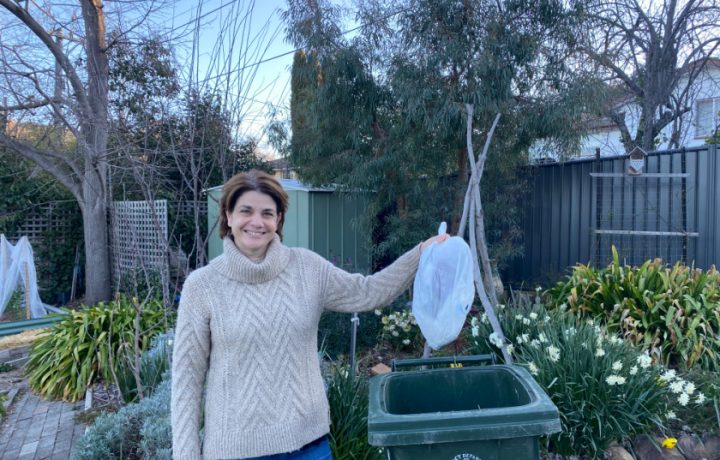
Could you fit a week’s worth of rubbish into one bag? Camille can.
Posted on
Low Waste Lifestyle’s Camille de Burgh shares simple small steps you can take to help the environment.
Right now it is easy to feel anxious and overwhelmed about our impact on the planet, particularly if you’ve seen anything on the latest “code red” report on the environment.
If you feel it might be time to consider reducing your personal carbon footprint, we bring you some home-grown inspiration in the form of public servant and mum-of-three, Camille de Burgh.
Camille has launched a public journey to reduce the amount of rubbish that ends up in her big green bin each week. Spoiler alert: She’s been so successful in her quest she has not filled her garbage bin in 34 weeks (and there’s room still!).
Each week she posts her enviably small garbage haul on her Instagram account Low Waste Lifestyle with tips and tricks as to how she does it. Camille is also studying a Diploma in Sustainable Living from the University of Tasmania.

You can see exactly what goes into Camille’s bin each week.
When did you start taking note of the amount of waste you produced? What were your first steps?
As is often the way, my journey has been gradual. Influenced by my parents, I have been composting for the last ten years or so. I’ve always loved to support small business and shop local, particularly at markets.
I started consciously trying to reduce my waste (both landfill and recycling) about two to three years ago. I did some reading and research (including about families who can put all their rubbish for a year in a jar!) and started rethinking my choices. I now actively avoid buying food with excess packaging and I choose cardboard packaging over plastic where I can.
As an example of one of my conscious choices, one of the swaps I did early on was to buy a soda stream so that I could stop buying bottles of sparkling water—that has made a huge difference to my recycling.
I think “being sustainable” can be too overwhelming if you try to do everything at once, I always encourage people to start with small changes one at a time and once you’ve incorporated that into your lifestyle, then move on to the next small change.
I am focusing on changes that will further reduce my waste. For example, I now use bamboo toothbrushes and toothpaste tablets, bars of soap, shampoo, and conditioner to further reduce my reliance on plastic bottles and pumps (just quietly the toothpaste tabs take a bit of getting used to!). I would encourage people to try some alternatives to the usual plastics, there’s so much choice now.
I’m also learning more about items that can’t be recycled conventionally through your curbside bin but can be recycled through programs like Terracycle (similar to soft plastics recycling). You can now recycle most of your toiletry and make up plastic tubes, including toothpaste and deodorant. You can recycle pens, batteries, ink cartridges, milk bottle lids and more.
There is a huge community out there who are all passionate in their own way about reducing the effect of human impact on the environment around us. Driven mostly by my weekly reels showing me throwing out my rubbish each week!! (its been 24 weeks without putting my bin out and its still not full), my follower count has been steadily growing and I’m realising that lots of people are really passionate about this and are super keen to learn more.
View this post on Instagram
What would you say to people who are unaware of the amount of waste they produce?
To be honest, I think some people just don’t think about, or don’t think about it in the context of everyone producing as much waste as they do. I’d say, stop and think about how much waste you put in your bin each week and what that adds up to over a month and a year.
Then on bin day go out onto the street and look at all the bins overflowing and try and think about what that all adds up to and where does it all go? We cannot keep producing, using and throwing away as much as we do. We need to embrace a circular economy where single use items are not produced as much.
To quote an American proponent of sustainability, Annie Leonard, “There is no such thing as “away”. When you throw something away, it must go somewhere.” I think that’s a really simple, but powerful statement. Just because we can no longer see it, it still exists, it’s still there.
Are there good resources available in Canberra?
Canberra has an amazing community of people committed to making a positive impact on our environment. There are a growing number of community gardens where people can come together to grow their own vegetables. There are compost services, bulk food shops (where you can BYO container), cooperatives where you can hire or borrow items that you only need to use once or twice.
There is a thriving vintage/second hand industry, with loads of shops, online sellers and clothing swaps, as people try and avoid buying new, and reduce the impact of “fast fashion”.
‘Buy Nothing Facebook’ is an amazing community group that is really gaining in popularity in Canberra. I recently asked for a compost bin and received both a compost bin and a brand new worm farm.
View this post on Instagram
What are some easy first steps to take?
There are three simple steps for people who want to immediately reduce their waste to landfill:
The easiest first step is to get food out of your bin by composting. Up to 40 per cent of household waste is food waste. There are a variety of ways to do this and one should suit nearly all home types.
For people without gardens, worm farms or bokashi bins are a great way to compost. There are lots of people (like me) who will happily take scraps from people who can’t compost. Subscription services where you can sign up and have someone collect your scraps and compost them for you are also becoming more available.
There is also an app called Sharewaste where you can sign up either as a donor or a recipient and drop your scraps off to someone in your neighborhood.
The second step is to recycle your soft plastics through the Redcycle collection points at either Coles or Woolies. So easy to do and will make a big difference to your waste.
Finally, don’t bring plastic and packaging into your home in the first place! This is where taking your own bag/keep cup/cutlery/straw etc comes in.
I also try and avoid most food packaging by shopping at markets. We are lucky in Canberra to have multiple options for markets. I shop at bulk food shops for some items for the same reason, it reduces bringing packaging into your home in the first place.