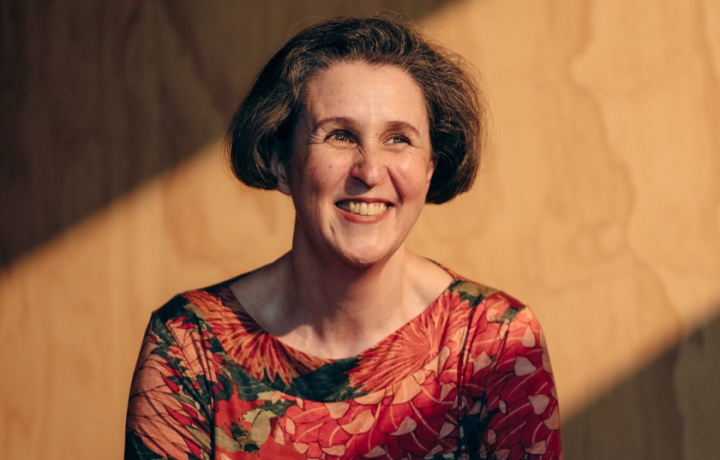
How I Got Here: CEO of MARION, Katy Mutton

Posted on
Admit it, we’ve all been there—deep dive stalking social media and LinkedIn profiles, trying desperately to figure out how the hell someone got their dream job.
It seems impossible and yet there they are, living out your career fantasy (minus the itchy business suit). It might seem hard to believe, but once upon a time, they were also fantasising about their future career, and with some hard work, they made it.
HerCanberra’s How I Got Here series reveals everything you wanted to know about the secrets of career success. And as the Chief Executive Officer of the leading organisation for writing in the ACT region, Katy Mutton has a few secrets to share.
Existential crisis time: Who are you and what do you do?
I’m Katy, the CEO of MARION, a not-for-profit organisation committed to elevating writers and their art. I wear many hats, I have two children, a cat, and a husband. I’m also a visual artist and designer!
Let’s go back to when you were a kid, have you always dreamed of working in this industry?
From about the age of 10 I wanted to be an artist. I loved art and literature and gravitated toward creative work. I studied design initially, then visual arts. However, I didn’t come to work professionally in the arts sector until I was in my 30s, I never imagined I would end up working in the literary space.
Tell us about when you were first starting out, what set a fire in your belly to get here and how did you do it?
I’ve followed an unconventional path to find myself here. I journeyed through many possible careers including retail, insurance, and architecture. I settled in the arts. I found my people. Whether its visual arts, literature, dance, or another creative sector we face many similar challenges to progress our careers. As an artist with 10 years professional practice behind me, I understand many of the challenges creatives face. As an administrator I can be part of the conversation for change, inclusion, and advancement of creative practice. I can advocate for new programs, development, and funding opportunities. Working for writers and engaging with the literary sector in this way puts fire in my belly.
Recall a time when you wanted to chuck it all in; what did you tell yourself when it got too hard?
Packing it in is never the solution. I’m like the Energiser bunny – I just keep going.
What was your biggest break?
I haven’t really had one in that traditional sense. If I had to pick something influential to my development as a professional it has been having mentors, those relationships have helped give me confidence to keep moving forward whether formal or casual. I am a big believer in the importance of mentoring relationships.
What’s the best piece of advice you’ve ever received?
Be authentic and listen.
What is it about your industry that you love and what makes you want to pull your hair out?
I love the buzz of creative ideas, the sense of what will come. Working in this industry, in the way that we are, I know that what we are doing will have some impact, at some point, for someone. That’s exciting; to know that you are creating an opportunity for someone to find that thing that sets them on a new path.
In terms of pulling my hair out it must be that the literary sector is woefully underfunded. I’m not sure many people outside it are aware of that. It’s frustrating that there is a lack of real investment in our writers. We work hard to build recognition of these issues and will continue to do so.
Tell us how you ‘stay in the know’, what media do you consume?
I read a lot of books, journals and listen to audiobooks, across genres. I try to read as many ACT region writers as possible so I’m aware of what is being created here.
Subscriptions to sector resources such as Books+Publishing are useful for seeing a broader picture of what’s happening across the sector.
Where do you see yourself in five years?
I hope I can look back on five years of creating opportunities for our writers and helping them build more sustainable careers. I’d love to think I played a part in building better pathways and connections for our writers to thrive. Of course, in my own practice I’m excited to think what new work might come in that time too.
Why should people follow in your footsteps?
It would be tricky following in my footsteps, it’s been such a circuitous path. However, I suppose that is the beauty of my path. It was never straightforward for many reasons. I think maybe to follow in my footsteps would be to stay open to new experiences and challenges even later in life, and maybe take a punt on an opportunity that is different. Taking a six-month contract with ACT Writers (now MARION) back in 2019 changed my entire trajectory and has led me to an area of work that I’m passionate about.
What advice would you give your past self?
Be kinder to yourself there is no right way to do things.
Photo credit: Mark Mohell.