How I Got Here: Heather Reid AM
Posted on
Admit it, we’ve all been there – stalking social media and LinkedIn profiles, trying desperately to figure out how the hell someone got their dream job.
It seems impossible, and yet there they are, living out your career fantasy (minus the itchy business suit). It might seem hard to believe, but once upon a time, they were also fantasising about their future career, and with some hard work, they made it.
Welcome to How I Got Here, HerCanberra’s series that reveals everything you want to know about the secrets of career success.
You probably know the name Heather Reid. A former Australian football administrator and an advocate for gender equity, diversity and inclusion in sport, she has made it possible for thousands of women to play football, both in the Australian Capital Territory and around Australia.
Named the 2026 ACT Senior Australian of the Year, we sat down with Heather about her work in supporting and mentoring players, coaches and administrators, locally and internationally and what it was really like as the first female CEO of Capital Football.
Existential crisis time: Who are you and what do you do?
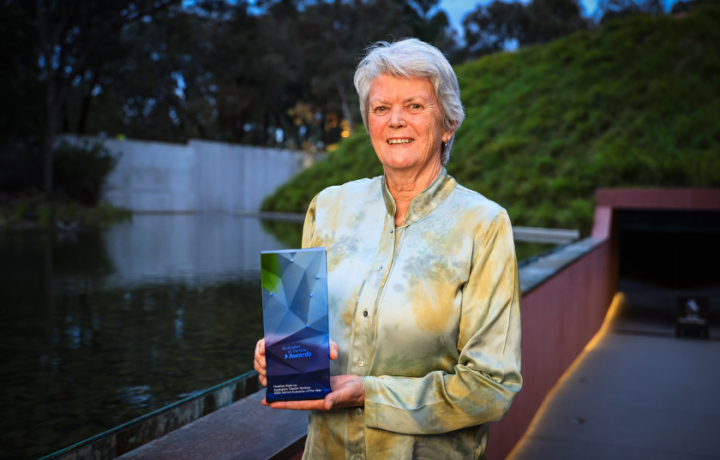
I’m Heather Reid, an award-winning trailblazer in women’s sport, primarily in football and the 2026 ACT Senior Australian of the Year.
I was born in 1956 in Goulburn, and lived most of my pre-adult years in Snowy Mountains towns where my dad worked as a plumber and then construction supervisor on the Snowy Hydroelectric Scheme and my mum worked as a hairdresser, complete with her own small salon in the backyard at Talbingo.
I graduated from CCAE (now University of Canberra) with the first cohort of Sport Studies students and I am a founding member of the ANU Women’s Football Club and the ACT Women’s Soccer Association (ACTWSA).
I’ve been the CEO of the Australian Women’s Soccer Association (AWSA), Womensport Australia and the ACT Football Federation (Capital Football). I also helped form Women Onside to promote gender equality in football and facilitated four Onside Mentoring programs. I was elected to the Board of Football Australia (FA) in 2018 and appointed as the first female deputy chair.
I’m now happily retired and live on the Sunshine Coast in Queensland. After almost 50 years of studying, teaching, volunteering and working in sport, I spend a lot of time working outdoors on our 4-acre rural property, enjoying the company of our border collie, Jasper, going to yoga and the gym (although not nearly enough), mentoring aspiring leaders and staying connected with a wide network of friends and family.
Let’s go back to when you were a kid, have you always dreamed of working in this industry?
I think I’ve always been a leader, from the time I was appointed high school captain. However, like a lot of kids at the time, I didn’t know what I wanted to do when I finished school.
I had learned to type when I was 12, so the career adviser recommended I go into secretarial work. The main suggestions in the 1970s for women who wanted a career were nursing, teaching, air hostess or office work. Looking back, I don’t recall why we weren’t given the option of becoming doctors, or pilots, or some other professional executive role.
I accepted the advice and moved to Canberra in 1974 to do a TAFE secretarial course and later became a typist and executive assistant, but after being involved as a player, coach and committee member in football, I knew that I wanted to work in sport and didn’t want to be a secretary for the rest of my life.
I was a planner, an organiser, a doer, and I had big ideas for how we could take women’s football to another level. I wanted to get more involved, especially at the national level. In 1981, a friend recommended I apply for admission to a new Bachelor of Applied Science in Sports Studies at CCAE. While I never envisaged working full-time as a professional in sport, I graduated in 1983 and I’ve never looked back.
Tell us about when you were first starting out, what set a fire in your belly to get here and how did you do it?
When I first got involved with football, I took on several volunteer roles in admin and coaching, including the ACT team manager at the national championships in 1982. My life changed during that week in Brisbane when I met the matriarch of the women’s game, Elaine Watson OAM, who was president of the AWSA. We talked for hours almost daily about how the administration and planning for women’s football could be improved and better resourced. Elaine liked my ideas, and we forged a lifelong friendship through dedication to a mutual cause until she passed away just before Australia co-hosted the hugely successful Women’s World Cup in 2023. This event would have been icing on the cake for all of Elaine’s hard work and determination to make the women’s game popular.
The fire in my belly started when I was appointed as manager of the national team (now called the Matildas) in 1984, and I joined the AWSA Board in 1985. The AWSA was barely 10 years old, and I was 28, but I knew this would be a lifelong journey. I was appointed as the national executive director in 1986 and set up the first national office in Hackett. I started with an electric typewriter and landline telephone. Everything was new, and exciting, but very challenging as I introduced management procedures and communication processes as well as improved the training and tour arrangements for our national teams.
Recall a time when you wanted to chuck it all in; what did you tell yourself when it got too hard?
Where do I start? Working in a politically charged, male-dominated environment has led to moments where I’ve told myself it was time to step away, recharge, and review my options. Two key times are fresh in my mind.
In 2011 and 2012, I was subjected to traumatic online harassment during a series of men’s Premier League finals that forced me to be more careful about where I went, who I spoke to, and who I could trust. Ultimately, I took defamation action against the main abuser and won a precedent case.
When I was on the FA Board in 2019, I was on the receiving end of more harassment and online trolling following the Board’s termination of a former national coach. I was exposed to a very nasty, orchestrated campaign to malign me and have me removed from the FA. Around the same time, I was diagnosed with cancer and had other things to focus on. I had previously resigned from my role with Capital Football and later removed myself from any FA involvement. I told myself: enough is enough, and that my health was far more important than football.
What was your biggest break?
This came in 1981 when I was encouraged to apply for admission to the Sports Studies course. However, because the course was initially established for athletes and coaches at the Australian Institute of Sport, and I didn’t fit that criteria (plus I was a 26-year-old ‘mature age student’), I started a Recreation Management course with similar units and then moved to Sports Management after I had demonstrated I could handle the studies. I graduated in 1983 and was very quickly on my way to being a professional sport administrator.
None of the work that I achieved over the years, from my time with the AWSA and subsequent work since then, would have been possible without the confidence of the Boards, especially the presidents, that I worked for and the unwavering support from my family and significant others.
What’s the best piece of advice you’ve ever received?
I’ve been offered a lot of advice over the decades, some needed and a lot that was unsolicited. The most treasured advice, however, came from my parents, who were two of my staunchest allies and provided nothing but unconditional love throughout my journey. Whilst I avoided talking to them about some of the nastier aspects of my work, they understood how much certain incidents hurt me. My dad used to say, “Don’t let the mongrels get you down”, while my mum would say “Rise above it”. This was their way of helping me cope with bullying and hateful remarks without stooping to the same level as the perpetrators. As Michelle Obama also famously said, “When they go low, we go high”. I love that mantra.
What is it about your industry that you love and what makes you want to pull your hair out?
I love that I’ve been instrumental in facilitating change for women in a sport that is truly the world game. I’m proud of the contributions that I’ve made and seeing how much women’s football is now accepted, admired and recognised compared to the early years when women were maligned and not taken seriously.
I love the women’s football community and the invaluable friendships that I have regardless of our different cultural, social, political and personal interests. I love seeing the thousands of little girls, wearing baggy shorts and big shirts, kicking footballs at our local fields on a frosty winter morning. Those scenes give me a lot of joy and satisfaction knowing the potential that girls can now realise.
I often want to tear my hair out over the gender politics and discrimination that exists in football. The constant need to argue for a better deal for women – whether that’s allocation of facilities for community clubs, or equal pay and prize money for elite athletes, or that we’ve still got a long way to go when it comes to shifting attitudes, creating more opportunities, and not accepting the tokens that are offered to pacify us. We need to crush the notion that men’s participation is the norm and women’s is an afterthought.
I despair when it comes to the governance, financial management, corruption, nepotism and political interference in our sport. Enough said.
Tell us how you ‘stay in the know’, what media do you consume?
I’ve given up on mainstream media for various reasons, and I rarely watch commercial television. I prefer to follow reliable, authenticated experts via platforms such as ABC, SBS, The Guardian, The Saturday Paper and The Conversation as well as listen to podcasts and follow specific people and groups on social media. I keep an eye on LinkedIn and occasionally look at Instagram. I tend to consume a lot of media (some might say ‘too much’) via X / Twitter and Facebook because that’s where I mainly find out what’s happening, with the posts being timely and relevant to my interests. I can get lost in the volume of articles that are posted.
Where do you see yourself in five years?
Towards the end of 2018, I was diagnosed with endometrial cancer. After a hysterectomy followed by chemotherapy and radiotherapy, I was cancer-free until mid-2021 when I was told I had pulmonary metastasis. Since then, the medical treatment, combined with some alternative therapies, has helped keep my condition under control, and I feel healthy. So, in five years’ time, I want to still be living on the Sunshine Coast, doing lots of physical work in our gardens, and thinking about what to pack for my 9th FIFA Women’s World Cup, probably in Europe. The best thing would be to hear my oncologist say that my latest blood test and CT scan results continue to be “remarkably unremarkable”.
Why should people follow in your footsteps?
As a prominent leader in sport, I’ve often had people say to me that they ‘want to be like me’ when they grow up, or finish their education or playing days, or whatever else. While I’m flattered by their sentiment, I often say, “Just be your true authentic self, follow your own path and be open to new ways forward”. I encourage them to step up and be seen, to be a well-informed and courageous disrupter, and to have a reliable cohort of advocates for support, especially when times get difficult.
I’ve faced many challenges over the decades, and I don’t want others to experience some of the things that I’ve faced in the quest for cultural change and gender equity. I’m more than happy to share my experiences and empower others if it helps them navigate the hurdles that lie ahead as they seek to be their own lever for change. We must have more female leaders, change agents and decision makers in sport, so if others want to follow in my footsteps, then I’d encourage them to wear sensible shoes or sturdy boots, be confident in their purpose and have a posse of confidants to back them up.
What advice would you give your past self?
Perhaps I could have developed thicker skin or exercised better judgement on some of my actions. However, I’d say – “Well done and be proud!” And I’d remind myself that I did my best in an unselfish way, with the best of intentions, when choosing action over indifference, and always with the love of the game at heart.
Feature image: Supplied.