Telopea Park students flocked to “farming” in 2023.

Posted on
The established hedges and flower beds of Canberra’s inner south are a long way from Australia’s rolling agricultural farmlands.
Yet students at Telopea Park School have this year had access to their own high-tech farm research station which allows them to investigate everything from food security to climate change.
The station, called iFarm, has allowed students of every age and ability to get their hands dirty while also conducting high-level data collection and scientific research—with the option to collaborate with a growing number of other iFarm schools around the country.
The iFarm sits discreetly on a small but sunny bit of gravel behind the classrooms and takes up the space of a caravan.
It uses solar and wind energy to power its high-tech functions and is completely linked to the cloud, allowing it to be managed hands-on by students during the week and remotely over weekends and school holidays.
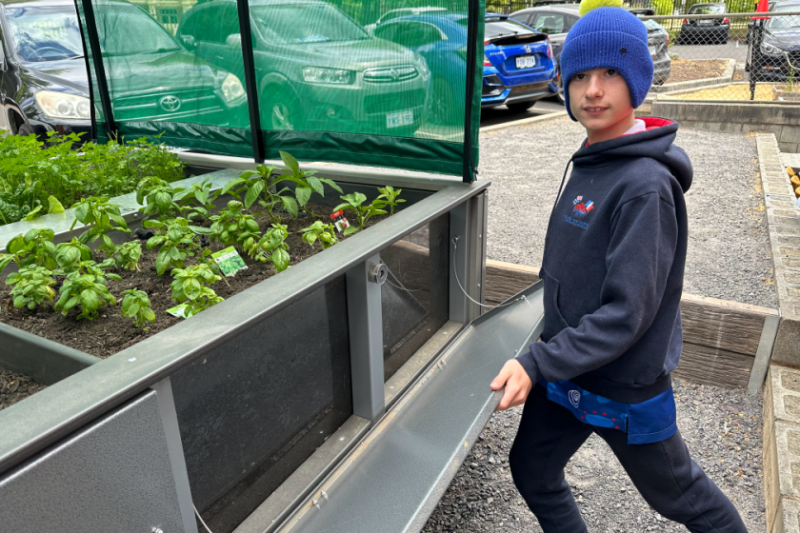
The sides of each bed in the iFarm are made from perspex to allow students to see what’s going on underground.
Apart from eight garden beds which are divided by Perspex so students can investigate soil and root systems, each iFarm incorporates a weather station, underground irrigation, overhead sprays, a 2,000 litre water tank, moisture and temperature sensors, a digital touchscreen, a worm farm for composting, and adaptable shade-cloths for different seasons.
The idea is you can see all aspects of plant growth in each of the eight beds, and you can extrapolate those results to a farm setting with one bed equating to one hectare of land.
Every aspect of the iFarm is built with learning in mind—even the electronic components feature transparent Perspex covers, to encourage understanding of electrical design and function.
French stream Year 10 student Zephaniah Thomas grew pak choy to consider how the density of plants in a plot of soil can impact on their growth. He’s a committed Science student who has never, before now, grown anything from seed. He can hypothesize the implications for large-scale crop growth and is delighted to see that after just a few weeks his seedlings were peeking through the soil.
Waratah learning support students meanwhile, grew all manner of things to learn how water and sunlight impact on plants, how to read and interpret data and how to conduct a science experiment.
Riley Nightingale is a Year 8 Waratah student who grew a beautiful crop of sweet mini capsicums and basil.
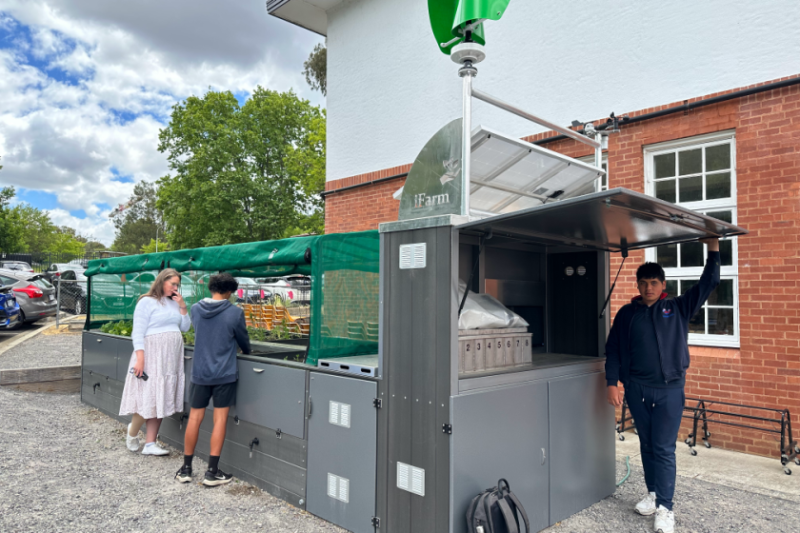
Wind and solar power are harnessed for the iFarm, which takes up then size of a caravan.
The Waratah classroom teacher says the iFarm has been a game changer for the students who love coming outside to dabble in the sunshine and soil and it has a positive impact on every aspect of their learning.
Acting head of Science Teagan Ashworth said the iFarm was applicable to every student in the school.
“Using the iFarm we can teach biology, physics, chemistry, technology, data analysis and literacy, and while we have only had the iFarm since July, the students have well and truly taken to it.
“Everyone appreciates they are out in the fresh air, taking part in hands-on learning and their well-being is also improved.”
She said all students from Year 4 onwards had access to the iFarm and there was also a focus on environmental science and sustainability which was popular with students.
“Of course what they are learning is so important for their futures.”
The brainchild of Steve Mansur and Kate Zlotkowski, a Tamworth couple who are passionate about future growth and expertise in Australian agriculture, iFarm has been provided to schools with support from the Federal Government.
There are currently 56 iFarms across the nation, with Telopea the first Canberra school to be part of the scheme.
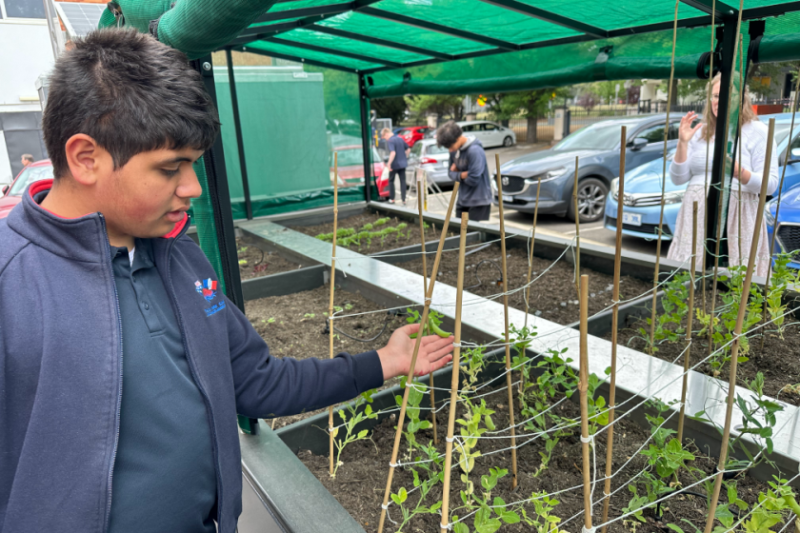
Students can watch plants grow from seedling to crop (and have a taste too!).
Schools can apply for an iFarm through an expression of interest and the Federal Government has subsidised them, with Steve and Kate hoping a second round of funding will help spread the iFarm concept.
“The iFarm is fully Australian designed, owned and manufactured and purpose-built for the Australian high school curriculum, and our goal is to get one in every high school in Australia,” said Kate.
It’s been a passion project for the couple who spent four years (with many hurdles) from the initial draft design to building the first iFarm.
“Our vision was to encourage students who may never have thought of Agricultural Science and its related fields as a possible career path. We also hoped to take some of the load off teachers by building something that would engage students like never before,” said Steve.
“The feedback from teachers has been quite overwhelming and better than anything we could have expected, which is humbling but also makes us excited for the iFarm’s future. “One of the things that makes the iFarm successful is the ongoing collaboration on the design and development with teachers, allowing us to purpose-build a machine in order to help fulfil curriculum requirements in STEM and TAS, thus ensuring it will be something they will use.”

