No, it’s not sunburn. We road tested a vampire facial.
Posted on
Last Sunday I braved the 2-degree temperature for a totally normal weekend activity—having someone draw blood from me, then smear it on my face.
Okay, there’s a bit more to the Insta-famous Platelet Rich Plasma (PRP) skin treatment (or ‘vampire facial’) than that, but you get the gist.
A treatment made viral by Kim Kardashian, PRP involves your own plasma-rich blood being used as a facial treatment after a session of micro-needling. So how does it work, and perhaps more importantly, why would I spend my Sunday doing this?
Well, since I spent a chunk of 2022 overseas, I’ve realised I have some sun damage (despite best intentions and constant sunscreen application), and as I’m in my early 30s, fine lines are becoming a reality.
I’m not particularly worried about either issue, however, like many people my age, I find myself curious about exploring skin treatments more powerful than retinol but less intense than injectables.
It turns out that a PRP skin treatment targets both fine lines and sun damage, as well as being suitable for acne scarring and hyperpigmentation. There’s no need to ‘subscribe’ to it as a treatment either, as it’s only recommended once a year at most.
“Our clients love PRP skin treatments because they can improve texture, tighten skin and soften lines and pores,” says Jenna Chan, Director of Hair and Skin Science which specialises in skin and hair loss treatments in Canberra.
“The downtime after PRP skin treatments is minimal and you start to see the full results after one to two weeks.”
So, how did it go?
PRE-TREATMENT
More than a week out from my treatment, Akriti, my helpful Registered Nurse from Hair and Skin Science Canberra, was in touch with a list of strict instructions.
These included keeping sun exposure to a minimum, wearing SPF 50+ every day, and for five days prior to the treatment, avoiding skincare actives like Vitamin A and retinol and discontinuing the use of any anti-inflammatories like ibuprofen.
THE TREATMENT
I arrive at Hair and Skin Science Canberra’s Dickson location to find a warm treatment room and a smiling Akriti. After walking me through the procedure and assessing any skin concerns, she takes a small tube of blood from my arm, exactly as you would at a pathology clinic.
After lying on the treatment bed, Akriti paints my face with numbing cream as a centrifuge spins the little tube to separate the blood from the plasma. 20 minutes and a numb face later, we’re ready to go.
First, the micro-needling. Akriti explains that since the skin on my forehead, nose, upper lip and chin will be more sensitive, she’ll start there to get it over and done with, using a very shallow setting. She’s not wrong. It is sensitive, but manageable, even for someone with a low pain threshold.
In my research, I read it feels a bit like someone is pulling a pen of “metal sandpaper” over your face. This is a great description. There are a couple of spots where I wince a little—the tip of my nose, for example—but it’s so quick that it’s easy to deal with and my face remains numb and cool throughout.
When Akriti moves to my cheeks, the sensation becomes far more tolerable and in total it couldn’t have been more than two minutes of micro-needling. Hard part, done.
Akriti then smoothes a thick, soothing viscous liquid all over my face—my plasma. It feels like a facial and with my eyes closed I forget to take a photo but I imagine it would be like something out of a Stephen King novel and have no regrets.
To help the plasma settle in and my porcupined face heal faster, Akriti sets me up with a dose of warm LED Light Therapy.
10 minutes later and Akriti gently removes my now-dried plasma and applies a series of soothing and occlusive balms. After some instructions about after-care (don’t wash your face or shower until the next day, no exercise or makeup for 24 hours, SPF 50+ every day), I’m all done. In total, it’s been less than an hour.
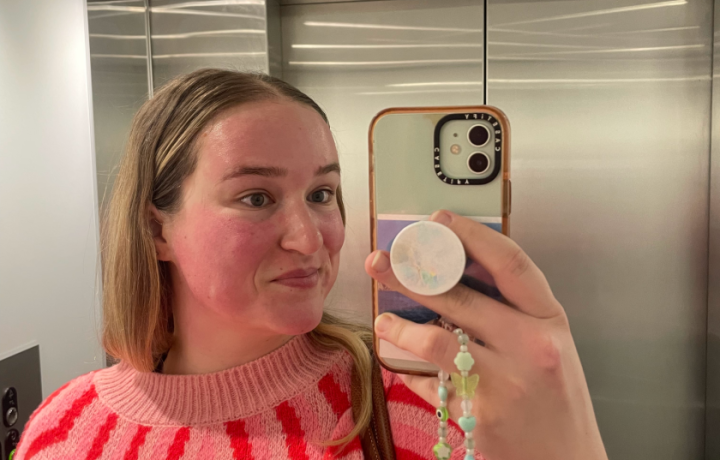
Afterward, it’s no surprise that my face is bright red (see photo above) and as the fresh winter air hits my cheeks, I feel grateful I’m not doing this in summer. The Hair and Skin Science website says you can go about your day after PRP treatments; however, while I felt completely fine, getting about in tomato form won’t be everyone’s cup of tea.
I’m not sure why I volunteered to pick up takeaway for dinner with friends after my treatment, but at least it made me get over my fear of being seen. Into the packed restaurant I went, and lo-and-behold, no one cared.
My face stayed numb throughout dinner, and according to my friends, it was only ‘just’ pink by the end. Before bed, I changed my pillowcase to make sure it was pristine but there was no heat or pain and my sleep was completely unaffected.
RECOVERY
The next day I wake to skin that looks remarkably calm. I would normally work from home to keep my skin sheltered as it recovers but I have an in-person training at the office, so I gently wash my face with water and apply products I have identified as mild. Big mistake. Both products (Cera Ve moisturiser and Weleda Skin Food) cause my skin to itch and tingle and I wash them off immediately. Luckily, my 50+SPF Cancer Council sunscreen serum feels fine and I slather it on before heading to the pharmacy.
La Roche Posay’s Cicaplast Baume B5 (a hero for those with sensitive skin) in hand, I head to the office. My pinked skin is taken for wind chill by my colleagues and no one gives me a second glance. The balm is perfect—soothing and gentle—and I quickly forget that I’ve had a treatment.
I’m curious to see how a morning Pilates class goes on Tuesday but my skin isn’t too sensitive and leaves me to sweat in peace. My face is perhaps 10% more pink after the class, but it’s barely noticeable. By Wednesday I’m back to wearing makeup (with gentle skincare underneath) and my skin looks normal, with a slight clearness to it.
SO, WHAT DID WE THINK?
Results of a PRP treatment are usually seen 1-3 weeks afterward as the injured skin encourages rapid collagen production and lasts up to 18 months, so time will tell.
What I can say is that the process itself was far less medical and scary than it sounds. Will you be uncomfortable? Yes. Will you meet yourself in tomato form? Yes. Could this potentially be the right level of cosmeceutical treatment for someone looking to target sun damage and fine lines? Let’s hope so.
The author received their treatment courtesy of Hair and Skin Science but their opinions remain their own.