Greybilly: Abigail Varney and Nina Baker
Posted on
Greybilly – A dense, massive silcrete generally grey to greenish grey or creamy coloured. Also referred to as Shincracker, this highly silicified rock is found towards the surface at certain fields particularly in Coober Pedy and Lightning Ridge. – Opal Miner’s Glossary
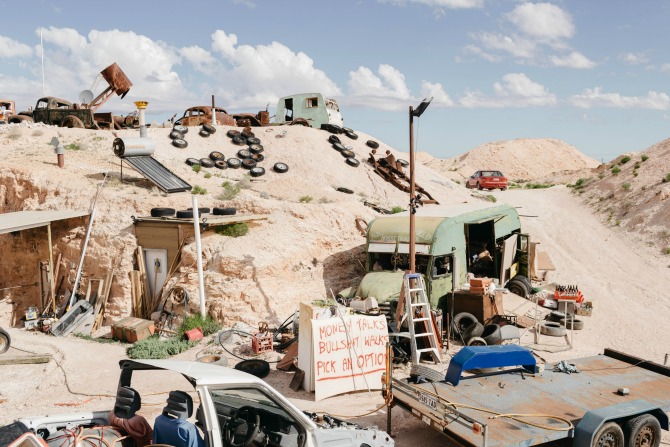
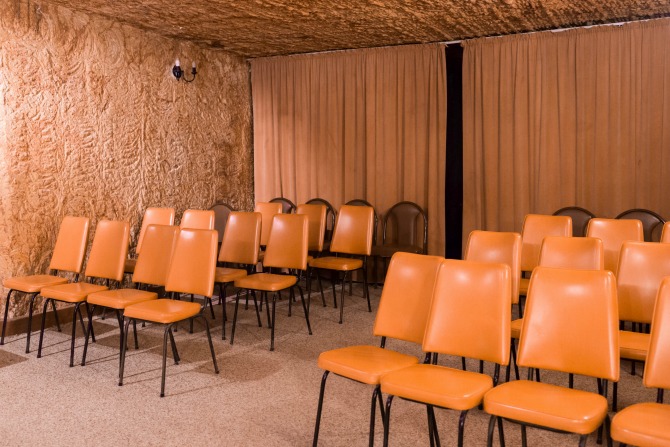
There is something otherworldly about Coober Pedy that appears in Abigail Varney’s images. In part, it is the emptiness; the thick stillness. People appear occasionally, but more often than not we see their traces: chairs set in rows, used tyres thrown aside, the ephemera of domestic life. These details of the once thriving global community have become props in a story for travelling guests.
Coober Pedy, the famed opal mining town in remote South Australia, runs on turbulent, gamblers’ luck. It is a town that fills up and empties out with each cycle of boom and bust. The name Coober Pedy is an anglicised combination of two Aboriginal words; the Mutuntjarra word Kupaka (meaning “white man”) and the Antakirinja word Piti (meaning “hole”). “White man in a hole.” What an apt description; literally true, slightly comical and possibly desperate.
Credit: Abigail Varney.
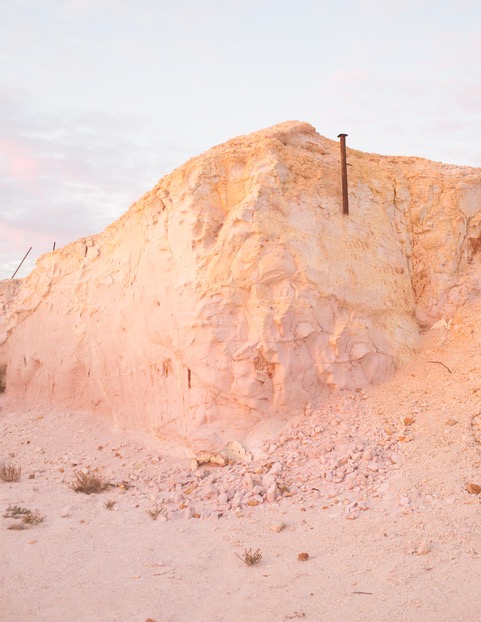
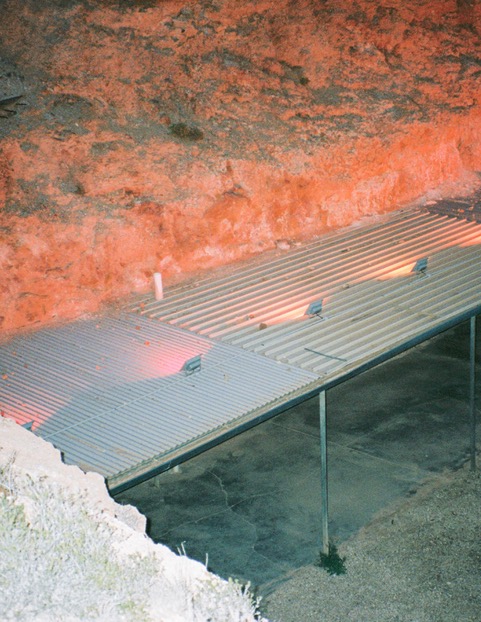
Coober Pedy and its desert surroundings look almost moon-like in Abigail’s photographs. However, glimpses of cloth caught in soil and machinery at rest, remind us that this landscape is itself another kind of human trace. The rocky hills are constructed from the detritus of mining. Elsewhere, we see dugouts – homes cut deep into the ground. In these spaces, architecture and site collapse into one as earth becomes walls and ceilings.
Credit: Abigail Varney.
Greybilly (or rather Grey Billy) sounds like it could be a person from Coober Pedy – a miner, an underground comrade. Grey Billy would definitely be a man. Within the dusty pink-drenched landscapes, masculinity dominates.
Credit: Abigail Varney.
The tones in Nina Baker’s work, Bakjes, have the same dreamy quality to Abigail’s photos: enticing and, after time, slightly unsettling. What first appears to be a soft, fleshy pink becomes a delicate mix of blue, egg-shell yellow and orange. Though sweet and creamy, the colours of Bakjes come with a synthetic aftertaste: these are plastic colours tinting plastic forms.
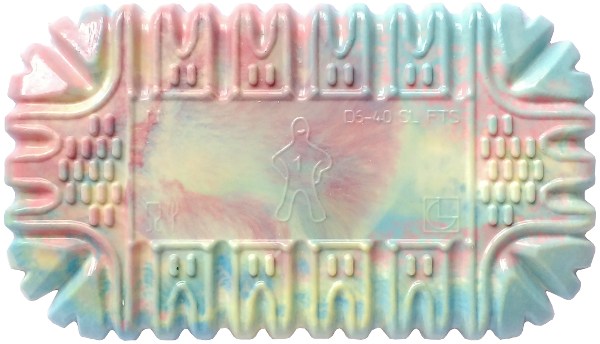
Bakje by Nina Baker.
Made in Amsterdam as part of Nina’s internship with pioneering conceptual jewellery artist Ruudt Peters, Bakjes takes its name from the Dutch word for plastic containers, the kind used to package vegetables, meat and cheese. Once unpacked and thrown aside, these containers become waste; the material detritus of contemporary life.
As Nina says, “These plastic containers are ingenious and ubiquitous. Designed with beautiful graphic indentations. They are stupid. Unnecessary, irresponsible, normal. Quickly wasted. Icons of our age.”
Materiality can be seen at the centre of Bakjes as plastic is used to etch plastic forms. Sometimes, the made surface is glossy and smooth. At other times, it is carved, cut and disrupted. This choice of material obviously inserts the work into a discussion about consumerist culture and its impact on the environment.
As Jasper Velzeboer wrote of the work, Bakjes “exudes the strange appeal that mass-produced items have in spite of – or perhaps partially because of – the ugly system that produces them. Wearing this jewellery can, therefore, be a celebration of tainted beauty as much as the donning of a badge of collective cultural shame.”
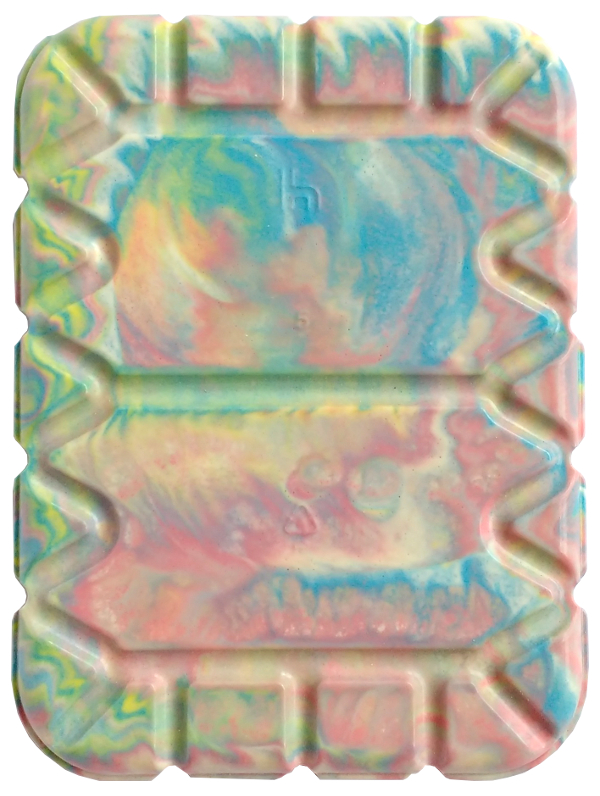
Bakje by Nina Baker.
Though Bakjes was made on the other side of the world to Coober Pedy, when set alongside Abigail’s images of a slowly depleting mining town, they are provocative. How do we ascribe value to materials and resources? What happens when they’re plentiful? What happens when they’re scarce?
the essentials
What: Greybilly
Where: Nishi Gallery, 17 Kendall Lane
When: Opening Friday 3 August at 6 pm. Exhibition runs until 29 September 2018.
Gallery open: Wednesday – Sunday from 11 am – 3 pm
Cost: Free
More information: nishigallery.com.au/exhibition/greybilly
This is a sponsored editorial. For more information on sponsored editorials, click here.
Leave a Reply