Five minutes with author S G Bryant

Posted on
Canberra author S G Bryant’s first two novels have their focus squarely on an “extraordinary” Australian woman from our colonial past.
But what does it take to recreate history within the limitless boundaries of fiction? How do you dredge up the past—especially when it takes you to dark places? And what’s next for Minnie Hunter?
We caught up with S G Bryant to chat writing process, research and 1890s Melbourne.
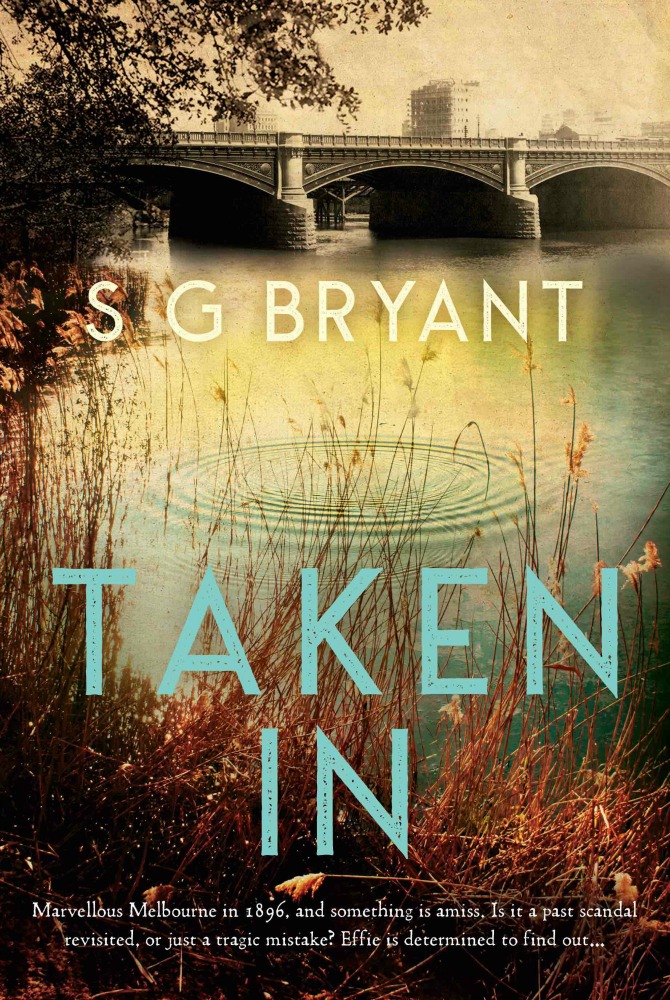
When did you first have the idea for Taken In?
My first novel, Boss, is a fictionalised account of the life of Susannah ‘Minnie’ Hunter, an extraordinary woman whose father was the first lessee of the Kalangadoo Pastoral Station, in the south-east of South Australia in the mid-nineteenth century.
Minnie’s story directly connected with my personal history: her father’s property included the land on which my family would eventually farm as soldier-settlers.
In the latter part of her life, Minnie ran a boarding house in St Kilda, in the 1890s and early 1900s. It was while researching background on Melbourne at that time, that I came across, and became fascinated by, the events and issues that became the basis for Taken In.
Melbourne at that time was a city of immense contrasts. The ‘marvellous Melbourne’ of the earlier years had been driven by the wool and gold booms, and had created extraordinary wealth and ostentatious lifestyles for many Melburnians.
But their world, and Melbourne’s economy, was rocked by the crippling recession of the early 1890s. This environment of high unemployment and social unrest, side-by-side with the remaining wealth and privilege of the few, seemed to me fertile ground for a mystery thriller, based on actual events and scandals of the time, and incorporating many actual historical Melbourne landscapes and characters.
Some of the key themes that I have explored in Taken In are the issues of baby fostering and adoption (culminating in the scandal of baby-farming), the suffragette movement and women’s independence more generally, emerging policing techniques, and the role of Australian Rules football in Melbourne’s social life.
How did you go about researching 1890s Melbourne?
The Internet is a marvellous research tool, and naturally was the primary source of historical information about Melbourne in the 1890s. But my research was also informed in a number of areas through reference books.
For example, as mentioned, one theme in the book is the early history of Aussie Rules football, and that theme is informed by the seminal book about the development of the game, Up Where, Cazaly?, by Leonie Sandercock and Ian Turner.
What drew you to historical fiction as a genre?
I came across Minnie Hunter’s story many years ago, in another lifetime really, when I was farming the family property at Kalangadoo land which was originally part of Minnie’s father’s pastoral run.
At that time, one of Minnie’s descendants visited the Kalangadoo area, in search of the site of the original homestead, bringing with them several parts of Minnie’s original diary.
A copy of this came into my possession and I was immediately captured by her story, and the lives of the people with whom she came in contact over her lifetime. I thought at the time that it would make a fascinating novel, and resolved that, at some time in my life, I would have a try at making that novel a reality.
You’re writing the second book in the Taken In series—tell us about that
As I mentioned, Aussie Rules football plays a part in Taken In. Given my passion for the game and its colourful history, I was keen to include more footy content in that novel, but my editor (very wisely) advised against my enthusiasm, pointing out that it would detract from the main focus of the story.
But no such inhibitions for my next novel, which has the current working title, Death in Black and White. This one is a direct sequel to Taken In, and is set entirely within an Aussie Rules club (no prizes for guessing it’s Collingwood).
I hasten to add I’m not a Collingwood supporter, but I was drawn to the Magpies because of their proud and colourful history, and their connections with some equally colourful historical figures.
Enough said, any further explanation may provide spoilers, although I can perhaps reveal that illegal betting plays a significant role in police investigations in the novel. Obviously, nothing has changed in the world of football.
What is your writing process?
I plot the development of my novels quite carefully, before putting finger to keyboard in earnest. That involves scoping out the plot, chapter by chapter, scene by scene, getting a good understanding of who my characters are and what motivates them, and making sure that the balance of the novel is how I want it to be.
Then I get into the first draft, trying not to be too fussy on this first pass, but just to get down a draft as quickly as possible. I usually write in the mornings, usually no more than three hours a day.
500 words a day is my target minimum, 1000 a day when the creative juices are flowing well, and 1500-2000 when I’m absolutely cooking with gas.
When the first draft is done, the hard part comes, refining, revising, cutting (mercilessly, I hope) where required. Anything up to 6-8 re-drafts before it goes off to my editor, then it’s an iterative process of working with her to get to the final version before the publishing process begins.
What can’t you write without?
As I think the above shows, I absolutely cannot write without a plan, and a very well developed one at that. I’m not one of those writers who can let the story organically unfold as they write. I need to have all parts of the story mapped out very carefully before I start writing. I think that’s particularly important for the mystery novel, where tightness and credibility of plot is so important.
That’s not to say that there can’t be changes, even significant changes, that occur as I’m writing or at the editorial stage. But even then, I find it easier to make those changes if I can see how they fit effectively into the overall plot/theme of the story, as it’s mapped out in the planning process.
What’s on your TBR pile at the moment?
I’ve just finished reading Garry Disher’s latest detective story, Peace, set in the mid-north of South Australia, where Garry grew up. Garry was a mate of mine at Adelaide Uni, and I’ve followed his long career from the beginning. I love his self-discipline as a writer, his great skill at evoking a brilliant sense of time and place with the utmost economy of words. And the grittiness of his novels too, there’s no sugar-coating with Garry’s work.
Most of my contemporary literary heroes are Australian: Tim Winton, Helen Garner, Richard Flanagan, Tom Kenneally, and Kate Grenville are perhaps the foremost. But there are many Australian writers who I think write brilliantly about our country and our people. Canberra’s own Karen Viggers is another I’ve discovered recently and whose work I love. And I want to delve into Sulari Gentill’s Rowland Sinclair series more thoroughly too. She’s one who is right at the top of my list of Australian historical mystery writers.

Leave a Reply