Still serving – the enduring magic of Tennis ACT’s “Ressies” competition
Posted on
Some sporting traditions are measured in trophies. Canberra’s Ressies can also be measured in generations, with juniors taking on their heroes, siblings sharing doubles glory and local players discovering just how far a good forehand might take them.
Incredibly, the ACT Resident Tennis Championships began in 1933, and today it’s still going strong. Over its lifetime, “Ressies” as it is lovingly termed, has delivered homegrown champions, memorable upsets and a pathway from neighbourhood courts to the international stage. Yet the tournament’s greatest strength may be the simplest – that it belongs to the locals.
According to Tennis ACT Historian Colin Adrian, the first championships were an initiative of the Federal Capital Lawn Tennis Association, celebrating the opening of the Manuka Tennis Courts Pavilion.
The men played for the Johnson Cup and the women for the FA Piggin Cup, both still held by Tennis ACT. Lower-grade, junior and handicap events also became part of the mix.
As tennis grew in popularity, Ressies attracted players, spectators and regular radio and newspaper coverage. Before World War II, Reg “Blackie” Bennett and Joan Shumack emerged as local legends, each winning six Resident Championships. Joan achieved hers while still a junior.
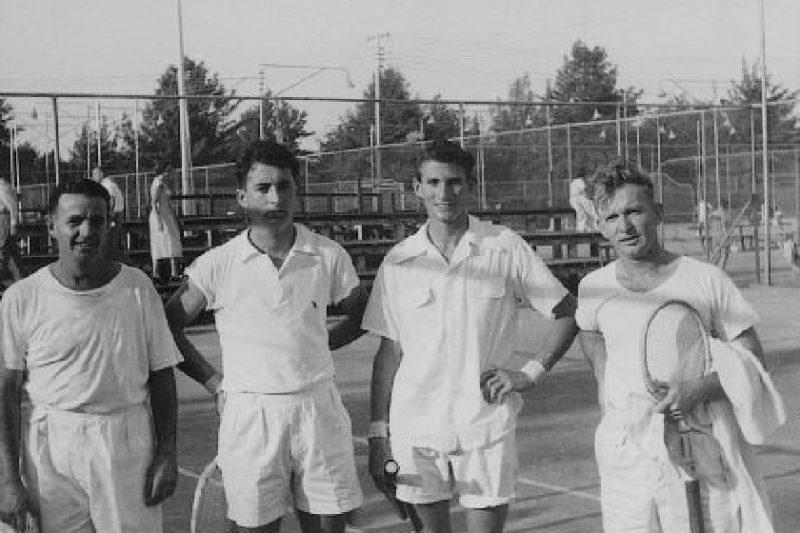
1954 ACT Residents Doubles Championship Final (L-R Reg ‘Blackie’ Bennett, Peter Roberts, Cres Roberts, Rex Patterson)
In the late 1940s and 1950s, Peter Roberts dominated the men’s competition, collecting seven singles and nine doubles titles, most of the latter alongside his brother Cres. Among the prolific women’s winners were Norma Crawley, Pat Macnicol, Judy Purdy and Barbara Winder, whose successes extended into the 1960s and in some cases beyond.
Then came Bruce Larkham. Emerging from the junior Residents, he amassed eight singles and nine doubles titles across more than a decade, while also, according to Colin, being the first Canberran to compete seriously overseas.
Upsets are part of the Ressies’ lore. In 1967, with close to 500 competitors and spectators watching, unseeded newcomer Ross Humphreys toppled Bruce in what Colin describes as the tournament’s biggest upset. Ross had recently arrived in Canberra on National Service duty with the Army at Duntroon. Bruce reclaimed the crown in 1968.
In 1970, the championships moved from Manuka to Tennis ACT’s new headquarters at Lyneham. The competition remained fiercely contested, particularly when Australian Institute of Sport players were permitted to enter as residents.
With high-performance coach Charlie Hollis, strong AIS links and interstate arrivals including Helen Holcombe and Ros McCann, later Balodis, the local tennis scene was changing.
The junior titles became a stepping stone towards AIS opportunities, overseas competition and, for some, US college tennis. Wally Masur, Ben and Annabel Ellwood, and Todd and Brent Larkham were among those who came through the junior Resident ranks before pursuing international careers.
Ros Balodis became the most successful women’s Resident champion, winning eight singles titles as well as a doubles and mixed title.
One final deserves its own highlights reel. In 1992, Ros, aged 33, faced 14-year-old Annabel Ellwood and prevailed 7–5, 7–6. Annabel found some consolation by winning the doubles with Nicole Pratt. She later won a World Youth Cup and reached a world singles ranking of No. 57.
The Ressies’ story is not only about the young guns. Veterans’ tennis, later known as Seniors, established separate age-based Resident titles from 1970 and junior age titles have also often run separately.
And here is a sporting trivia gem: squash great Heather McKay was a Resident tennis champion too. In 1957, competing as Heather Blundell, she won the under-17 singles title.
After her squash and racquetball career, Heather returned to tennis, winning ACT Resident Seniors titles before claiming world 60-plus team and singles championships in 2001.
Colin’s history of Ressies names nine Canberra world Seniors champions, including Heather, her elder sister Kay Schiavinato, Ros Balodis and Helen Holcombe. All had won multiple ACT Seniors Resident titles. Clearly, the competitive spark does not come with an expiry date!
While formats have changed with court availability, sponsorship, weather and the wider tennis calendar, what endures is the chance to test yourself against your peers, whether you are chasing a title or simply a cracking match.
Tournament Director Skye Davis says Ressies occupies a unique place on the local tennis calendar.
“It’s a chance for local players to compete against the best talent from across Canberra and see who comes out on top,” Davis says.
“There’s plenty of pride on the line. Whether you’re representing your club, taking on a long-time rival or testing yourself against the strongest players in the ACT, it’s an opportunity to be part of something that’s distinctly Canberra.”
Organisers are moving from round-robin play to an elimination format, with an option for additional singles match play after a first-round loss. Junior events sit alongside men’s and women’s open singles, doubles and mixed doubles.
While the race to be crowned Canberra’s local champion will be a major drawcard, the event retains the community atmosphere that has made it a favourite among players for generations.
“You’ll see fierce competition on court, but you’ll also see clubmates supporting each other, old rivals catching up and players from all corners of the tennis community coming together,” Davis says.
From Manuka’s pavilion to Lyneham’s courts, Ressies maintains an enduring sweet spot of serious tennis, local pride and room for the next generation to make a little history of its own.
Registrations are now open for this year’s Ressies comp, and close on November 30. The tournament runs from Friday 11 December to Sunday 13 December. Go to tournaments.tennis.com.au for all the details.
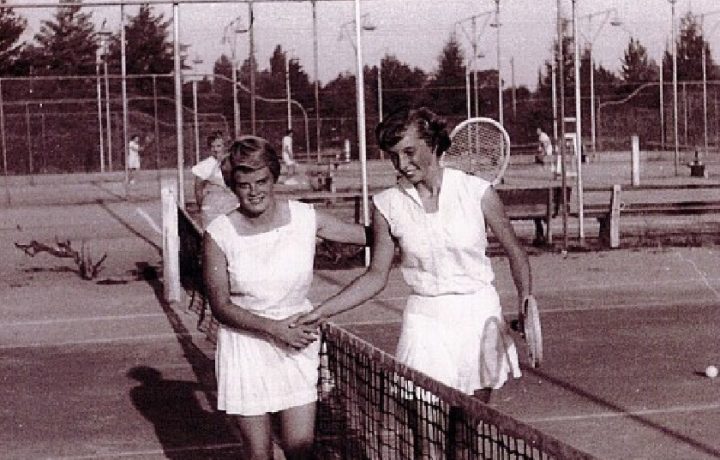
Main image 1954 ACT Residents Championship Junior girls final (L-R Pat Macnicol, Judy Grangel).