Sustainable life: Carbon positive home

Posted on
Global warming looms like a tribe of rampaging giants. It is a future with more drought, bushfires, smoke haze and rising sea levels. How does one person stand up against the tide to make a change when the problem is so big?
Just as climate change is a challenge that was created by the actions of people, it is a challenge that people will need to solve. We can be optimistic about the future. Around the world, people are standing together to make a difference on climate change. Greta Thunberg began leading the movement for change when she was still a high school student. More than 1 Million Women have joined together in a campaign to build a lifestyle revolution to save the planet
Going carbon positive is a change that we need to see in people’s lives to regenerate our planet. Together we can turn the tide of climate changing, rampaging giants. Living carbon positive is just a few steps away.
Step 1. Know your carbon footprint
Step 2. Decide what you’re going to change (or not)
Step 3. Offset the difference
Step 1. Know your carbon footprint
The choices we make every day have a profound effect on our personal carbon footprint. Do you fly to your holiday destination or choose somewhere that’s accessible by car? Have you got solar panels or do you pay a premium for renewable energy through the electricity grid? Do you like to buy new stuff… clothes, shoes, computers or furniture, or do you search out second hand? Do you eat local tomatoes all year, or only local tomatoes when they’re in season? Should you be vegetarian? So many choices.
Here are three typical annual carbon footprints built using the United Nations Climate Change Lifestyle calculator. These are from typical households around Canberra with fictional names.
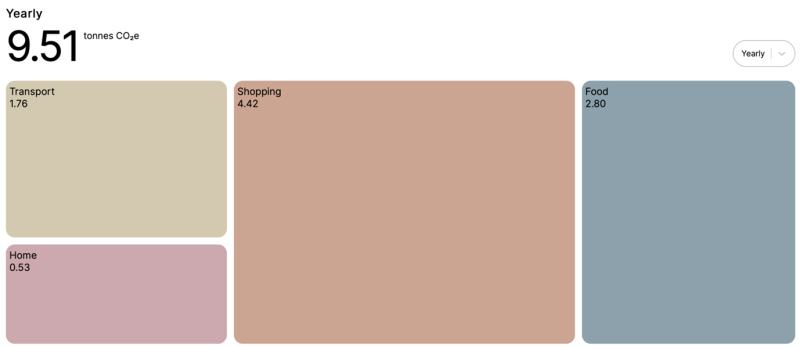
Peter lives alone in a Braddon apartment, walks to and from work and only takes holidays that she can get to with a car. She is a typical consumer, buying quite a few new things each year. Her electricity is directly from the grid – 100% renewable in Canberra – and she has a normal diet that includes meat.
Peter’s carbon footprint is quite low because she hasn’t taken any flights. To reduce emissions even further, Peter might choose to focus on reducing her consumption of new products or eating less meat. Being vegetarian could almost halve the carbon contribution of diet to Peter’s overall total.
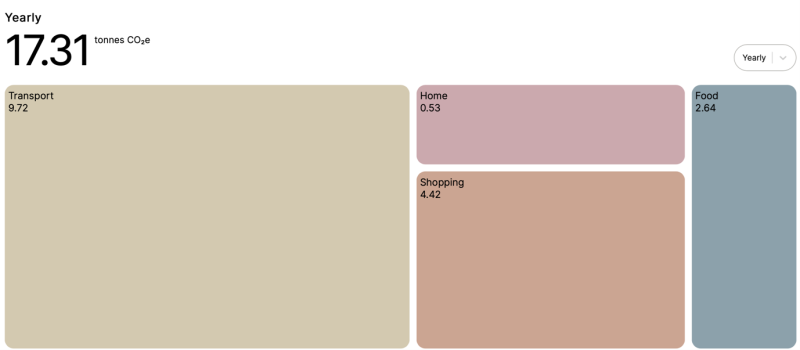
Miranda lives in Western Creek with her partner and two children. They have a medium-sized house, a car and she has taken one short flight and one long flight for holidays. Miranda’s home is heated and cooled with an electric heat pump. Miranda catches the bus to and from work each day and has a hybrid car. She is a normal consumer, buying new clothes, shoes and small whitegoods this year. Miranda has one meat-free day each week.
Miranda’s carbon footprint is quite high, driven mostly by the flights she’s been taking as well as her her consumption and her diet. The fastest way for Miranda to reduce her footprint is to take less flights.
Navigating your carbon footprint can feel like you’re navigating a lumpy minefield. Until every item that we buy has a carbon price attached, the simplest way to know your personal carbon footprint is to use an online calculator to do the heavy lifting.
The United Nations Climate Change Lifestyle Calculator is easy to use and builds from a sophisticated international data set. It takes about 4 minutes to complete an initial assessment, with more detailed assessment available. The Calculator helps you to understand your carbon footprint through the categories of home, transport, shopping and food.
Step 2. Decide what you’re going to change (or not)
Home
Electricity
If you live in Canberra, your electricity is 100% renewable – hooray! If you live outside the ACT, consider asking your electricity provider for a 100% renewable electricity plan or instal solar panels. Most solar panel installations pay off in 5–8 years, well before the panel’s warranty period ends.
Gas
Typically used for heating water, heating your home and cooking. Each has alternatives that are carbon neutral — if your electricity is from a carbon neutral source. Consider improving efficiency in the way that you heat your home by adding insulation in the roof or sealing drafts.
Waste
Greenhouse gasses are created by food, garden waste and wood breaking down inside a landfill. The simple answer? Don’t put these items into landfill. A food and organic waste curb side collection service is coming for all Canberrans in 2023. If you can’t wait, consider composting your food waste through a home or community compost, a worm farm, and a bokashi bucket.
Recycling paper, glass and metal is another great way to reduce your greenhouse gas footprint. By recycling, you’re reducing the energy needed to produce new products.
Transport
Vehicle
Does every adult in your family need their own car? Does every journey need to be by car? Does your car need to be run on fossil fuels?
Where you live and how you structure your life matters. Consider public transport, bikes and walking as alternatives. Consider owning just one car per family, rather than two or three.
Air travel
Do you need to take every trip by air? Are there holiday options closer to home? Reducing the footprint of air travel is about avoiding and reducing the number and size of journeys by air. Reducing air travel is an easy way to reduce your carbon footprint.
Shopping
Every time we buy a new computer, new clothing or new appliance, there’s been energy — usually resulting in carbon emissions — involved in the production and shipping of that item. Second hand items are usually locally sourced, so less shipping and there’s no new emissions involved in creating the product. Take a buy nothing new challenge to see just how much stuff you didn’t really need in the first place or could source second hand.
Food
Food makes a bigger contribution to your household’s carbon emissions than most people realise. According to the UN Food and Agricultural Organisation, 14.5% of all human emissions are from livestock, most of this is from meat production.
The greenhouse gas impact of different foods is surprising. Meat is the big contributor to food carbon. So, consider eating less meat or becoming vegetarian. If you do eat meat, consider chicken before anything else. Chicken is good because it doesn’t require much grain to grow the meat, and because chickens don’t fart quite so much as the other animals. Surprisingly, dairy has a bigger carbon impact than chicken per kilogram… owing to both the transport of feed and the farting of cows. Consider cutting back on your dairy.
The other significant contributors to food carbon are the fossil fuels used to transport food and those used to heat greenhouses to grow out of season. Join the world’s eat local movement and find ways to eat fresh, seasonal produce you’re your local farmer’s market.
Step 3. Offset the difference and make your impact positive
There’s quite a bit of choice in the offsets market. The international gold standard certification body, endorsed by the United Nations for the offset activities having the highest level of environmental integrity as well as other benefits, like women’s empowerment or improved biodiversity. Most of the certified offset projects are in developing countries and you can choose whether your offsets are from hydroelectricity, wind farms or biodiverse forests.
There are offset projects everywhere around the world. Choose an offset project that connects most deeply for you.