Take a page out of these books: Your guide to the 2026 ACT Literary Awards shortlist
Posted on
The 2026 ACT Literary Awards shortlist has been announced. These are the local books you need to get on your radar.
MARION – the leading organisation for writing in the ACT – has announced the shortlist for the 2026 ACT Literary Awards, and this year there are some serious page turners.
The Awards celebrate the authors that call the ACT and surrounding region home, recognising exceptional work across poetry, fiction, nonfiction, and children’s literature (both self-published and traditionally published).
The award winners will be announced on Thursday 2 July at a special event held at Verity Lane. In addition to the category awards, one of the shortlisted works will also be selected to receive the Marion Halligan Award, which will be announced on the night.
With tickets set to be released to the awards soon, here is the shortlist. Your TBR is about to get a whole lot bigger.
FICTION
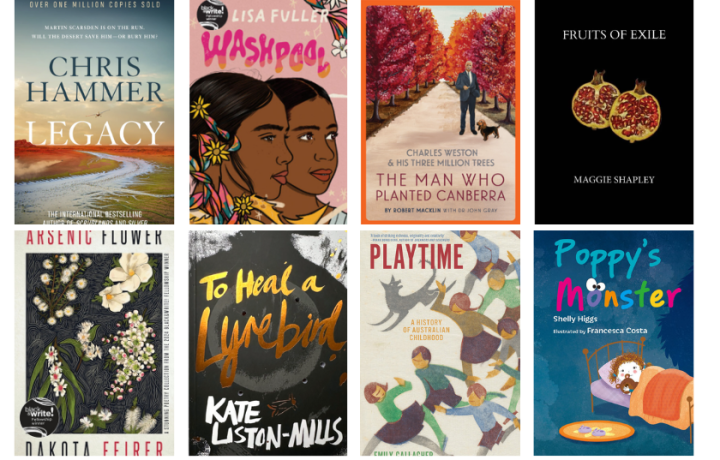
Legacy by Chris Hammer
If you haven’t read anything by Chris Hammer, consider this your sign. The eighth book by the award-winning author, Legacy follows Martin Scarsden as he flees following an assassination attempt. But when he lands in even more trouble with a deadly family feud leaving him at death’s door, it’s all he can do to survive.
Chris Hammer has penned Martin Scarsden’s most perilous, challenging and intriguing assignment yet – and as a leading Australian author of crime fiction, you can bet that Legacy will leave readers hanging onto the edge of their seat.
When Sleeping Women Wake by Emma Pei Yin
Emma Pei Yin’s debut novel When Sleeping Women Wake is a love letter to the forgotten women of war – and it promises to take you on an emotional journey.
Following three spirited women – a mother, her daughter, and their maid – during the Japanese occupation of Hong Kong in 1941, the novel explores how ordinary people are capable of extraordinary things. It is full of themes of invasion, occupation, war, resistance, gender equality, love and friendship.
In The Name of the Trees by Merlinda Bobis
Merlinda Bobis is no stranger to being nominated for awards. Shortlisted for the ACT Notable Award for Fiction in 2021 for her novel The Kindness of Birds, her latest short story, In the Name of The Trees, has been nominated for the ACT Literary Awards.
Spanning four generations of women shaped by war, colonisation, migration, and ecological loss, In the Name of The Trees blends myth, memory and history to tell an unforgettable intergenerational story: Lola Narra trying to heal her granddaughter Dao, who was paralysed in an accident that killed her father.
It’s a story of cultural survival, resilience, and kinship set between the Philippines and Australia (including Canberra).
To Heal a Lyrebird by Kate Liston-Mills
From the author of The Waterfowl Are Drunk! and Dear Ibis comes a poignant journey of courage, strength and love in the face of the unfathomable.
Pambula-based author Kate Liston-Mills’ To Heal a Lyrebird focuses on the bond between a mother and her son and asks the question “Can they survive a broken world when all the odds are against them, and nothing is as it was before?”
NON-FICTION
Politics, Pride and Perversion by Erik Eklund
Shortlisted for the NSW History Awards, the 2025 NSW Community and Regional History Prize and Longlisted for 2025 The Australian Political Book of the Year, Politics, Pride and Perversion by Erik Eklund is a must-read for anyone interested in politics.
The compelling biography of Frank Arkell – the most successful politician of his generation – dives into the tragic consequences of unbridled male lust, deep social inequality and unaccountable class power. And while we might know how Frank Arkell’s story ends, it doesn’t make how he got there any less interesting.
Playtime by Emily Gallagher
This groundbreaking book, exploring the history of children’s play and imagination in Australia between 1890 and the Second World War, will change the way you see Australian social history and tells vital stories about social relations, change and continuity.
Built around six imaginative worlds (amateur journalism, bird loving, war and adventure, dolls, the future, and monsters and fairies), Playtime tells the story of the generations that grew up at a time when nation and empire were being reimagined amid the globalising currents of war, technology and trade.
The Man Who Planted Canberra by Robert Macklin with Dr John Gray
Robert Macklin is one of Canberra’s most wide-ranging and accomplished authors with no fewer than five awards to his name. His latest book is worth picking up.
The Man Who Planted Canberra tells the story of Charles Weston and his three million trees, exploring the re-greening project that transformed Canberra into the horticultural wonder it is today.
Also featuring familiar names like Marion Griffin, it offers an interesting insight into the making of Canberra.
Versailles Mirrored: The Power of Luxury, Louis XIV to Donald Trump by Robert Wellington
Ever wondered why Versailles remains a powerful point of reference for those who wish to flaunt their social, cultural, and political capital? Versailles Mirrored explores just that.
Written by Robert Wellington – Associate Professor of Art History in the Centre for Art History and Art Theory at The Australian National University – the book examines the enduring fascination with the Sun King’s palace through eight case studies spanning the 17th to 21st centuries.
It’s an interesting investigation of cultural capital, taste, and the use of luxury in statecraft.
CHILDREN’S
Washpool by Lisa Fuller
A magical middle-grade adventure about two sisters who need to rely on their own wits and bravery, Washpool is the second book from Lisa Fuller, a Wuilli Wuilli woman from Eidsvold, Queensland descended from Wakka Wakka and Gooreng Gooreng peoples.
Washpool blends classic Alice in Wonderland elements with First Nations mythology and follows Bella and Cienna as they are accidentally transported to the strange new world of Muse, where they work with magical creatures on an eye-opening quest. Washpool is written for ages nine and up.
The Drought Kangaroo by Jackie French and illustrated by Danny Snell
The Drought Kangaroo is the third picture book in the powerful series about climate disaster from award-winning Australian duo Jackie French and Danny Snell.
Based on the true story of a young kangaroo who went on the longest journey of his life and ended up living by a creek on Jackie’s property, The Drought Kangaroo has a light-hearted but educational storyline about animals and the challenges they face in environmental disaster. It’s ideal for ages zero to two.
Creature Corridors by Billie Rooney and illustrated by Anke Noack
Recommended for ages five to nine, Creature Corridors follows kangaroos, koalas, birds, fish, crabs, cassowaries and lizards through wildlife corridors that exist across forests, rivers and seas.
The book explains how wild animals often travel to find food, shelter or a place to breed – and how difficult and dangerous it’s becoming as humans continue to affect their habitat.
It’s a great way for children to discover how we can share our world with them.
Poppy’s Monster by Shelly Higgs and illustrated by Francesca Costa
A picture book for ages four and above that explores anxiety, Poppy’s Monster is a valuable and heartwarming story written by psychology graduate Shelly Higgs. The book follows Poppy, who is being followed by an anxiety monster that is making her miserable – but then one day she realises her monster might just be frightened too.
Taking children through all the emotions – and showing them that it’s okay to feel anxious – it offers them tools to manage their feelings.
Peculiar Parents by Stephanie Owen Reeder and illustrated by Ingrid Bartkowiak
Dr Stephanie Owen Reeder is the author of over 25 books for both children and adults, and Peculiar Parents is her latest publication. Introducing children to 60 Australian animal species – from parrots that play the drums to dancing spiders – the book focuses on all things family.
Peculiar Parents is full of amazing facts that young readers will love, from picking a mate to making a home, having babies, finding food and looking after one another.
It’s ideal for ages six to 12.
Luna’s World by Hayley Gannon and illustrated by Michelle Conn
Written by a teacher librarian working in Canberra, Luna’s World is the first book in a brand-new illustrated diary series for fans of Ella Diaries and Diary of a Netball Star.
The book follows Luna Merrian – a 10-year-old with BIG dreams – and uses her diary to show everything that’s happening in her world. Luna is desperate to become a library monitor – AKA a Little Librarian! The only problem? Her school enemy: Jade Jones.
Heartwarming and easy to read, it’s written in diary format and will resonate with library lovers aged six to nine.
POETRY
Wita Witalana by Paul Collis
Wita Witalana is Paul Collis’ second collection of poetry, and in it you’ll find a powerful call to listen to the messages carried through the trees.
A reminder of the stories etched within the Australian soil, the poetry asks readers not only to see the effects of colonialism on a people, but to experience those effects as someone thrown into its brutal shadows.
It’s a meditation on the complexities of Indigenous life in contemporary Australia, containing themes of longing, memory, and the enduring strength of connection to land and culture.
The Dingo’s Noctuary by Judith Nangala Crispin
An illustrated 70,500-word verse novel by acclaimed poet, visual artist, motorcyclist and volunteer firefighter Judith Nangala Crispin, The Dingo’s Noctuary has received several awards and prizes, including the 2023 Sunshine Coast Art Prize and the 2020 Blake Prize for Poetry.
The story is set against a backdrop of Australia’s central deserts, and unfolds through combinations of poetry and prose, alongside maps of land and stars, plant pressings, and 47 afterlife portraits of animals and birds.
Exploring themes of identity, belonging, and the fragile threads that connect all living beings, poetry lovers will be unable to put this work down.
Arsenic Flower by Dakota Feirer
From black&write! fellowship winner and Bundjalung and Gumbaynggirr man Dakota Feirer comes, Arsenic Flower.
In this debut collection, he explores the legacy of generational trauma and the cultural wisdom of First Nations people. Using dazzling imagery and rhythms inspired by lo-fi hip-hop, the poems confront the violence of colonialism that echoes still in the complexities of blak masculinity.
Powerful, diverse and original, we promise that you haven’t read anything like Arsenic Flower before.
Fruits of Exile by Maggie Shapley
Through the voices of seven women in a Canberra book club, Fruits of Exile explores the theme of exile as they discuss the works of Australian poets Gwen Harwood and Margaret Scott – ‘literary exiles’ in the male-dominated spaces of Australian poetry.
The poems trace journeys of emigration, marriage, motherhood, and self-discovery, inviting readers to reflect on what it means to leave, to stay, and to find home in unexpected places.
A fun fact? The first draft Fruits of Exile was part of Dr Maggie Shapley’s PhD thesis on the publication of Australian female poets.