American Masters – the NGA’s proud heritage
Posted on
How abstract expressionism helped define the National Gallery of Australia’s place in Australia and the world.
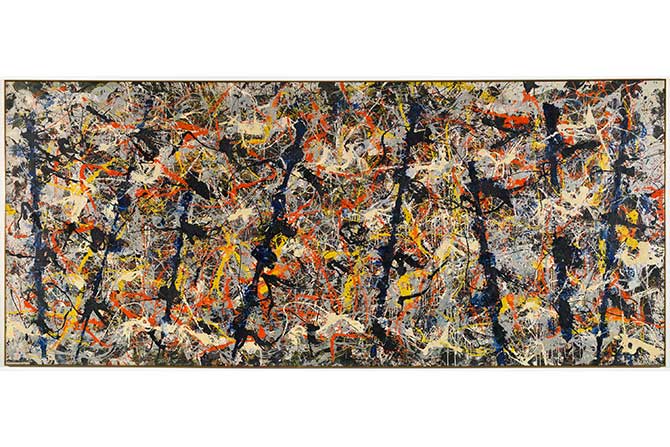
In 1973, when the then director of the National Gallery of Australia (NGA) James Mollison sought to buy American artist Jackson Pollock’s Blue Poles, it was outside his discretionary budget of $1 million.
But so convinced was he of the abstract expressionist’s place in Australia’s most important art collection, he took the next step—asking Prime Minister Gough Whitlam to approve the purchase.
Whitlam did so—and a record $1.3 million was paid for a painting that is now synonymous with the NGA and is one of the show-stoppers in the upcoming American Masters 1940-1980.
Back from a four-month loan to the Royal Academy of Arts in London, it is reportedly valued at $350 million and still generates the strong opinions on the nature of art to this day.

Jackson Pollock
Blue poles 1952
oil, enamel, aluminium paint, glass on canvas
National Gallery of Australia
© Pollock-Krasner Foundation/ARS/Copyright Agency
Yet its purchase as part of a wider array of seminal American Masters is now considered a testament to the collecting vision and legacy of the early NGA, which culminated in one of the world’s best and largest collections of post-war American art outside of America.
The NGA’s new director Nick Mitzevich said: “This exhibition reflects Australia’s courage, confidence and ambition at the time the national collection and Gallery was built”.
“It is important we understand this period in art history and its influence here in Australia.”
As the NGA established itself under Mollison in the 1970s and 1980s, it embarked on an unprecedented vision to build a national collection, securing some of the finest works of modern and contemporary art for Australia.
More than 75 per cent of the works of art in American Masters were purchased before the Gallery even opened in 1982. The NGA’s investment in American art was bold and often controversial—notwithstanding the outrage expressed over Blue Poles by many who felt Whitlam was squandering taxpayer dollars on something a child may have created.
Eliciting headlines such as “$1.3 million for drips and drabs” and “barefoot drunks painted out $1 million masterpiece”, the painting has now become a national treasure, symbolising the country’s cultural bravery and optimism and aligning the NGA with the American Abstract Expressionism movement that developed in the creative melting pot that was New York after World War II.
American Masters explores how a generation of young Americans challenged tradition and reinvented modern art, paving the way for a series of movements such as Colour-field, Pop, Photo-Realism and Conceptual art, and redefining art itself.
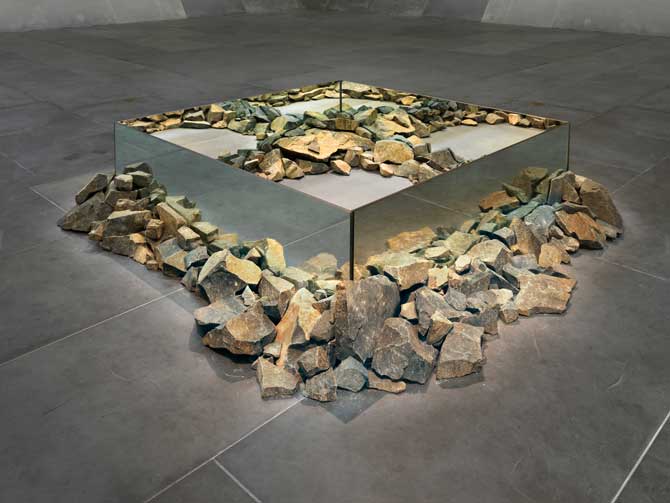
Robert Smithson
Rocks and mirror square II 1971
basalt rocks and mirrors
National Gallery of Australia
© Robert Smithson/VAGA/Copyright Agency
In his foreword to the exhibition catalogue, Nick dedicates the exhibition to Mollison, saying his foresight ensured that the NGA’s collection of post-war and contemporary American art “ quickly grew to become one of the most important outside the United States of America”.
And while the gallery also acquired “defining collections of historic, modern and contemporary Australian art—which, from the mid-1980s, integrated contemporary Indigenous art—the American and broader international holdings across all media, carefully nurtured by the founding Director, provided a broader artistic context and lent global distinction.”

Barnett Newman
Broken obelisk 1963/67/2005
weathering steel
© 2018 The Barnett Newman Foundation
New York / ARS, New York/Copyright Agency
American Masters features over 150 works by more than 70 artists, including: Mark Rothko, Willem De Kooning, Frank Stella, Man Ray, Andy Warhol, Robert Mapplethorpe, Yoko Ono, Cindy Sherman, Sol LeWitt, Eva Hesse, Dan Flavin, Louise Bourgeois, Barnett Newman, Chuck Close, Roy Lichtenstein, James Turrell, Jackson Pollock and more. The exhibition has been made possible through the support of Principle Partner, Terra Foundation for American Art.
the essentials:
What: American Masters 1940–1980
When: Opens 24 August, and runs until 11 November
Where: National Gallery of Australia, Parkes
Cost: Free


Leave a Reply