Maya Newell: In My Blood It Runs
Posted on
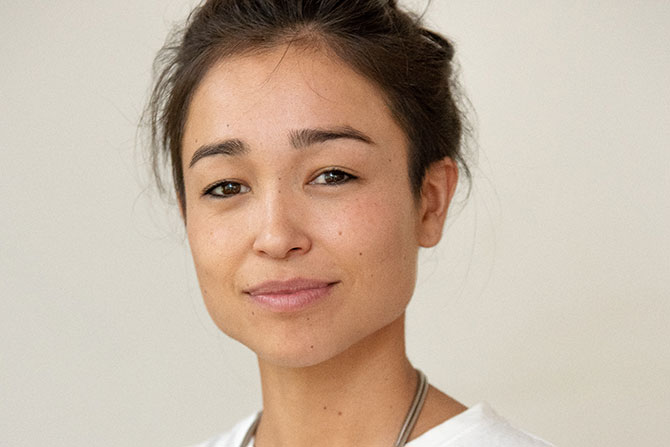
Australian filmmaker Maya Newell will be in Canberra for the screening on Friday of her new film In My Blood It Runs.
Her new international hit will play as part of the Stronger than Fiction Documentary Film Festival that kicks off today at Dendy Cinemas.
Maya’s first film Gayby Baby (2015) gave a voice to young people growing up with same-sex parents. It achieved an Australian cinema release, played a big part in the Marriage Equality debate, and also had the distinction of being banned in Australian schools.
For her latest film, In My Blood It Runs, Newell again gives a voice to a young person, a ten-year-old boy from Alice Springs. Despite speaking three languages and being respected as a young healer, Dujuan is ‘failing’ at school.
As he comes under the increasing scrutiny of welfare and police, his family rally to try and find a way to stop him becoming another statistic.
Maya, can you tell us a bit about how you made the film?
“I shot the film mostly by myself with a little bit of help here and there – sound recordist David Tranter gave me a hand when it became a little bit intense.”
So you were responsible for sound and lighting and the cinematography and you are also doing the interviewing?
Shooting on my own has now become a preference for me because of the intimacy that can be achieved when you are just one person, but it’s also by necessity in documentary, particularly observational documentary when you are filming over a long period of time. It’s virtually impossible to pay a crew to be there the number of hours that I was there over the years.
How long did it take to shoot?
It took three years. I was living in Alice Springs. Where Dujuan lived was just around the corner from my place so it was pretty easy to go and shoot.
It’s a big thing to make a full-length feature with a main character as young as Dujuan.
Yes, it’s been a huge part of the filmmaking to ensure the duty of care around Dujuan and there were many moments where we thought we might not continue to make the film.
Originally we were going to have several children in the film but then I met Dujuan – he’s an exuberant, intelligent, cheeky rascal character and I knew pretty early on he would be able to hold the film. He’s very articulate in the way that he poetically describes his life.
There’s something really wonderful about a child’s point of view. He has a deep moral grounding in what is right and wrong and this shows up common misconceptions about aboriginal people in a way that is really interesting.

Maya Newell (with camera) and Dujuan Hoosan.
Did you have any idea at the beginning where Dujuan’s story was going?
No, in the beginning I thought we were making a film about the education of aboriginal children – they are taught only in English, even though it’s not their first language and they are measured by western values.
So it’s no surprise that the education system largely misses First Nations children like Dujuan.
Then shortly after we started filming, the 4 Corners film about Dondale was broadcast showing the torture of children there and it became apparent that you could lock up a 10-year-old in Australia. And I learnt that every child in detention in Alice Springs was Aboriginal and it became clear that Dujuan was very quickly heading towards that outcome.
But that’s only the beginning of what is an amazing story and we don’t want to spoil it for the audience. One really unusual thing about the film that I noticed is how very closely you worked with the participants in the film and the community.
“It is unusual. In documentary filmmaking, it’s common practice when you’ve finished making a film, to show it to the people who are in it, to give it the tick of approval, but we wanted to do something that is a little bit deeper and more meaningful.
When we set out to make this film, I was very aware that we were a team of both First Nations and non-Indigenous filmmakers and in Australia, we have a very long history of misappropriation of First Nation stories and so while I was deciding whether it was right for me to sit with these families, and to support Dujuan to tell his story, we came up with a structure of creation and making that made it feel ok and allowed the family to be properly credited in the creation of that story.”
I gathered a mixed group of producers including Larissa Behrendt, indigenous filmmaker and human rights lawyer, Felicity Hayes, the traditional owner of Alice Springs, Rachel Naninaaq Edwardson, a First Nations woman from Alaska, Dujuan’s grandmothers and a board of advisors and elders from the community.
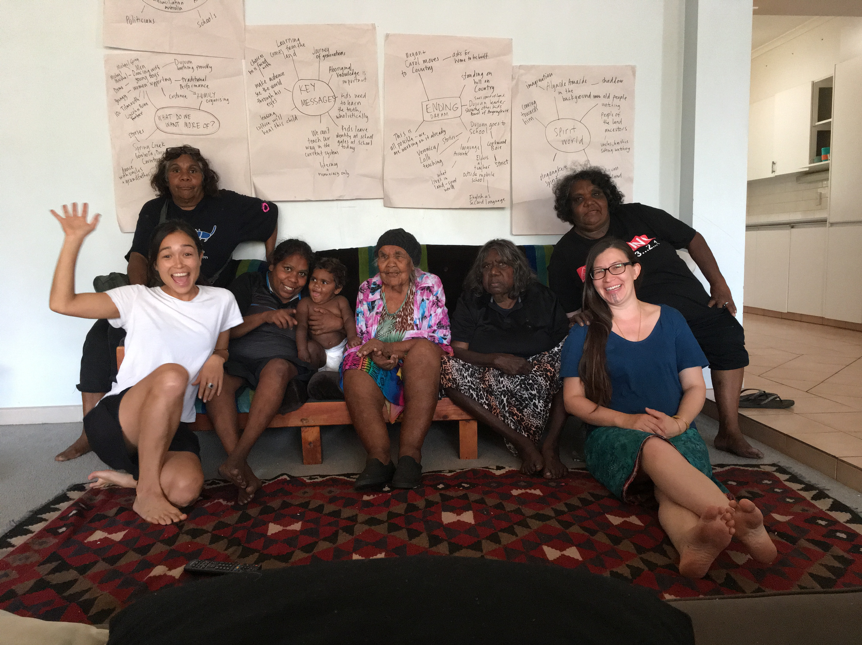
Maya with the team.
We had full-day workshops before we started filming, not only asking can we make a film with but also – What do you want to say? and looking at how we could break down stereotypes of aboriginal people. And that consultation and collaboration continued in every aspect of the making of the film. Dujuan was very interested in the camera, and and also the interviewing process. He did some filming and every time I interviewed him, he did an interview with me. That’s not in the film, but it was part of the fun we had working together.
The involvement of the advisors, the elders and Dujuan’s grandmothers continued past the filming into the editing and several of the advisors are credited as collaborating directors.
We showed people what we had filmed and we edited part-time in Alice Springs so that people could walk into the edit when they felt like it.
With so many people involved, were there every any differences of opinion?
Differences of opinion, always. We had many robust conversations about what should be in or be left out of the film and these differences were resolved through discussions. You work through it.
There was one serious instance within the film, where one of Dujuan’s aunties was stabbed, we were unsure if it should go in the film or not, we didn’t know whether it was right to include it, whether it was too intense or whether it was failing in our duty of care to that family, whether it would trigger unhelpful stereotypes so we just put those questions to the family.
I think there’s a bias amongst filmmakers that if you involve your subjects in these tricky conversations, that they will deny access and ask for only the positive things to go into the film, but these families, they face these hardships every day and they were happy to shine a light on these issues that they face. It is a matter of balancing – the Australian media only show the negative side.
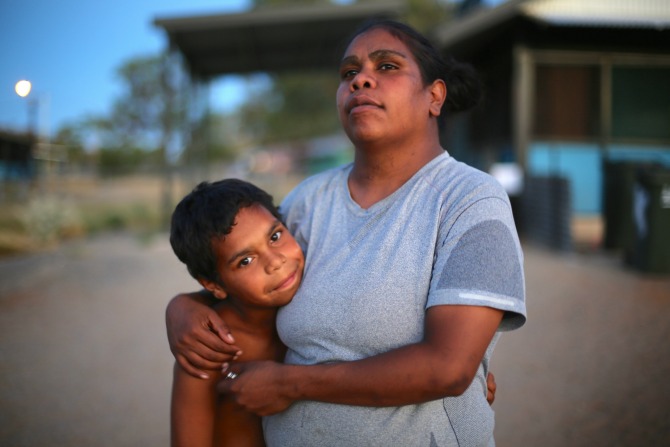
Dujuan Hoosan with his mother Megan Hoosan.
Tell me about the world premiere of In My Blood It Runs at the prestigious Hot Docs Festival in Toronto earlier this year
Yes, we were lucky to be selected and I went with eight members of Dujuan’s family. The business of getting passports and visas for all of them was worth a movie in itself! We had a terrific response and some great reviews there. And then for the Australian premiere at the Sydney International Film Festival, we did a crowd-funding campaign and raised money to bring the family down to Sydney.
As we begin to hold screenings round the country, Dujuan and his family will have other opportunities to travel with the film and speak publicly about personal truths that they have experienced over the course of making the film. One of these opportunities is very exciting: at the end of the year, we will be going to Geneva to screen it at the UN to the Committee on the Rights of the Child which is part of the Human Rights Commission.”
In My Blood It Runs screens at 6.15 pm Friday 2nd August at Dendy Cinemas, Canberra Centre. There will be a Q&A after the screening with director Maya Newell and producer Larissa Behrendt in conversation with Alex Sloan.
Click here for more information and tickets.
Feature image credit: Jamie James.
Leave a Reply