Fashion Revolution Week: Kelli Donovan on slow fashion, greenwashing and real change

Posted on
Revolution is a collective act, and when it comes to creating a fashion industry that actually prioritises ethical, sustainable, and intentional choices, everyone has a part to play.
It feels like only yesterday that the HerCanberra team was creating our Canberra Girl’s Guide to Sustainable Fashion, inspired by our sell-out sustainable fashion swap and the choice to place the then 18-year-old climate activist Greta Thunberg on the first-ever cover of Vogue Scandinavia.
And while a lot has changed in the fashion industry during the five years since – including a boom in the second-hand market and a focus on vintage fashion– it some ways, it still feels like ‘conscious fashion’ is a buzzword, rather than a commitment.
Data from the Australian Institute in 2024 revealed that not only do Australians buy more clothes per person than any other country (averaging 56 new clothing items a year), but the average value of item purchased is AUD $13 – lower than the UK ($40), USA ($24), Japan ($30) or Brazil ($16).
When it comes to what goes to landfill, the report states that more than 200,000 tonnes of clothing make its way to the junkyard: the equivalent weight of almost four Sydney Harbour Bridges.
But the world’s largest fashion activism movement is hoping to change that.
Originally founded by Orsola de Castro and Carry Somers in response to the Rana Plaza disaster in 2013 – which killed 1,134 workers and injured more than 2500 – Fashion Revolution is a non-profit organisation advocating for a clean, safe, transparent and accountable fashion industry.
Mobilising people, brands and policymakers through research, education and advocacy, for over 10 years, they have held Fashion Revolution Week to coincide with the disaster in Bangladesh and to honour the lives lost.
The intention? To create both a better fashion industry and to create a path for future generations to follow.
“Fashion Revolution Week is our annual campaign, bringing together the world’s largest fashion activism movement for seven days of action,” explains Australian Country Coordinator Milly Grace.
“More than a decade on, it has become a powerful global moment for collective action across 75 countries.”
This year Fashion Revolution Week takes place from Wednesday 22 until Tuesday 28 April, and is calling for people to ‘reclaim the collective’, standing united to challenge how fashion is made and consumed.
Believing that it takes many people, perspectives, and approaches to drive change, Fashion Revolution Week takes shape in unique ways around the world – ranging from community events and campaigns to education, advocacy and creative activism.
“At its core, it’s about people engaging with activism in all its forms; whether that’s someone already working in fashion, an organisation looking to do better, or someone who has never before considered the impact of their clothing and wants to get involved, even in the smallest way,” says Milly.
“There is no superior way to participate; every action adds up. Success might look like someone learning to mend a button, watching an eye-opening documentary, attending an event, or simply starting a conversation with a friend.”
In the lead-up to Fashion Revolution Week, we sat down with three Canberra creatives working in the slow fashion space to talk about its importance and how conscious fashion is a collective mission.
Here, we speak with designer Kelli Donovan.
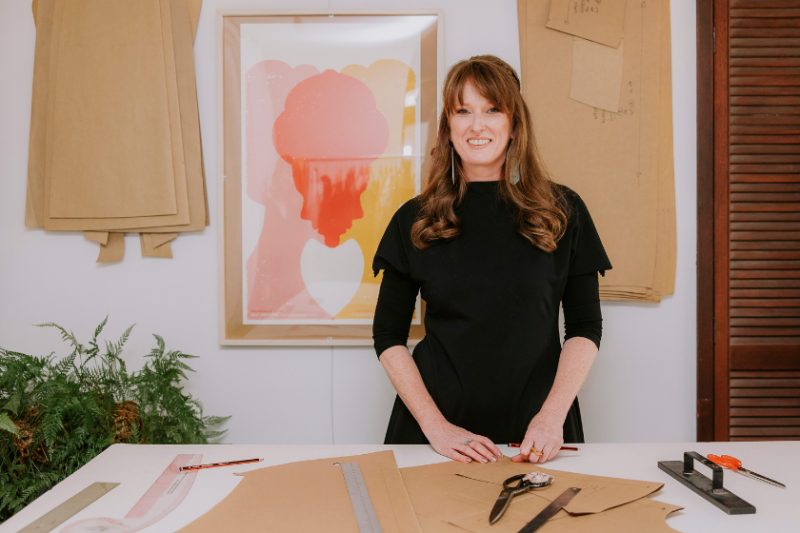
Best known for her Australian sustainable fashion label Pure Pod, Kelli is also the founder of circular and sustainable fashion brand KELI Studio, Kelli Donovan Studio – a service that offers consulting, mentoring, public education, and workshops in the sustainable fashion space – and is the co-founder of sustainable fashion festival Clothing The Loop.
An activist, educator and change maker, Kelli is a pioneer of the Australian eco-fashion movement and continues to lead the way when it comes to sustainable design practices.
What is ‘slow fashion’ to you?
Slow fashion is about purpose, ethics, and craftsmanship. It means designing with the full life cycle of a garment in mind – from fibre sourcing through to its end of life.
At its core, slow fashion also recognises the skill and creativity required to create stunning, cherished clothing. Transforming a flat textile into a well-fitted garment takes hours of design, patternmaking, fittings, and refinement – craft that is often undervalued in the age of fast fashion and dehumanised in the manufacturing. Even the cheapest clothing has less than 100 hands creating it from start to finish.
To me, slow fashion is an art and should be recognised for this.
How can people make more mindful, lasting choices when shopping?
Buy less, choose well, and value what you own.
When I started in sustainable fashion in the early 2000s, options were limited in wholesale organic and sustainable fabrics and what clothing consumers could purchase. Now, there’s far greater access to responsible materials and designs. Consumers can support this shift by choosing quality over quantity, prioritising natural fibres, and buying locally made clothing and supporting local designers.
Ask yourself: which pieces in your wardrobe have you truly loved and kept for years? Those are the purchases worth making and wearing for a long time.
Second-hand and vintage shopping is another powerful option. Op shops, vintage stores, and online pre-loved marketplaces offer unique pieces while extending the life of existing garments – and it’s often a fun, treasure-hunt experience.
Is “sustainable fashion” becoming a marketing buzzword? How do you cut through the greenwashing?
Yes, “sustainable fashion” can be misused by many small and large companies. The best way to cut through it is through education. Knowledge is power. Here and here are some resources to help inform your of the power of positive thinking in your clothing choices.
Learn about materials and processes, ask brands questions, and engage directly with designers. Transparency matters. If something is very cheap, made from synthetics, or lacks a clear story, it’s unlikely to be truly sustainable, and someone is paying the price down the supply chain for their cheap labour and producing synthetic textiles.
We are all affected by our clothing and consumer choices and the impacts they have on our bodies, as well as the world around us. As a designer, I believe we have the obligation to design and make things that should reduce impact, recycle and reclaim for the longevity of our health and environment.
What would the fashion industry need to change to make ethical consumption the norm?
We need to reduce overproduction and rethink our relationship with clothing in a personal way, as well as at a higher level in the creation of clothing in the fashion industry. We also need to integrate government laws across the globe and standards for manufacturing and waste to make ethical consumption the norm.
We need to consider on each of these levels of who is making it, where it is made, how it is made, and where it ends up at the end of its lifecycle. We can all do this by being mindful, living simply without excess, learning and asking questions.
Real change will come when consumers reject disposable clothing and support brands that prioritise quality, ethics, and longevity. Supporting local ethical designers and brands also strengthens community wealth, supply chains, and jobs within Australia and around the globe. It keeps highly skilled fashion industry workers and craftspeople in jobs to support their families and incomes in their local communities.
What do most people get wrong about the cost of ethical clothing in Australia?
Many people underestimate the time, skill, and cost involved in making clothing ethically and creating clothing with the intent of longevity.
Developing a single garment can take thousands of dollars in design, patternmaking, sampling, and production. Small-batch manufacturing, which is common for ethical brands, means these costs are spread across fewer pieces.
Producing locally with specialised ethical manufacturers also involves fair wages, higher-quality materials, and high-cost business overheads. Ethical clothing isn’t expensive – it reflects the true cost of making garments properly.
Can fast fashion brands genuinely reform, or is the business model the problem?
The unethical business model itself is the issue. Fast fashion relies on mass production, low costs, and rapid turnover – often at the expense of people and the environment.
While reform is possible in theory, it’s difficult within a system driven by volume and profit with no consideration for the people making it or the impact on the environment. These practices also undermine local designers, skilled craftsmanship and economies.
A future dominated by ultra-fast fashion would mean more waste, poorer quality products, and greater environmental harm and products made with no backstory or essence.
What’s the most common misconception about sustainable fashion?
A major misconception is that sustainable fashion only matters to people “interested in fashion.” In reality, it affects everyone because we all wear clothes.
Another is that it’s simply “more expensive.” While it can cost more upfront, it reflects fair labour, better materials, and longer-lasting garments. The bigger issue is awareness. Most clothing ends up in landfill, and synthetic fibres persist in the environment for decades.
We all have a role to play – buy less, buy better, repair, resell, and swap. Small changes in our habits can create meaningful impact.
To find out more about Fashion Revolution Week and how to get involved, visit fashionrevolution.org or follow @fashionrevolutionaustralia
Feature image: Mikhail Lipyanskiy.