From silence to the stage: How Leensaa Jarso found her voice to fight racism
Posted on
Leensaa Jarso knows the power of speaking up.
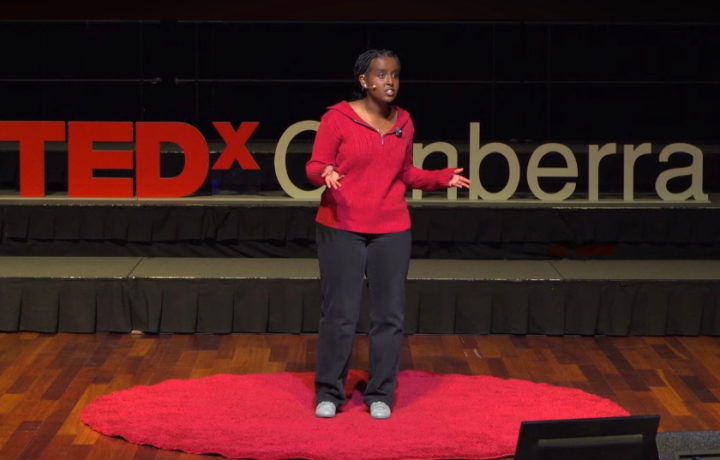
As a Year 12 Student at Canberra Girls Grammar School, she took to the TEDx stage to talk about internalised discrimination and to spark uncomfortable – but essential – conversations.
Here, the current ANU Law and International Relations student reflects on her journey, from how childhood experiences with discrimination shaped her identity, to why she chose to shatter her own silence, and why Australia urgently needs honest conversations about racism today.
I always loved watching Tedx Talks, they were my dad’s favourite. But if you told my younger self that I would one day do a Tedx Talk on racism, I would have laughed in your face.
I always thought Tedx Talks were only given by professionals, experts who had everything figured out. I never thought someone like me – a young black girl who is still learning how to make sense of their own racist experiences – would one day give a speech on how to overcome it.
But the truth is, this talk started long before I ever stepped onto that stage.
It started when I was seven years old, when my parents sat down and told me how this beautiful world is also an unfair one which will be hard to navigate as a young black woman.
Growing up, I treated my experience with discrimination like a bad haircut, something I tried to ignore until it eventually grew out or disappeared. But instead of disappearing, it grew inside me. I learned how to internalise it and I began questioning myself and my worth instead of questioning the situation itself.
But a part of me was always waiting.
I was waiting for someone to speak up about racism, even mention the word, so I didn’t feel like I was alone in my silence.
But as I got older, I realised that silence does not fix anything and it does not make the problem go away. It just leaves the room quiet for the more people to get hurt. Seeing racism affect my family and younger students was the breaking point for me. It’s one thing to develop thick skin for yourself but it is another thing entirely to watch a child begin growing theirs.

There is something so confronting about watching someone else go through something that you stayed silent about. It made me realise that silence does not make things go away, it allows things to continue.
This is why in my speech I described racism as:
“… a virus. If we don’t address it and you continue to stay silent, when it comes to the ‘R-word’. Then it will only grow and evolve and adapt and find new ways to infect our society”.
I realised I could not keep waiting for someone else to stand up, start the conversation, and address racism for what it truly is. I decided that I was going to be that person for my sister, for the younger students who needed someone to look up to and for myself.
Because once you stop internalising it and start talking about it, things begin to change and you start to feel a bit better.
When Tedx Canberra Youth announced they were having an event and looking for speakers, I was in Year 12. I was a captain at school and after delivering a speech on Harmony Day, I felt I had already started creating change in the way racism was discussed within my school community.
When I applied for Tedx, it felt like an opportunity to create change beyond the walls of my school.
When I found out I was selected as a speaker, I was shocked. I did not think I had what it takes to be a Ted Talker; someone people would want to listen to.
But when I began writing the speech, I realised something important: I had to stop waiting for someone to talk about something I felt so passionate about. I have to be the one that signs up, shows up and speaks up.
Submitting my TEDx application felt terrifying. I knew the topic wasn’t easy or light, but it was necessary, needed to be done and long overdue. We don’t talk about racism enough and I wanted to start a conversation in Australia.
This is why I want people to use my 3L’s as I stated in my speech.
“Listen to the stories of those affected by racism. Learn about your own biases and the history and impacts of racism. And finally, lead by example”.
Standing on that stage, from multiple rehearsals to the big night, I felt like I belonged there.

I felt like I was speaking to my younger self, trying to be the voice that I once needed to hear. I was speaking from lived experience and hope. Hope that conversations like this could be more normalised, more open and less uncomfortable. Because real change comes from not avoiding difficult conversations but rather confronting them.
Standing on that red circle, I wasn’t just delivering a speech.
For the first time, I felt comfortable in my own skin to use my voice.
And I learned that using your voice does not require perfection.
It simply requires the willingness to start.
To start the uncomfortable conversation.
To listen.
To learn.
To lead.
To challenge the silence and become the person you once needed yourself.