How I Got Here: Dr Marie-Louise Ayres, former Director-General National Library of Australia
Posted on
Admit it, we’ve all been there – stalking social media and LinkedIn profiles, trying desperately to figure out how the hell someone got their dream job.
It seems impossible, and yet there they are, living out your career fantasy (minus the itchy business suit). It might seem hard to believe, but once upon a time, they were also fantasising about their future career, and with some hard work, they made it.
Welcome to How I Got Here, HerCanberra’s series that reveals everything you want to know about the secrets of career success.
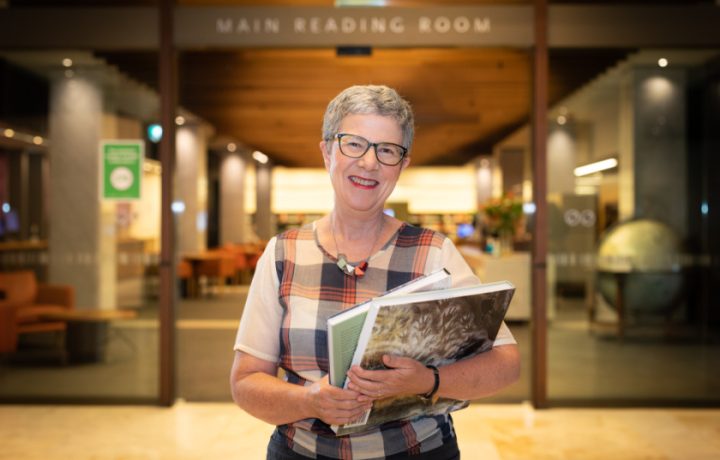
This week we feature Dr Marie-Louise Ayres, who retired in April as Director-General of the National Library of Australia after nine years in the role, 24 at the Library and more than 30 in the profession.
Existential crisis time: Who are you and what do you do?
Still the same person I was before retiring as Director-General of the National Library of Australia in April: feminist; optimist; smiler; proud public servant; happily married for 45 years; mother, grandmother, daughter, sister and friend; reader; nature lover; cook; person who likes doing things with her hands.
No crisis, just the adventure of taking time to curate a different kind of life after a profoundly satisfying (and surprising!) career.
Let’s go back to when you were a kid, have you always dreamed of working in this industry?
No! I always loved libraries – but that’s because I loved reading, and studied literature to PhD level, not because I ever saw myself working in a library (I didn’t really have any career plans, just kept immersing myself in what I loved). I fell into a library job completely accidentally towards the end of the PhD. I’ve never regretted it.
Tell us about when you were first starting out, what set a fire in your belly to get here and how did you do it?
I realised very soon after starting my first library job (focused on Australian literature, my academic subject) that I could be very happy in that world. I must have been incredibly annoying, because I was always asking ‘Why do you do it that way?’, ‘Could we do it differently?’. I think I was good at joining the dots, and at thinking – and acting – in ways that focused on maximising opportunities for scholars and learners to find the information they wanted.
Recall a time when you wanted to chuck it all in; what did you tell yourself when it got too hard?
Towards the end of my first five-year term as Director-General (early 2022), I really did contemplate chucking it in. Leading through COVID was tough for any CEO, and the Library had major infrastructure and financial issues that were really difficult. I reminded myself of a phrase I heard former Irish President Mary Robinson use in an interview with former Prime Minister Julia Gillard, about ‘steadying herself’ in tough times. And I had rock-solid support from my family, friends and executive team. I’m so glad I didn’t finish up then!
What was your biggest break?
Looking back, there were three points in my career when I got the opportunity to step aside from the day to day and learn deeply; a travelling fellowship five years into my career that saw me visiting special collections libraries in the US and UK; a travelling fellowship 13 years into my career that saw me visiting more special collections libraries in the US and Canada – and gaining the information needed to implement a transformative system at the Library; and an immersive senior leadership program for the library profession shortly thereafter. My institutions invested in me each time; with the benefit of hindsight, those investments paid off.
What’s the best piece of advice you’ve ever received?
Stay true to yourself. I have never, at any time in my career, felt anything other than my authentic self. That provided a strong sense of coherence between my inner and public selves that stood me in good stead.
What is it about your industry that you love and what makes you want to pull your hair out?
The library industry – worldwide – is so committed to serving current and future communities. I’ve always loved that sense of being ‘in service’ to the knowledge seekers of today and tomorrow. The Australian library industry is almost uniquely collaborative – and that nation-wide collaboration is one of the things I found most satisfying in my career, and that I will miss most.
Pull my hair out? Nothing to offer there. I think the industry does a wonderful job at engaging in big issues (how do we engage respectfully with First Nations people? How do we think about and engage with AI? How do we ensure the freedom to read in a time when that is under threat? What is our role as part of the democratic infrastructure?).
Some parts of the academic community might like us to move faster or to prioritise their needs and indeed, a few have been extremely rude in expressing their view on this. But I’ve always believed that the industry’s approach of radical incrementalism and a very long view serves our community best.
Tell us how you ‘stay in the know’, what media do you consume?
I do not consume any social media at all – I choose not to waste my time in arenas that provide some positives, but are controlled by large corporations that do not have public interest at their heart. I also choose not to be provoked into outrage by algorithms – ‘steadying myself is still a key factor I how I approach the big issues of the day.
So I’m old school – I read the Canberra Times, ABC News, Guardian, and The Conversation every day, the NY times several times a week, and watch SBS or ABC TV news a couple of times a week. Weekend newspapers were an occasional treat during my last few years of working – there was far too much weekend work to allow for that.
During my time as Director-General, I really was ‘scanning’ for anything I thought we needed to be aware of – and shared that as required, often very early in the morning! I suspect I’ll now engage in more long-form news reading.
Where do you see yourself in five years?
Physically – still in my beloved Ainslie, out in nature every day! And based on the wonderful examples of ‘retired’ people around me, I expect that I’ll have settled into a rhythm that will include service to the community (putting my decades of learning to use in new ways), time with people and activities I love, and – I hope – still learning.
Why should people follow in your footsteps?
They shouldn’t! I truly believe that following one’s own heart and passions leads to really satisfying work lives, and I am privileged I’ve been able to do that.
But if the question is why people should follow in the library profession or the broader cultural profession or the broader public service, it’s that there are such deep satisfactions in working with teams over the long term to serve our fellow Australians.
While in my NLA role, I often reminded staff that we got lots of immediate ‘pay-off’ from that service – we could see, speak with, and engage directly with those benefiting from our work. There is so much honourable work across public services where excellent people work diligently on behalf of others for decades, without getting immediate satisfaction.
What advice would you give your past self?
I had a birthday recently, and my husband gave me a beautiful watercolour portrait he’d painted, based on a photograph taken in 1999 (in fact, while I was on that first career fellowship). I look at that past self – and the further past self who married at 18, had three children by the time I was 24, started a PhD when they were 1, 3 and 5 – and think ‘you did all right. You steadied yourself. I’m proud of you’.