How I got Here: Dr Sophie Lewis
Posted on
Admit it, we’ve all been there—deep dive stalking social media and LinkedIn profiles, trying desperately to figure out how the hell someone got their dream job.
It seems impossible and yet there they are, living out your career fantasy (minus the itchy business suit). It might seem hard to believe, but once upon a time, they were also fantasising about their future career, and with some hard work, they made it.
Welcome to How I Got Here, HerCanberra’s series that reveals everything you wanted to know about the secrets of career success. Our second subject is Dr Sophie Lewis, ACT Commissioner for Sustainability and the Environment.
Existential crisis time: Who are you and what do you do?
My job is the Commissioner for Sustainability and the Environment. This role provides an independent voice for the environment in the ACT and aims to improve the environment and sustainability of our city.
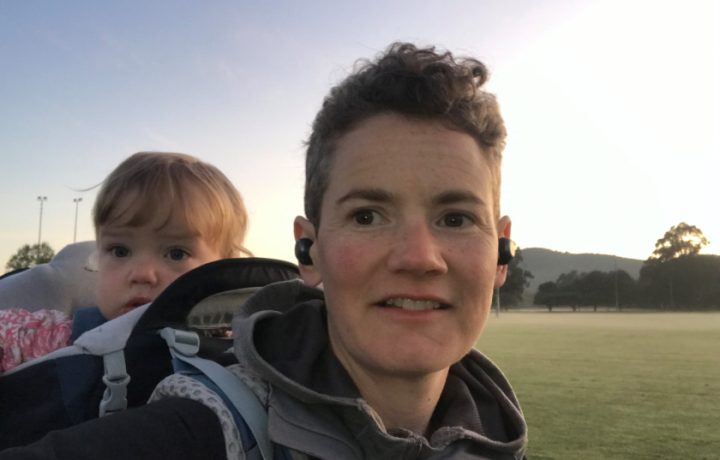
While that’s my job, most of the time I am leaving meetings in a rush to pick up one of my kids (Morgan is 5 and Ash is 1), or messaging my wife to find out who is responsible for putting the potatoes on for dinner, or trying to make our whippets behave (Flip is 6 and the puppy is called Honey, but Morgan was desperately keen to name him Jason). Occasionally I have the energy for running and have now hit an age when I’m required to admire native birds.
Let’s go back to when you were a kid, have you always dreamed of working in this industry?
I’ve wanted to be a scientist since I was four-years-old and my parents took me out stargazing. I was very lucky to have family, friends and educators who encouraged my interest in science and allowed me to pursue my interest in our natural world. On reflection, part of that may have been 1980s relaxed parenting that allowed me to roam around picking up bits of old bone and feathers for my collections. Either way, it was wonderful to have been gifted the chance to explore.
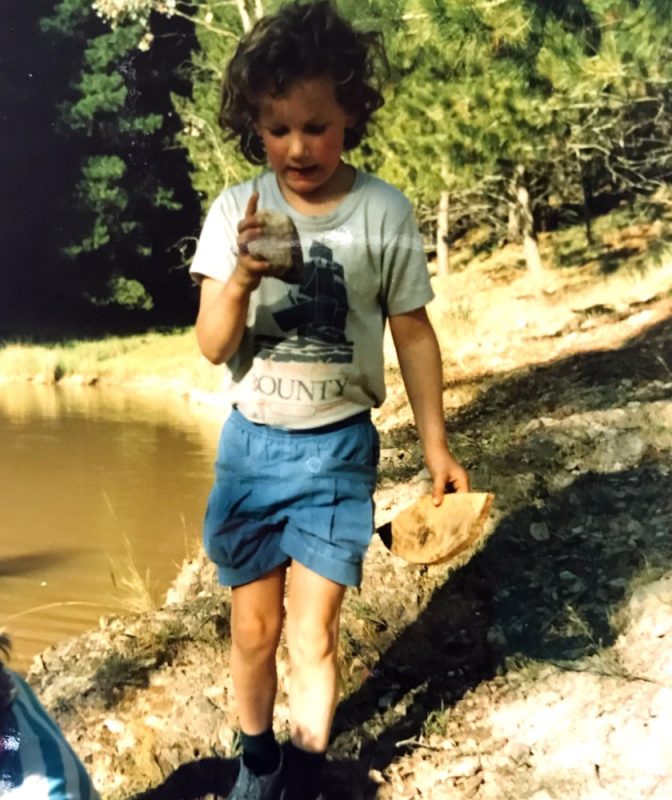
Young Sophie collecting heck knows what as part of her nascent scientific exploration
My dream as a kid was to be a scientist and discover our world. I do that a bit differently now but it’s definitely been a lifelong passion.
Tell us about when you were first starting out, what set a fire in your belly to get here and how did you do it?
Throughout my academic career I was never particularly interested in the technical aspects of the science. The details were always a bit of a chore. For me, the work was always about the environment and valuing our natural world. I was particularly driven by this commitment to our environment at university and in the early years of my career as a postdoc.
Recall a time when you wanted to chuck it all in; what did you tell yourself when it got too hard?
This is me nearly every day. I’m quite a reactive person and it’s not uncommon for me to declare I’m packing it all in and becoming a dog walker. But it turns out I don’t chuck it in daily. I’ve had decades now working on issues of climate change, environmental degradation and biodiversity loss and throughout that I’ve gained a lot of resolve. When work gets tough, the challenge gives me a lot of resolve to continue to speak for the environment.
Back in 2020 I did end up chucking it all in. In Canberra, we’d had weeks and weeks of endless thick smoke, searing heat, catastrophic fires and drought. On New Year’s day 2020, the smoke was horrifically unpleasant and by mid-morning on New Year’s day we knew we had to leave or take a gamble on permanent damage to our health.
For two weeks, by day I had a strangely normal summer holiday in Hobart with my brother and sister-in-law and my baby nephew — long days of beach and playgrounds and babycinos and trips to feed kangaroos at the wildlife sanctuary. At night I put my daughter to bed and cried in grief for our land, our animals, our people. At that time, I was an academic and lead author for the Intergovernmental Panel on Climate Change. My expertise was on climate change and extreme events in Australia.
I knew I had to quit. I knew that continuing to work as an academic, lecturing and writing scholarly papers was no longer something I could do. I wanted to contribute more tangibly, to see outcomes and to focus on our city, not insurmountable global issues. Sometime chucking it all in is the best decision you can make.
What was your biggest break?
One hundred per cent meeting my wife at the old worn out ANU gym back during my PhD days. She’s the most steadfast support, she builds me up, and tells me when I’m being ridiculous when few others do. I cannot imagine I would have any comparable professional successful and certainly not my beautiful family without her. Luckiest break ever!
What’s the best piece of advice you’ve ever received?
My first postdoc supervisor sat me down one afternoon and said “Sophie, it’s amazing what can happen if you ask for what you want”. He was quite right. I’d had a very bruising PhD experience with a long period of having been bullied and came into that role with very low confidence. David saw a lot in me and helped build me back up, including encouraging me to articulate what I wanted and expected.
What is it about your industry that you love and what makes you want to pull your hair out?
In my current role as an individual statutory office holder I am part of the ACT Public Service. I don’t particularly identify as a public servant but love elements of it. I love how many of my colleagues are so deeply committed to serving Canberra and its people. I get very (!) frustrated by situations or cultures that curb imaginative thinking and fall back on processes or systems or structures that limit good outcomes.
Tell us how you ‘stay in the know’, what media do you consume?
I’m not sure I remain ‘in the know’. Until recently I really valued social media for hearing different perspectives and voices that weren’t present in my life in-person, and for staying up-to-date across a range of issues. I relied heavily on twitter but didn’t feel like I could stay there any longer and am now working out how I stay in the know without it. It’s been tremendously valuable for me to be less in the know, and to recognise that consumption of media comes at a cost to personal energy.
I think I have a better balance now in more deliberate reading of news and particularly listening to podcasts. My son is an early bird and usually up around 4am, so I get lots of podcast time on early walks together.
Where do you see yourself in five years?
This is such a tricky question to grapple with. I’m so deep in the time of young children, of endless hand, foot and mouth and gastro outbreaks, washing nappies, making school lunches and sleepless nights that I can’t imagine life in five years. My role continues for another two and half years, over that time my wife and I will likely decide who will work full-time and who will be primary school mum. Short answer? Probably messaging my wife to see whose turn it is to put the potatoes on and who will take the kids to gymnastics.
Why should people follow in your footsteps?
Nobody should follow in my footsteps! Nobody! My career sounds like it has been a considered and deliberate progression but it has been a series of poorly-considered decisions, reactions and mistakes that have lead beautifully but circuitously to my current role. I have the best job in Canberra so no complaints from me. But it has been haphazard and nobody should emulate my way. I do encourage everyone to be equally unafraid of making mistakes and taking missteps in their commitment to their values.
What advice would you give your past self?
I wouldn’t mind time travelling back 20 years to tell a less grey-haired Sophie that work isn’t everything. While I have always a great work-life balance in terms of the time I spend in each domain, it took the enormous disruption of the pandemic for me to realise that there are so many ways to be content and spend energy and achieve ambitions that aren’t within our professional lives.