How I Got Here: Nicole Henry, Head of Government Affairs for Australia and New Zealand at Fortinet
Posted on
Admit it, we’ve all been there – stalking social media and LinkedIn profiles, trying desperately to figure out how the hell someone got their dream job.
It seems impossible, and yet there they are, living out your career fantasy (minus the itchy business suit). It might seem hard to believe, but once upon a time, they were also fantasising about their future career, and with some hard work, they made it.
Welcome to How I Got Here, HerCanberra’s series that reveals everything you want to know about the secrets of career success. This week we sit down with the Head of Government Affairs for Australia and New Zealand at Fortinet, Nicole Henry. Nicole’s career has taken her from science and innovation policy to international diplomacy, trade, national security, and now cybersecurity. Over more than two decades, she has built a career in roles that sit at the intersection of government, industry, technology, and Australia’s national interests.
Today, Nicole leads Fortinet’s government affairs work across Australia and New Zealand, working across government, industry, and academia on cybersecurity, critical infrastructure, and digital trust. She is also continuing to invest in her own development and is currently completing an MBA in Technology and Change at the Australian Graduate School of Management. Here, she shares her career journey.
Existential crisis time: Who are you and what do you do?
During the week, I’m Head of Government Relations for Fortinet in Australia and New Zealand. Cyber is certainly one of the most interesting industries to work in right now!
I’ve had a fascinating accidental career spanning law, government, science, technology, and international diplomacy. After more than 20 years in the public service, I’ve moved to the private sector where I get to bring those experiences together. Governments are shaping the way technology is developed, regulated, and used, while industry is on the front line of protecting the systems and services we all depend on. I love being able to connect those two worlds and help turn policy ambitions into practical outcomes.
Outside work, I’m a very proud mum, an enthusiastic traveller and adventurer, and happiest when I’m exploring somewhere new, preferably near the ocean.
Let’s go back to when you were a kid, have you always dreamed of working in this industry?
Not at all! Cybersecurity as we know it today didn’t even exist when I was growing up. But I’ve always been curious. I’m one of those people who doesn’t just want to know how something works. I want to understand the what, how, and why, and how everything fits together. I’m constantly disappearing down intellectual rabbit holes, and that’s something I’ve never grown out of.
I started my career in the legal profession, running a paralegal practice in a boutique law firm before moving to Canberra and joining the Australian Public Service. It was excellent grounding for my career, teaching me to navigate complexity, think critically, and find practical solutions. From there, my career took me into science, technology, innovation and industry policy, and eventually cybersecurity. I didn’t set out with a plan to work in cybersecurity, but looking back, there’s a clear thread connecting the different stages of my career.
Tell us about when you were first starting out, what set a fire in your belly to get here and how did you do it?
I’ve always had a lot of drive and energy, and I’ve been motivated by doing work that matters. I love solving complex problems, particularly when there are competing interests, no obvious answer, and an opportunity to make things work better.
I’ve never been particularly good at standing still. I worked on quite a few task forces during my time in government, and I loved the pace, the challenge, and the opportunity to make things happen. I’ve never had much patience for sitting around talking about what needs to change. I’d much rather get on with it! But I’ve also learned that being driven doesn’t mean operating at full speed all the time. When everything is moving quickly, sometimes the smartest thing you can do is slow down, take a breath, and give yourself space to think. It helps you keep perspective and make better decisions.
Recall a time when you wanted to chuck it all in; what did you tell yourself when it got too hard?
There have certainly been difficult periods, both professionally and personally. My mantra has always been “one foot in front of the other”. It’s deceptively simple, but it’s carried me through some incredibly challenging times.
When you look at the whole mountain, it can feel overwhelming. But there’s going to be an outcome one way or another, so I focus on what I can control, break things down into manageable pieces, and take the next step. You don’t have to solve everything at once. And I certainly don’t do it alone. I’m incredibly fortunate to have amazing people in my life who I trust completely and can lean on when things get tough. That’s something I value enormously.
Sometimes just getting through the day is enough. You don’t have to be the best version of yourself every single day.
What was your biggest break?
I’ve had some extraordinary opportunities throughout my career, including representing Australia at the World Trade Organization. But two experiences really stand out.
The first was co-leading the development of Australia’s National Hydrogen Strategy with Dr Alan Finkel, Australia’s Chief Scientist at the time. We had an incredibly talented and committed team, and a sector that was genuinely engaged. It was one of those wonderful opportunities where everyone was pulling in the same direction, and you could see what was possible when government, industry, and researchers came together.
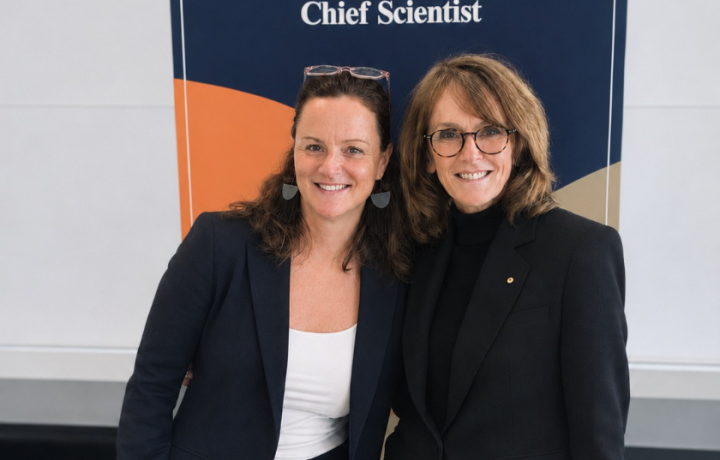
The second was becoming Chief of Staff to Dr Cathy Foley, who succeeded Alan as Australia’s Chief Scientist. Cathy is someone I admire enormously. She combines extraordinary intellect with genuine curiosity, integrity, and humanity. It was a privilege to work alongside her and engage with remarkable people across science, government, research, and industry.
Both experiences reinforced something I’ve believed throughout my career: great science and technology matter, but so does our ability to turn them into real economic and community benefits.
What’s the best piece of advice you’ve ever received?
Keep pushing, but be patient. The pushing part comes fairly naturally to me. Patience has required a little more practice!
There’s an important difference between being tenacious and being dogmatic, and that nuance matters. You can be absolutely committed to an outcome without being wedded to a particular way of getting there. I’ve learned that changing minds is rarely about winning an argument. It’s about understanding different perspectives, knowing when to challenge the thinking and when to listen, and bringing people with you.
Sometimes persistence means pushing harder. Other times it means stepping back or reconsidering your approach. Knowing the difference is where judgement comes in. I’m still working on the patience bit!
What is it about your industry that you love and what makes you want to pull your hair out?
I love the mission. Technology is everywhere, and cybersecurity is fundamental to our national security, our economy, and the way we live.
And there’s never a dull moment! From cyberattacks affecting supermarket freezers in France to the growing use of AI to find and exploit vulnerabilities, the threats are constantly evolving. The innovation happening on the defensive side to keep pace is equally fascinating.
I also love the intellectual challenge. There are some extraordinary minds working on problems that really matter, and there’s always something new to learn.
What makes me pull my hair out? Not much, really. I try to maintain perspective! If anything, it’s the growing regulatory burden. The Australian Government has done a lot of work this year to improve alignment, but there’s still plenty of room for improvement internationally.
Greater consistency would reduce the compliance and assurance burden on businesses and technology providers, freeing up more time and resources for what really matters: defending against cyber threats.
What was your biggest ‘pinch me’ moment?
I’ve had a few, but being posted to Jakarta as Australia’s first Industry, Science and Resources Counsellor was certainly one of them.
Working for the Australian Government in an embassy is an extraordinary privilege, and one that was never lost on me. I had the opportunity to represent Australia and work with the Indonesian government, industry, and research partners to strengthen cooperation in areas including critical minerals, batteries, and electric vehicles.
I loved the diplomacy, the people, the culture and the opportunity to build relationships between two countries with so much to offer each other. Indonesia is a fascinating country, and the people are wonderful. I travel back as often as I can, and it now holds an incredibly special place in my heart.
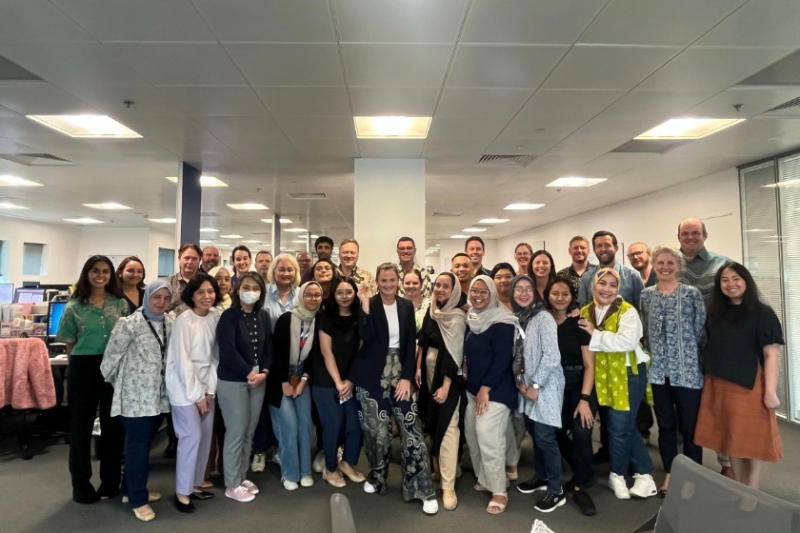
Nicole Henry in Jakarta, 2025.
Tell us how you ‘stay in the know’, what media do you consume?
I get my daily updates from InnovationAus and The Mandarin. I also follow Gartner, Forrester, and The Economist for research, analysis, and emerging trends.
I’m a big fan of Stanford University’s Entrepreneurial Thought Leaders podcast, produced by its Technology Ventures Program. It has some excellent conversations about innovation, entrepreneurship, and turning ideas into reality.
I also watch both the ABC and Sky News. I think it’s important to understand different perspectives, challenge your own assumptions and form your own views rather than simply gravitating towards opinions you already agree with. And some of my best insights come from conversations with interesting people. I’ve been fortunate to work across science, technology, government, and industry, and I love making connections between ideas that don’t initially seem related.
Where do you see yourself in five years?
I’ll still be doing interesting, meaningful work, learning, and challenging myself. With cybersecurity and technology evolving so quickly, I can’t imagine running out of things to be interested in. But I’m also increasingly conscious that life is about much more than work.
I’m a proud mum; I love spending time with the people who matter to me, and I have a literal bucket list of places to visit and adventures to experience. I intend to keep working my way through it! I’d also like to be spending plenty of time underwater, exploring somewhere beautiful, followed by a margarita on the beach. Interesting work, good people, new experiences, and time with those I love. That’s a pretty good life in my book.
Why should people follow in your footsteps?
I’d encourage people to find their own path rather than follow in my footsteps. I’ve had a fascinating career, but it certainly wasn’t mapped out when I was 20. I’ve taken opportunities, moved between disciplines, made some unconventional decisions, and followed my curiosity into areas I couldn’t possibly have anticipated. What I would encourage people to consider is a career where they can contribute to something bigger than themselves.
Policy, advocacy, and government relations aren’t always the careers people immediately think about, but they offer extraordinary opportunities to help shape the way our economy and society function. And you don’t need to be a scientist to work in science policy, or a technologist to contribute to technology policy. Different perspectives and experiences can be incredibly valuable.
Be curious, build relationships, act with integrity, and don’t be afraid to challenge yourself. Most importantly, don’t confuse other people’s expectations with your own ambitions.
What advice would you give your past self?
Do the things. Take the opportunity. Book the trip. Have the conversation. Go on the adventure. Back yourself. Don’t wait until you know everything or have every possible risk worked out.
And make time for the people you love. I’m incredibly proud of my career, but the thing I’m proudest of is my daughter. Being her mother means the world to me. One thing I’ve learned is that we’re all replaceable in the workplace, no matter how important we think our jobs are. But we’re not replaceable in the lives of the people who love us.
We live in a fast-paced world, and it’s easy to get caught up in the next deadline, the next achievement, or the next opportunity. Work hard, do things that matter, and make a contribution. But don’t forget to enjoy the life you’re working so hard to build.