How I Got Here: Migrant and refugee health expert, Professor Rose McGready
Posted on
Admit it, we’ve all been there – stalking social media and LinkedIn profiles, trying desperately to figure out how the hell someone got their dream job.
It seems impossible, and yet there they are, living out your career fantasy (minus the itchy business suit). It might seem hard to believe, but once upon a time, they were also fantasising about their future career, and with some hard work, they made it.
Welcome to How I Got Here, HerCanberra’s series that reveals everything you want to know about the secrets of career success.
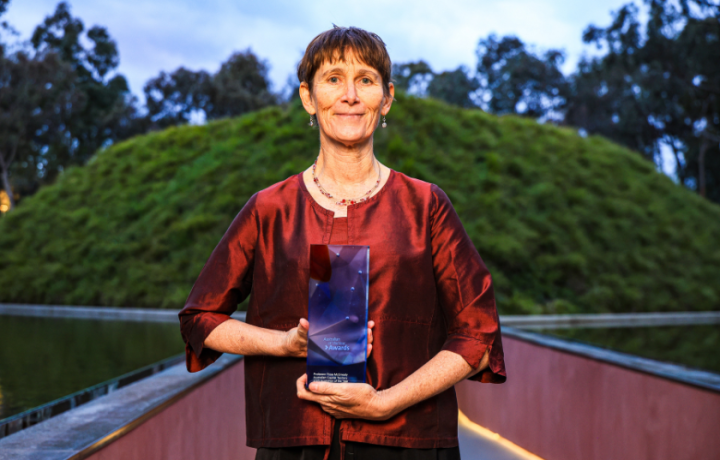
Professor Rose McGready has devoted her life to improving the health of vulnerable people. Spending three decades providing health services to displaced people in the border region between Thailand and Myanmar, her work has saved thousands of lives.
Here, we sit down with the 2026 ACT Australian of the Year to talk about how her commitment, compassion and clinical expertise have led to helping some of the most vulnerable communities in the world.
Existential crisis time: Who are you and what do you do?
I’m Rose McGready, an Australian-trained doctor (Sydney University). I love home (Canberra) where I grew up and I like adventure – somehow a six-month volunteer adventure turned into 32 years working in healthcare with refugees and migrants at the Thailand-Myanmar border.
Let’s go back to when you were a kid, have you always dreamed of working in this industry?
I really did not know what I wanted to do. I liked most things: school and sport, and most people, and my brothers taught me to have adventures. We did some very risky things – which could have turned out differently. When I was a kid, I thought Australia was so big I would never finish seeing it in my lifetime. We grew up in an era where screentime was restricted to one hour a day. Our screentime role models were Skippy, The Flying Nun, Uncle Martian and Zorro. We mostly played.
Tell us about when you were first starting out, what set a fire in your belly to get here and how did you do it?
I was offered a trial period at the Australian Institute of Sport for swimming while studying stats and maths at ANU. I didn’t take it because I would not be fast enough (hard decision). I switched to study Medicine at Sydney Uni, worked in Darwin, wanted to go to Africa so studied tropical diseases in Liverpool in the UK, but landed in Asia.
Recall a time when you wanted to chuck it all in; what did you tell yourself when it got too hard?
That has happened more than once. I think growing up in a family where handling loss, quite literally dodging a chucked tennis racket because the game was lost, lent a sort of hardiness and humour to difficult times.
At my worst…a friend, Leanne Stafford (Canberra girl!), realised, and said she would miss me. That was enough to prevent a suicide. Leanne died in a car accident at a young age, and the guilt has never left me. Leanne keeps me going in hard times – I live for both of us. I’m so glad that years after we graduated from Medicine she could come and see what work and life at the border was like. She came at a ‘good’ time and had the opportunity to travel into Burma for the day with me, help at the clinic, see elephants and deliver babies.
What was your biggest break?
What do I say here? Not winning a medal at the 1982 Commonwealth Games trials? I promised myself if I didn’t get a medal, which I missed out on by one hundredth of a second (I got fourth place), that I would quit swimming. It changed my direction completely, and that landed me in a refugee camp called Shoklo (it’s a river) with a team of Karen, Burmese, Thai, and a few Europeans who were dedicated, caring, pragmatic, proactive problem solvers and accepting of my incomprehensible Australian accent. Why? Our decades of work on malaria changed the World Health Organisation guidelines on treatment in pregnancy (also in non-pregnant). The work is an excellent example of implementation science with studies at the frontline impacting the people at the frontline who were dying and getting sick from malaria, including losing their babies from malaria in pregnancy. It was a terrific lesson in conducting research to make a difference, and I have applied it to so many aspects of our work on mother and child health at the border. It has saved thousands of lives locally and globally.
Through the Borderland Health Foundation, we support humanitarian work amongst marginalised populations who have fled conflict and conscription, who are sheltering in Thailand but mostly want to return home to a safe Myanmar.
Through Shoklo Malaria Research Unit, a field station of the Faculty of Tropical Medicine, Mahidol University, Bangkok, Thailand, and part of the Mahidol Oxford Tropical Medicine Research Unit (MORU) supported by Wellcome (UK), we continue to research topics that impact the daily lives of marginalised populations and prevent them from reaching their full potential. A significant emphasis is placed on maternal-child health and infectious diseases such as TB and malaria.
And the 2026 ACT Australian of the Year (AOY) award can’t go unmentioned as a big break. It was unexpected but a wonderful way to reconnect to ACT after decades away, washing away feelings of loneliness. It was awe-inspiring to see the amazing work of the AOY nominees in ACT: Karen Schlage CF, Lauren Cannell and Sarah McGoram OAM. I feel we should have conspired to join hands and take the stage as a well-connected clique.
What’s the best piece of advice you’ve ever received?
“Will you just get on with it!” from my mother (use an exasperated voice), when I was procrastinating. Sometimes we just need to finish something. It isn’t going to be perfect but it lets us move to the next step.
What is it about your industry that you love and what makes you want to pull your hair out?
A lot of the people I work with have not had the opportunity for education, such as a degree in midwifery. Myanmar is a mess. Recurrent coups and conflict have sent health AND education backwards and robbed youth of valuable years of learning. Those intern years in medical education when mentors give you a solid grounding are also lost. The Australian education system that put me in one end and pushed me with the other was a privilege – I am grateful. What delights and amazes me is how much our local staff manage to achieve from local training despite those missing years of what is normally government-supported education.
I can’t pull my hair out. I don’t have much. Power, greed and inhumanity – what we see all too much of in the 24-hour media – I have not got time for those people. It is accentuated most days when I witness those with less helping out their neighbour. It is humbling and motivating to continue to try to help here. I have learned so much from people here.
Tell us how you ‘stay in the know’, what media do you consume?
I’m not that good at staying in the know. My Dad told me about the tragic 2004 tsunami in Thailand when we had our Christmas call. I try to get different perspectives on news by checking out less mainstream services.
Where do you see yourself in five years?
Trying to fit in adventures to support the Dr Rose McGready Foundation …maybe in Canberra? I don’t know. Work a bit more on overcoming my awkwardness.
Why should people follow in your footsteps?
They shouldn’t. Each of us has our own uniqueness – and our paths will likewise be unique. We can all help those less well off than ourselves or make people smile, and we should do that through our uniqueness, using whatever strengths our genetic lottery gave (or didn’t) give us.
What advice would you give your past self?
Doesn’t matter; I wouldn’t have listened 😊
Feature image: Australian of the Year Awards ACT © Salty Dingo 2025.