New local podcast puts the spotlight on ADHD
Posted on
When Callie Barrett’s GP first approached her about ADHD, her first reaction was to dismiss it.
As a 43-year-old woman in a senior role in the public service, she didn’t think she fit the bill.
“I was very anti-it, I thought it could definitely not be me,” she says.
“I felt the narrative in social media was aimed at people younger than me and was very deficit focused, looking at how dreadful life could be with it.”
It wasn’t until earlier this year, when her symptoms started filtering into her home life, that Callie finally accepted the diagnosis.
“There were big things and small things, for example, I have shocking time blindness and need multiple alarms and live by post-its—if it’s out of sight it’s out of mind. There’s also a lot of rejection sensitivity, and being really sensitive if you get criticised,” Callie says.
“I was managing these things at work, but all this anxiety and rage was coming home with me, so that was probably the catalyst [to finally accepting it]—I was managing it, but at a big cost because I was masking it too.”
While she and her husband Lauchy were looking into the research around ADHD, an idea for a podcast was born.
“At the time, it became clear my seven-year-old daughter had ADHD as well,” Callie said.
“Lauchy and I were struggling to find information, and we thought we needed to change the narrative. There wasn’t enough information for people who were looking for what we were looking for—none of it was really aimed at professionals or people who had families, so we decided to do it ourselves.”
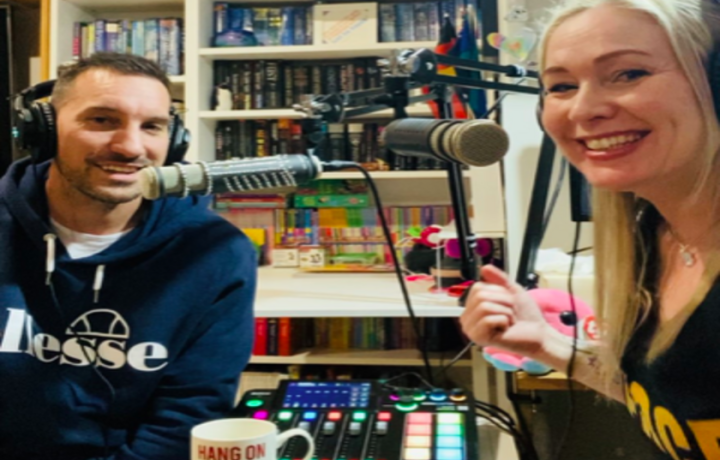
Lauchy and Callie in the studio.
Callie and Lauchy spent hours researching for the podcast, mapping out 100 ideas for episodes and assessing the risks.
They officially launched the podcast last month, cheekily named FthemFish: ADHD for grownups (referencing a meme about an octopus who punches fish).
Discussion topics so far have included the dilemmas around finding a diagnosis, ADHD and Autism Spectrum Disorder and the perspectives of partners of neurodivergent people.
“We’re different in that our content is relatable and light, but you can still get something from it,” Callie says.
“We didn’t want to be too dark, we wanted to add some humour too.”
Since the podcast launched, Callie says the response has been “phenomenal.”
“Literally on a daily basis we receive responses from people all over the world who listen in Canada, the US, the UK, Belgium Indonesia and Malaysia,” she says.
“They say ‘I’ve just found your podcast, and we’ve been looking for something like this for so long.’”
As well as being informative, Callie hopes the podcast will create a supportive space for neurodivergent people.
“We know kids with ADHD receive more criticism by the age of 10 than neurotypical kids, and we know there are more suicide rates among neurodivergent people, so I think that’s why this is really important, because it’s going to encourage people to have a conversation rather than internalising,” she says.
Since telling people about the podcast, Callie says she has had many people—even her staff—come forward and say they are neurodivergent.
“As someone who is in a leadership position, I’m going to be open, and transparent and show ADHD doesn’t have to be a restricting factor,” she says.
“Even though I know I’m putting myself out there and it can be terrifying, if I can provide a community where people feel they can come forward and feel supported, then it’s worth it.”
You can listen to Callie and Lauchy’s podcast via Spotify here or follow @fthemfish_adhdforgrownups on Tiktok or Instagram.