The writing of ‘Cicada’ – a local woman’s journey to the heart of Australia
Posted on
is a woman of many talents. As well as being a writer, she is trained as a doctor. Having graduated from the University of Western Australia, she specialises in population health and infectious diseases, and has worked as a GP in the Kimberley, as well as lived in Canada, where, she says, her two sons developed an obsession for ice hockey. She is currently living in Canberra, working for ACT Health.
Moira’s inspiration in her writing is her mother, Fay. Fay grew up in rural Western Australia and was from a “fairly poor” background, but had always nurtured a love of books and writing. According to McKinnon, her mother was part of the local writers’ club and published pieces in their newsletter. However, she couldn’t always finish them, so Moira, her brother Alex and her sister Heather used to help her – they were her “ghost writers”. McKinnon tells me, “We sure got a kick seeing ‘our’ pieces in the newsletter.”
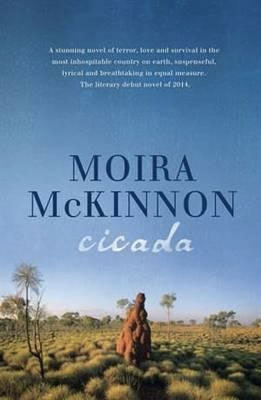
So from ghost writer in a writers’ club newspaper to published author, McKinnon’s first novel, Cicada, is set in the remote Kimberley, and explores the journey of two women – one a wealthy English woman, the other her Aboriginal servant – as they attempt to survive in the alternatively hostile, alternatively nurturing landscape. It charts not only the progression of their physical journey, but also the development of their relationship.
At a recent literary lunch held by Paperchain Bookstore and Nibblez Catering, Moira explained how she began to write Cicada; how, one day, she decided that she wanted to write a novel that would never be published, that no one would ever read. And with the snow falling outside her window in Canada, she resolved to set it somewhere hot – hence its setting in the dusty, scorching heat of remote Northern Australia.
Moira also discussed why she writes. While she acknowledged that people write for all sorts of reasons – to entertain, for the love of the language, for deep reasons, to let the imagination fly – she made the following observation: “And then there are people who write just because they cannot not write. And when I started Cicada I was one of those people – I just had to write.”
So then there were the seeds of a novel, set in the 1920s – “No ultrasonic this, no digital that” – when horses were still used for transport and when Aboriginal people still had an everyday presence for the people in her story. But, as Moira acknowledged, it is difficult to decide whether you have the authority to write about Aboriginal people. With her experience in the Kimberley, she knew “a bit” about them, but “I didn’t really understand their culture enough, despite having worked a lot with them.”
Readers will probably be surprised to learn that the original plot of Cicada was very different – a murder, hostages, an escape into the bush, the English lady saved by “a tall, handsome fellow from World War I”. However, as this plot began to develop, Moira received a rather prophetic email from the Aboriginal Medical Centre in Halls Creek in the Kimberley where she had worked previously, asking whether she could come back to work for a few weeks locally. Her response? “I looked at the snow and I though, ‘Yeah, I can wrangle this.’”
 During her time in Halls Creek in the Kimberley three things happened that “changed the shape” of Cicada. The first was flying into Halls Creek in a little plane. Moira described in vivid detail to a captive audience:
“You fly across and there’s he rivers going through the country … the red dirt and the mottled eucalypts and spinifex. And it was the wet season – in front the sky was stark blue, with a little wisp of a white cloud, and behind, the storms were coming from the West, big billows of black cloud. When the plane landed, we could smell the dust, eucalypts, could smell the rain coming. And it was like the land had just come and wrapped itself around me, and then I realised I was going to have to write a lot about the land – in fact, the land was probably have to be the main character.”
The second thing that happened was she started to ask her patients in more detail about bush tucker. She described how, on asking the first time, they wouldn’t look at her. Asking the same person a second time, “You could see the light in their eyes and the joy of talking about that”. And on the third time, you would get an invitation to come out with them while they searched for bush tucker. And according to Moira, nobody can run faster than an old Gidja woman chasing a goanna. She listened to stories about the 1920s, about bush tucker; she listened to stories of dreaming. And according to Moira, the salient aspect of their stories was that “they were so sad to have lost their land”.
The third influence was her experience at the Language Resource Centre, founded by Gidja elder Josie Farrer, now member for the Kimberley, for the purpose of recording the language and stories, and preserving them for posterity in writing. Her original thinking was “I’ll put some Aboriginal words in my book, make it sound more authentic,” however she was surprised at the complexity and beauty of the language – six or seven words for fire and for water, different prefixes and suffixes for denoting a person’s relationship to an object.
What seems, however, to have struck her in the most profound manner was the concept of “skin naming”, which has a visible presence in Cicada. Skin naming is a system that some Aboriginal tribes still use in the Kimberley that consists of eight male and eight female skin names. When a child is born, they inherit a name according to their mother’s skin name. This name “determines how they relate to one another”. However, every plant and animal also has a skin name, so, “when a child is born, he also has lots of uncles and aunties in the bush … a relationship with every tree, with every type of lizard”. For McKinnon, this reflected a level of intimacy with the landscape that she had never realised existed to such an extent.
As a result of these experiences, “My story started to change – the characters demanded that they be different. The tall, handsome man disappeared, and I wrote furiously … I sat on the veranda and wrote, and then I realised that my story had incorporated so much of the country and so much of the people’s stories – magic stories all became part of Cicada.”
McKinnon then gave Cicada to Josie Farrer, who encouraged her to continue writing. But with this encouragement came fear – “Now I had responsibility, now I had to make this book work. I had to get it published. I had to work hard.”
Then, says McKinnon, she became an airport novelist, a late-night novelist, and a rink-side novelist. She missed a lot of planes. And then she found a publisher, who, despite acknowledging that “books on Aboriginal people don’t sell well”, wanted to represent her.
Concluding her speech, McKinnon observed: “So I don’t know really what kind of writer I am any more. I do know that it has been a transformative experience … I think it changed the way I think about the land and how we relate to the land.”
Cicada is the vessel of this change of perspective, and indeed encourages in its readers a similar reconsideration of our way of life and our relationship with the land. With Australia being such a land of paradox – of mines and ore, and of the intimate connection between the land and the Aboriginal people – Cicada’s gentle provocation is both timely and subtle, and persists long after you have turned the last page.

Leave a Reply