Fashion Revolution Week: Corella & Crow on First Nations design, culture and the value of knowledge
Posted on
Revolution is a collective act, and when it comes to creating a fashion industry that actually prioritises ethical, sustainable, and intentional choices, everyone has a part to play.
Taking place from Wednesday 22 until Tuesday 28 April, Fashion Revolution Week is calling for people to ‘reclaim the collective’, standing united to challenge how fashion is made and consumed.
The hope? To create both a better fashion industry and to create a path for future generations to follow.
In the lead up to Fashion Revolution Week, we sat down with three Canberra creatives working in the slow fashion space to talk about its importance and how conscious fashion is a collective mission.
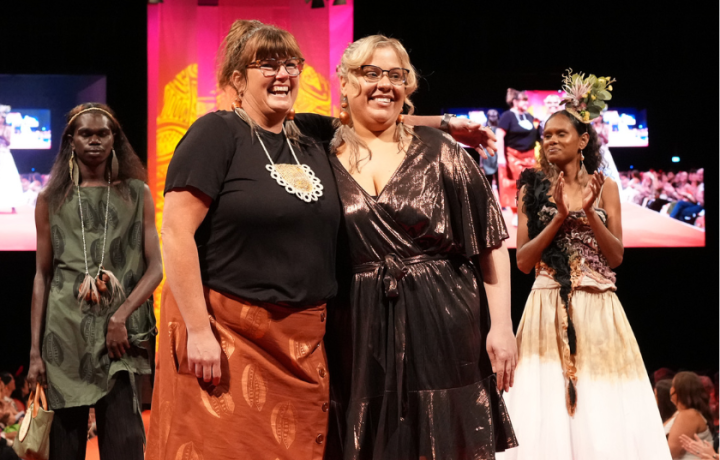
Showing their debut collection at Country to Couture in 2025, Corella & Crow is a bold First Nations-owned slow-fashion label created by designers Rechelle Turner and Megan Daley.
Showing a collection of 12 looks and 150 handmade pieces that explore their culture and connection to Country, the duo never expected their designs to walk the catwalk, let alone for two years in a row.
Preparing to show a new collection at Country to Couture 2026, here the Wiradjuri and Ngunnawal women talk about what slow fashion means to First Nations people and the important role they play in the fashion industry.
What is ‘slow fashion’ to you?
Rechelle Turner: Slow fashion is about relationship, care and responsibility. It is about slowing down enough to understand where materials come from, who makes them, and how they impact Country.
It is also grounded in process – working with slow, often hand-made practices like weaving, dyeing, screen printing, pleating, lace work, tanning, embroidery and beading. While these can be replicated by machines, true slow fashion honours the knowledge, skill and traditions of families and artisans. Many of these practices carry generations of knowledge, and without care, they risk being lost.
How can people make more mindful, lasting choices when shopping?
RT: It starts with slowing down. Ask yourself: Do I need this? Who made it? What is it made from? How long will it last?
Choosing fewer, better-quality pieces and caring for them properly is key. Repairing, re-wearing and restyling are powerful acts. Supporting makers who are transparent and ethical also shifts the system. Mindfulness is really about reconnecting – seeing clothing not as something to consume quickly, but something to build a relationship with over time.
Is “sustainable fashion” becoming a marketing buzzword? How do you cut through the greenwashing?
RT: Yes, it often is. I think sustainability has become a label that can be applied without deep accountability.
To cut through that, I look for transparency over claims. Who is doing the work? Are they naming their processes, materials and impacts honestly? Are they working at a scale that aligns with sustainability, or producing mass volumes while claiming to be ethical?
Real sustainability is often quieter. It is small-scale, community-connected, and grounded in practice, not just branding.
Megan Daley: Make more informed choices when it comes to clothing, do a bit of research and understand where your clothing comes from.
There are a lot of marketing buzzwords, and companies are profiting from the consumer wanting to make more sustainable choices like trying to choose natural fibres, such as bamboo. But the actual process to turn this into wearable fabric has a huge environmental toll. When in doubt, go for materials you know – like cotton, wool, and linen – rather than synthetic materials.
What would the fashion industry actually need to change to make ethical consumption the norm, rather than the exception?
RT: The industry would need to fundamentally slow down. That means reducing overproduction, shifting away from constant trend cycles, and valuing quality over quantity.
There also needs to be a redistribution of value, paying makers fairly, respecting cultural knowledge, and embedding accountability across the entire supply chain. Most importantly, it requires a shift in mindset. Moving from extraction to relationship, and from profit-first thinking to responsibility to people and Country. But there is also responsibility on the consumer.
Many people have lost the skills of making and mending. They do not know how to sew, repair or even reattach a button, so items that still have years of life left in them are often thrown away. Relearning these skills is powerful. It reconnects people to what they wear and slows down the cycle of consumption.
If demand changes, the industry will have to respond. We are already seeing this in places like the European Union, where policies are being introduced that require large companies to take responsibility for their waste and overproduction. That kind of accountability is essential, but it needs to be matched by a cultural shift in how we value and care for what we own.
Is the concept of “slow fashion” new, or does it echo something that was always embedded in First Nations ways of making?
RT: It is not new. What is now being called “slow fashion” has always existed within First Nations ways of being and making.
Our practices have always been grounded in respect, sustainability, and deep connection to Country. Materials were used with care, nothing was wasted, and making was guided by knowledge systems, seasons and responsibility. Slow fashion, in many ways, is a return or a remembering of what has always been known.
How does First Nations culture around making and caring for objects inform your approach to fashion?
RT: It shapes everything. Making is not separate from culture, it is an extension of it.
Through my practice, I think about responsibility to Country, to materials, and to the stories held within each piece. There is care in how something is made, but also in how it is worn, shared and passed on. Processes like weaving, dyeing, and working with reclaimed materials are not just techniques, they are ways of maintaining relationship and continuing knowledge.
Do you feel like First Nations voices are genuinely part of the sustainability conversation, or is that knowledge being overlooked?
RT: There is growing recognition of First Nations voices within the sustainability conversation, but often it remains surface level. Our knowledge systems are referenced, but not always deeply listened to or respected in practice. Too often, ideas are taken without the responsibility, relationships and cultural protocols that sit behind them.
For meaningful inclusion, First Nations voices need to be centred, not added on. That means leadership, decision-making power, and proper recognition of cultural and intellectual knowledge.
It is also about valuing that knowledge properly. Slow fashion takes time. It holds generations of skill, practice and cultural understanding. It is not just about slowing down on the consumer end; it is about recognising the true value of what is being made. Consumers need to understand that and be willing to pay accordingly.
When something is made with care, with knowledge, and with responsibility to Country, it carries far more than just material. It carries story, culture and connection. And that deserves to be respected, protected and valued in the way we engage with it.
MD: Not authentically. I think First Nations people have always been part of the conversation when it comes to sustainability, and I think most First Nations people are conscious when it comes to environmental impact, but I don’t think we are particularly being considered or heard in these conversations.
I know that recently Australian Fashion Week has banned all fur, wild animal skins and feathers. While I agree that we need to examine animal welfare within the fashion industry, I also think this kind of blanket mindset isolates Indigenous communities who have been using animal projects sustainably for generations. There is a lot of knowledge and thought that goes into the creation of these garments.
To find out more about Fashion Revolution Week and how to get involved, visit fashionrevolution.org or follow @fashionrevolutionaustralia
Feature image: Dylan Buckee.