Cupping Sessions: The new Wine Tastings
Posted on
Need something a little different to do for your next girls get-together?
How about a cupping session? It’s basically the caffeinated version of a wine tasting where you get to taste test a bunch of different coffees. It’s super simple and heaps of fun. It’s also way less calories than a champagne breakfast and you don’t have to be a super coffee-nerd to participate. In fact, it’s a great way to start exploring the world of coffee a bit more deeply.
I’ve watched cupping sessions before, but until recently I had never actually participated in one. Lucky for me, the gang from Drum & Dry – a local coffee subscription service – invited me along to a cupping session at Red Brick Espresso last Sunday.

It was hosted by head roaster Tim Manning, and head barista, Gabriel Dickinson. Tim explained that they do cupping sessions a couple of times a week in order to decide how to roast the coffee they have and what coffee they are going to buy for the cafe. Red Brick also supply to about 20 other local businesses, namely Local Press, Elemental and The Knox, so it’s not just themselves that they’re buying for – it’s a big business decision. It’s like test-driving a car. You’ve gotta give the wheels a spin before you commit to a finance plan, right?
Having said this though, a cupping session doesn’t have to be a particularly serious thing. It can be a recreational, experimental, creative experience. Any of you could do it at home, so I’ve broken down the process into a few easy-to-follow steps.
Firstly, measure out and grind up the coffee. Normally you’d be cupping more than one coffee at a time so it’s important to label or number the cups you put them in so you don’t lose track of or confuse the different coffees. At Tim and Gabriel’s session we cupped 16 different coffees!
Once you’ve picked out the coffee you want to cup, weigh out some beans. Tim normally weighs out 11 grams. Then place each coffee into a numbered cupping bowl and go run the beans through a grinder. Once all the coffee has been ground, line up the cupping bowls on a table in numerical order and take a whiff! Much like wine tasting, it’s important to take note of any particular aroma/s which may compliment or influence how the drink tastes.

Next step: brewing! Fill up each cupping bowl with 200 millilitres of water just off the boil.

Tim’s cupping bowls held exactly 200mls of water so we filled them up all the way. Once the bowls are filled let them brew for four minutes. During that time you’ll see a crust forming on the surface. That’s the coffee grind rising to the top and solidifying.

After those four minutes, take a spoon and break through the crust.

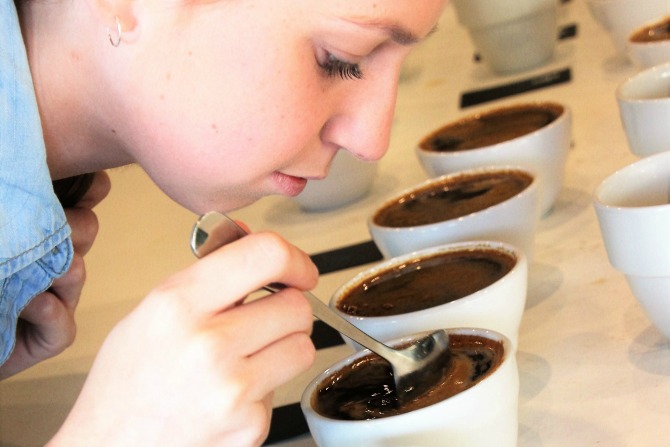
Lean in close to the cup, and take a big sniff as you push your spoon forward through the sediment. Again, pay attention to what you smell – was it similar to what you smelled when the coffee was dry? Once you’ve cracked the crust on all your coffees, use two spoons to scrape off all the sediment and allow the coffee to brew for another 15 minutes.

While we waited for our coffee to brew, Tim explained that each of the coffees had been sample roasted specifically for cupping.

This means that the coffee is intentionally roasted to a light profile so you can really taste the true characteristics of that coffee. When it’s roasted to a medium or dark profile you tend to lose the more delicate tasting notes and it can become too rich and overpoweringly chocolate-y.
Think about how you brew your tea. The longer you leave your teabag in, the stronger it’ll become. Then you might want to add some milk, or sugar, or even honey. The stronger you make it, and the more stuff you add to it, the less it starts to taste like your original cup of tea. This isn’t necessarily a bad thing, depending on your tastes, but it’s always better to know exactly what the tea tastes like in the beginning before you start tailoring it to your tastes. It’s the same for cupping coffee.
Here comes the fun part. Taste your coffee! Get a spoonful of coffee, and slurp it into your mouth as loudly as you can! I know it seems like a very strange way to explain it, but that is actually how it’s done! The first time I saw someone do it the sound reminded me of that last big, ugly gurgle the bath makes when you’re emptying all the water.
You’ll want to taste each coffee over three stages – when it’s hot, when it’s warm and when it’s cold. The way a coffee tastes can often change with its temperature, and if you’re looking for a coffee to serve both hot (i.e. as an espresso) and cold (i.e. cold brew) you want to make sure that it tastes good both ways! Make sure you have a cup of clean water to rinse your spoons with in between coffees. You can purchase special cupping spoons to do this, but a medium-sized soup spoon will do the trick.

Take notes while you are tasting. I’d suggest you split your notes into two columns – flavour and texture – to help you determine what exactly you like about a coffee.
Cupping is a sensory experience after all, so it’s not confined to merely what you taste in terms of flavour. It also encompasses how something tastes texturally. This is what barista’s would describe as “mouthfeel”. For example, Gabriel served me an espresso before the cupping session which I described as extremely juicy, flavoursome with citric notes, but a little bit thin.
I didn’t really like the way it tasted thin. I prefer a coffee that has more body to it, something more syrupy that can pack a punch. The taste of the coffee itself was lovely, but it was the texture that didn’t win me over.
Handy hint: If a coffee you’ve cupped tastes papery or grassy that often means a coffee has aged past its peak and is probably not worth using. (I described the taste similar to what you would experience when you are licking the inside of an envelope before you seal it.) However, coffees do age differently. Some taste good for longer than others so don’t write-off a coffee solely based on its age.
Something to remember: Everybody’s palate is different, so there are no wrong answers when it comes to tasting notes! You might have tasted apples when everyone tasted oranges. And there’s absolutely nothing wrong with that. Your tongue isn’t broken, that’s just what you tasted. The cool thing about sharing tasting notes is that once you’ve pointed something out, everyone else might pick up on it if they take another sip. It’s a collaborative experience.
Just make sure that once you’ve finished cupping you have a substantial meal afterwards! Gotta soak up all of that coffee somehow, otherwise you’ll end up with a massive caffeine headache!
If you’re interested: In partnership with Pod Food and Fleur Studd from Melbourne Coffee Merchants, Red Brick Espresso will be hosting a Degustation Coffee Breakfast on 19 March.
It’s a four course degustation encompassing an array of exciting flavour combinations and matched brewing techniques. The theme is Bolivian Coffee and the importance of supporting the production of it. This might be a good way to gain some insight into the world of specialty coffee and learn a little bit more about the industry if you’re not already familiar with it. Tickets are $60 and available for purchase online.
the essentials
What: Red Brick Espresso
Located: 4/35 Carruthers St Curtin, Canberra
Contact: (02) 6285 1668
Open: 7.30-4.30 Weekdays, 7.30-3 Saturdays, 8-3 Sundays
Web: www.facebook.com/Red-Brick-Espresso-261578173898339/?fref=ts
What: Red Brick Espresso Degustation Breakfast
Where: Pod Food, 12 Beltana Rd Pialligo, Canberra
When: 19 March, 9am
Web: www.facebook.com/events/914053092046238/
Tickets: $60, available for purchase here http://www.podfood.com.au
What: Drum & Dry Coffee Subscription Service
Web: www.drumanddry.com.au
*Images courtesy of Steve Croft from Drum & Dry


Leave a Reply