She’s in the water: it’s time to try Deep Water Running

Posted on
Did you know close to half of employed people aged 18 to 64 years described their days at work as “mostly sitting”?
At Her Canberra we find that statistic quite alarming, so we are doing our part to educate our community about the importance of moving throughout the day. A lot of research has shown that prolonged periods of sitting and inactivity can have a negative impact on your physical and mental health. Have you considered taking a splash in the local pools before or after work?
Some local pools in Canberra open at 5.30 am and close at 9 pm, perfecting for fitting into your day.
In our last series we focused on hitting the local trails around Canberra—and this month we are exercising in the water. Water is a natural weight-training machine that is highly adjustable; the harder you push and pull in the water, the more resistance you create. The water acts as a cushion for your weight-bearing joints and preventing further injury.
Did you know the human body responds to water immersion with changes in the heart, peripheral resistance, and blood flow, as well as alterations in skin, core and muscle temperature (Wilcock et al., 2006)? The changes in blood flow and temperature may influence inflammation, immune function, muscle soreness and perception of fatigue.
Some people find swimming boring, or they don’t want to put their head underwater—however we have some options for you: shallow water walking/running drills, Hydrolates (Aquatic Pilates) and Deep-Water Running Interval Training.
The key is consistency and enjoyment. Find something you love—and stick with it!
Before we dive into part three, did you get a moment to read part one and two of She’s in the water?
In part one, we discussed “the why” behind immersing in water; hydrostatic pressure, blood flow, buoyancy, viscosity, vasodilating, the brain and releasing of neurochemicals, local pools in Canberra and their opening hours, and simply “how to get started”.
Part two, we introduced the Hydrolates (Aquatic Pilates) concept, gave you a mini–lower limb program to do at your local pool, touched on self-management equipment options, and stressed the importance of variety.
Welcome to part three of She’s in the water.
Mini-Hydrolates Session
How did you go with last week’s mini-Hydrolates session? Did you self-manage at a local Canberra pool (or your home pool)? At Capital Hydrotherapy we host over 200 Hydrotherapy sessions a week—so we know it’s popular. Hydrolates is targeting our ‘powerhouse’ muscles: the abdominals, pelvic floor, erector spinae group, hip flexors and gluteals which when stable, allow for safer and more controlled movements of our extremities and reduce the risk of injury. All you need is a noodle, or two. Here’s another mini-Hydrolates program, focussing on the lumbar spine and hips (click here):
- Oblique twist: two sets x 10 repetitions
- Hip external and internal rotation: two sets x 10 repetitions
- Upright to prone glute stretch: two sets sets x five repetitions (30 sec hold)
I’d recommend mixing up the Hydrolates session with some shallow water running/walking, and Deep Water Running. Variety is key.
Deep Water Running Technique
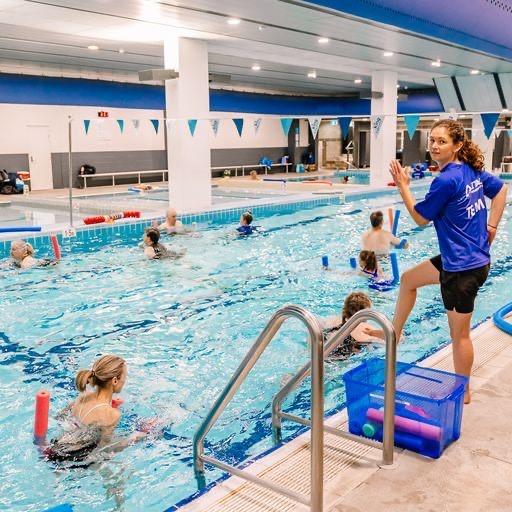
Have you ever learnt the Deep Water Running (DWR) technique? It looks simple but, it’s not! Mastering the correct DWR technique is essential. Yes, basically it’s just “running in deep water”, however, the DWR technique is a suspended movement, therefore may take a little longer to learn the movement pattern. Once you learn where your centre of gravity is, you will be able to maintain and control your upright correct running technique. Balance and stability are the key—which is why the Hydrolates and DWR complement each other.
You can turn the DWR movement pattern, into a beneficial exercise session—all without getting your hair wet! Deep Water Running Interval Training (DWR-IT) is a non-weight bearing form of exercise which mimics the land based running technique and land-based training program. It’s a great option for those who have load management issues and sit for long periods for time. The DWR technique releases the hip flexors (which tighten when we sit), opens the chest and strengthens our postural muscles.
Program 1: Upside down pyramid
Main focus: Strength-endurance

Program 2: 5- 1 -5
Main focus: Strength-Endurance-Power

I’ll drip feed another two DWR-IT sessions in part four of She’s in the water—try the above first. Remember, you don’t have to start with a long pool session, just 20 to 30 minutes is great. PROGRESS, NOT PERFECTION.
Start with one session, then add another session – like building a house (“one brick at a time”).
Skin and hair care after the pool
Be organised. Have a swim kit bag ready to go (like a “go bag”); so there’s no excuses, and no itchy dry skin. Buy an after-swim body wash/shampoo/conditioner, a moisturiser and a quick dry towel. The thinner and more lightweight the towel, the faster it dries. Go for a breathable fabric, like microfibre. We want a long-term approach to your exercise program—invest in a good product, and you’re more likely to take a splash before or after work or even at lunch.
If you want to get an early morning session in before work and the chlorine is a problem for you, there are products out there that eliminates pool chemicals and odours. I use the Trihard brand, which hydrates, restores and sooths dry skin and hair; and they have a pre/post swim eye gel (for those who don’t like panda eyes after a swim).
In part four we will focus on another series’ of DWR-IT, a mini-Hydrolates (Aquatic Pilates) program for burnout (think—wall Pilates), a shoulder program for the casual swimmer, and hydration.
Did we inspire you to find those old swimmers, organise a “go-bag” and take a splash?
Love, Kirra
Capital Hydrotherapy and Exercise Physiology is open for one-on-one Hydrotherapy, Aquatic Physiotherapy (and land-based Physio), land-based Exercise Physiology, small group therapy, Hydrolates™ classes (Aquatic Pilates) with strict COVID-safe precautions.
If you are injured, have a chronic health condition, or need a plan to improve your health and wellbeing—call us today 6156 2223!

