Why Canberra sports clubs are stepping up to tackle vaping

Posted on
Sport is a cornerstone of Canberra life. From gymnastics halls to touch football fields, local clubs are places where young people build confidence, friendships and healthy habits.
But like many parts of the community, sporting environments are not immune to the rise of vaping.
That’s where Cancer Council ACT’s VAPE Support – Sports program comes in. Designed to help sporting organisations create healthier environments for young people, the free initiative provides education, training and practical resources to help clubs address vaping in a supportive and informed way.
According to Alex Dreyer, Team Leader – Prevention at Cancer Council ACT, the program grew out of increasing concern about vaping across the community.
“Around 2022–2023, it became clear that vaping was becoming a serious issue, not just in Canberra but across Australia,” Alex explains. “Our role is to give people the information they need to decide whether vaping is something they want in their life – and if they choose to stop, to connect them with the right support.”

While sport is often associated with healthy lifestyles, Alex says the reality is more complex.
“People assume sport is automatically protective and that people involved in sport wouldn’t be vaping,” he says. “But if you spend time at sports clubs on weekends, you see a range of health behaviours.”
That insight helped shape the VAPE Support – Sports program, which focuses on meeting clubs where they are and providing flexible support that works within existing training schedules and volunteer-run environments.
The program offers a range of resources, including education sessions for athletes and staff, brief intervention training to help adults have conversations with young people about vaping, and signage and information to help clubs promote vape-free environments.
Flexibility is central to the approach.
“Across many health programs in sport, we’ve learned that the most effective approach is to ask clubs what will work for them,” says Alex. “Every club and every sport is different.”
The goal isn’t simply to discourage vaping, but to create club cultures where healthy choices are supported, and role models lead by example.
For Touch Football ACT, the program was an opportunity to better understand an issue they knew was affecting young people.
“We wanted to benefit our players by improving our overall knowledge of vaping,” says Jared Mathie, Community Sports Coordinator at Touch Football ACT.
“We wanted to improve the health of our community and thought it was a great initiative to introduce through our junior representative teams.”
Before participating in the program, vaping simply wasn’t something the organisation felt confident to discuss.
“Before the program we were having little to no conversations regarding vaping,” Jared says. “Partly because we weren’t fully equipped to handle these conversations if an issue arose.”
Education sessions delivered through the program were integrated into the teams’ Sunday training schedule, making it easy for players and coaches to participate.
Participants learned about the health impacts of vaping, the side effects associated with nicotine use, and how quitting support works. The response, Jared says, was overwhelmingly positive.
“I was genuinely surprised by how invested the players were once the session started,” he says. “When some of the dangers of vaping were discussed, there was a strong reaction from players who realised how harmful it could be.”
The sessions also helped coaches and volunteers feel more confident navigating conversations that can sometimes feel uncomfortable.
“Our coaches appreciated the opportunity to sit down with their players and discuss important issues that affect them in everyday life,” Jared says.
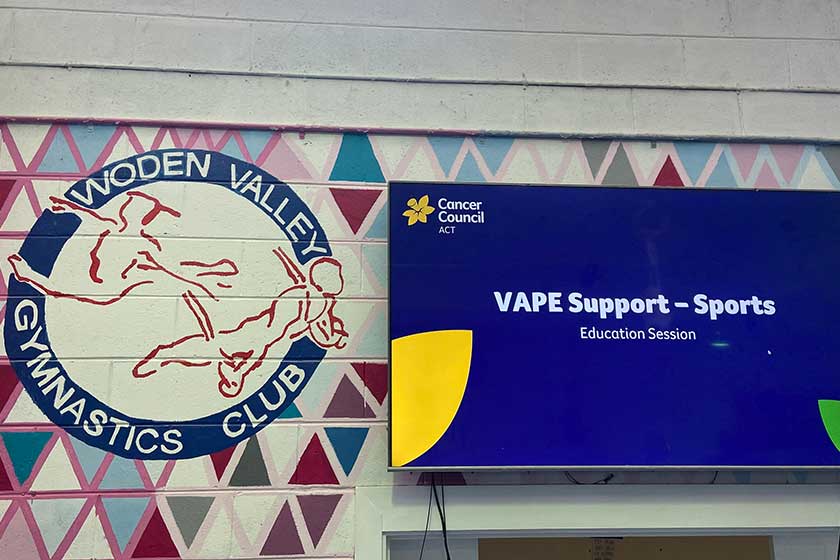
A similar experience played out at Woden Valley Gymnastics Club, where the program helped open up important conversations across the organisation.
“Our governing organisation, Gymnastics ACT, informed us about the workshop opportunity,” says Naomi Nye, the club’s Gymsports Director. “We knew vaping was a social issue, particularly among young people and within the age bracket of many of our coaches, so we thought it would be ideal to run an education workshop.”
The club delivered education sessions both online and in person – one for more than 40 coaches and another for gymnasts aged 10 and above.
“The sessions covered how to say no if others pressure you, how to have appropriate conversations about vaping, and the health risks and impact it can have on athlete performance,” Naomi says.
Importantly, the workshops gave staff the confidence to address issues if they arose – while also ensuring young people who may already be vaping are supported and directed to appropriate help if they want to stop.
“We’ve seen coaches become much more confident having conversations with their peers if they see someone vaping,” Naomi explains. “Prior to the workshop we had a few issues with staff vaping in change rooms, but the program empowered people to report concerns respectfully so they could be managed discreetly.”
In fact, the club hasn’t received a report of a young person vaping in or around the gym for more than 10 months.
One moment, Naomi says, made it clear the program was working.
“A floor supervisor who was only 18 noticed a parent using a vape secretly in the foyer. She felt confident to approach them privately and use the methods suggested by the program,” Naomi says. “She told us she didn’t think she would have had that conversation so confidently without the workshop.”

For Cancer Council ACT, stories like these highlight the important role community members can play in supporting young people’s health.
“One of the most encouraging things we see is people realising they can play a bigger role in supporting young people,” says Alex. “Anyone in the community can be a trusted source of support.”
That support matters because vaping is often more visible in young people’s social environments than adults realise.
“Many adults assume vaping isn’t happening in their school or sporting community,” Alex says. “But young people tell us they see it everywhere.”
By equipping clubs with practical tools, education and confidence, the VAPE Support – Sports program aims to ensure sporting environments continue to promote the health and wellbeing they’re known for.
For clubs considering the program, the message from participating organisations is simple.
“As administrators and volunteers we already have a lot to do,” Naomi says. “Bringing in a team whose job is to provide information and resources that support your athletes’ health and wellbeing makes sense. The heavy lifting is done for you.”
And for parents watching their children grow through sport, the stakes are just as clear.
“Youth sport is about building strong bodies, resilience and lifelong healthy habits,” says Jared. “Vaping works against all of that.”
Interested in bringing the VAPE Support – Sports program to your club?
Cancer Council ACT works with local sporting organisations to deliver free education sessions, training and resources tailored to each club’s needs.
Learn more about the program at actcancer.org.