Australian life through the decades: Photography front and centre at National Archives
Posted on
Did you know there are close to 11 million photographs housed in the National Archives of Australia?
They chart everything from iconic moments in our history to quieter snippets of everyday Australian life.
Photographers who captured both ends of this spectrum are Australian government photographers, the unsung heroes of recording Australian history. Now, a new exhibition at the National Archives has brought them “out of the darkroom and into the spotlight”.
Focus: Australian government photographers showcases photos from 1939 to 1996 taken by photographers employed by government media agencies and reveal a rich slice of Australian life. This diverse range of snappers included household names like Harry Frauca, Max Dupain, Mervyn Bishop and includes ‘intimate nature photography, striking architectural shots and images that capture everyday memories from Australia’s past’.
“These photographs were taken all over Australia and feature people who often don’t realise they have been captured in the collection,” says National Archives Curator Emily Catt.
“You might have seen the photographs on stamps or in public places – once they entered the collection the photographs could be used in a variety of ways. For six decades, photographers created this vast pictorial library of Australia.”
To give you a sneak peek inside the exhibition, we asked Emily to share three photographs with us, as well as their unique significance.
Jim Fitzpatrick (1917–2005)
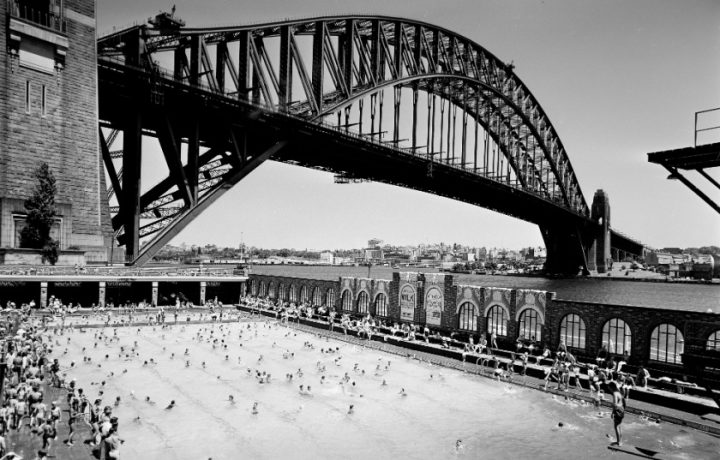
Seeking relief from the heat at the North Sydney Olympic Pool 1956
NAA: A1200, L19920
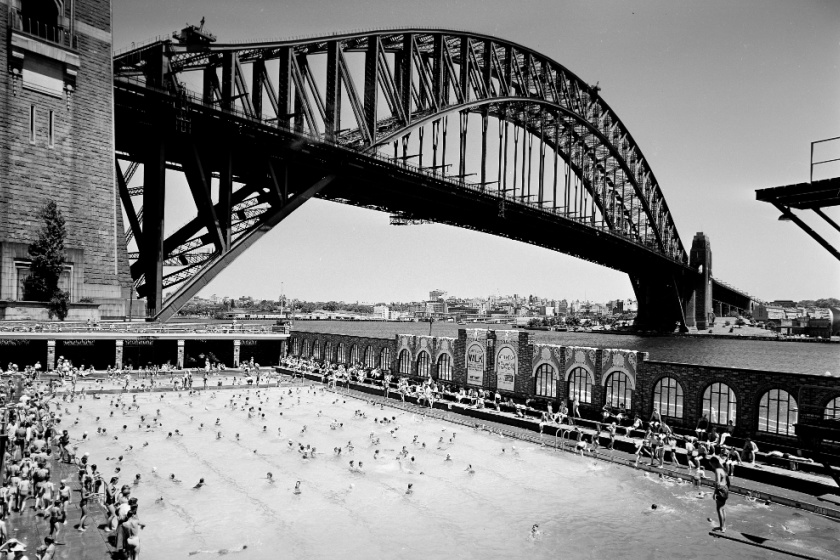
Jim Fitzpatrick (1917–2005), Seeking relief from the heat at the North Sydney Olympic Pool 1956. NAA: A1200, L19920.
“This shot was taken by Jim Fitzpatrick, who worked for the Department of Information during the Second World War and was then based in the Sydney office as a photographer,” explains Emily. “More than 3000 photos have been attributed to him and likely more that aren’t attributed across the 1950s, 60s and 70s in Sydney.”
While the shot is striking and iconic, Emily explains it was actually one in a series about the North Sydney Olympic Pool in the foreground than it was about capturing the Harbour Bridge from this angle. One from the other direction captures the famous Luna Park gates.
“When we look at these images in high-resolution we get to see new details such as the boys in the bottom left corner that have caught the photographer in action, the ‘WALK – Safety first’ sign – decades later we are still being warned about the same things – ‘BE TIDY – Rubbish bins provided’.”
“We also notice how many things have changed – this is Sydney Harbour before the Opera House and with a much lower skyline.”
Jim Fitzpatrick (1917–2005)
Nightlife on William Street, Kings Cross, Sydney 1970
NAA: A1200, L84008
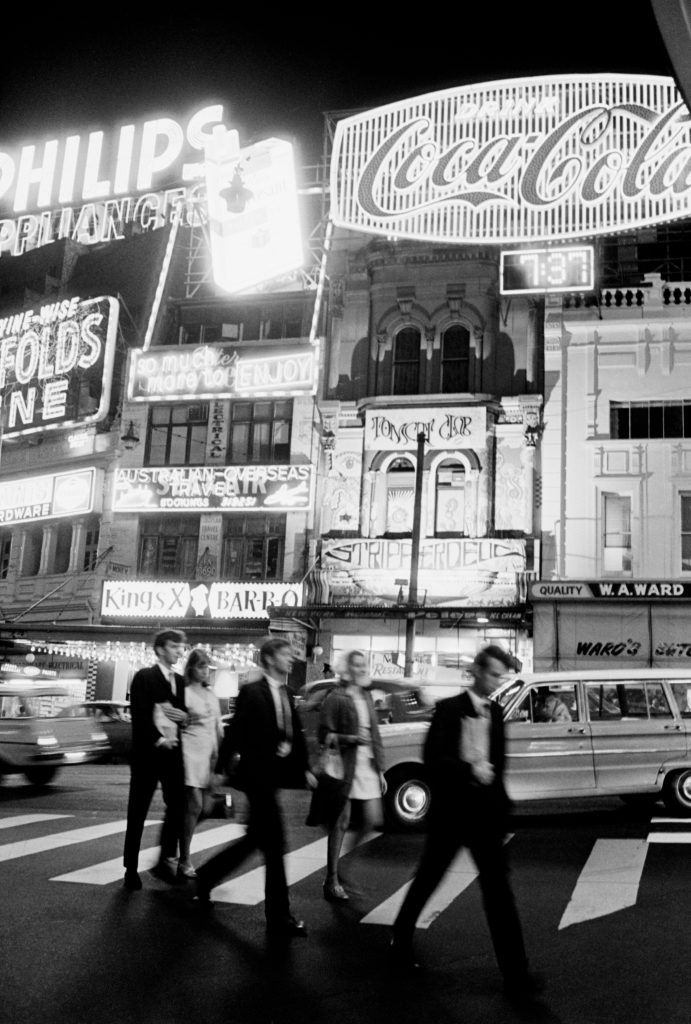
Jim Fitzpatrick (1917–2005), Nightlife on William Street, Kings Cross, Sydney 1970, NAA: A1200, L84008.
“This photograph forms part of a series of Kings Cross taken at night – these were taken in 1970,” says Emily.
“For people overseas who might think of Australia as being entirely rural or more like a big country town – these photos really show the cosmopolitan nightlife in Australia.”
“When we think of government photographers we might think of images of diplomatic visits or portraits of Prime Ministers, but this photograph really shows how diverse the collection is.”
“Apart from the Coca-Cola sign which has seen a few upgrades, the location is almost unrecognisable today and highlights how much things have changed (like the addition of the Cross City Tunnel) but also how many things haven’t – so many familiar brands like Dunlop, Coca-Cola, Phillips. We no longer see cigarette advertisements.”
“Now that the world is digital, we look online for travel destinations or even places we might want to move to. In the past, how would people find out about Australia? This was part of the important role that government media departments played.”
Mike Jensen (b. 1943)
Crowds beneath the monorail at the Brisbane Expo, Brisbane 1988
A6135, K22/7/88/99
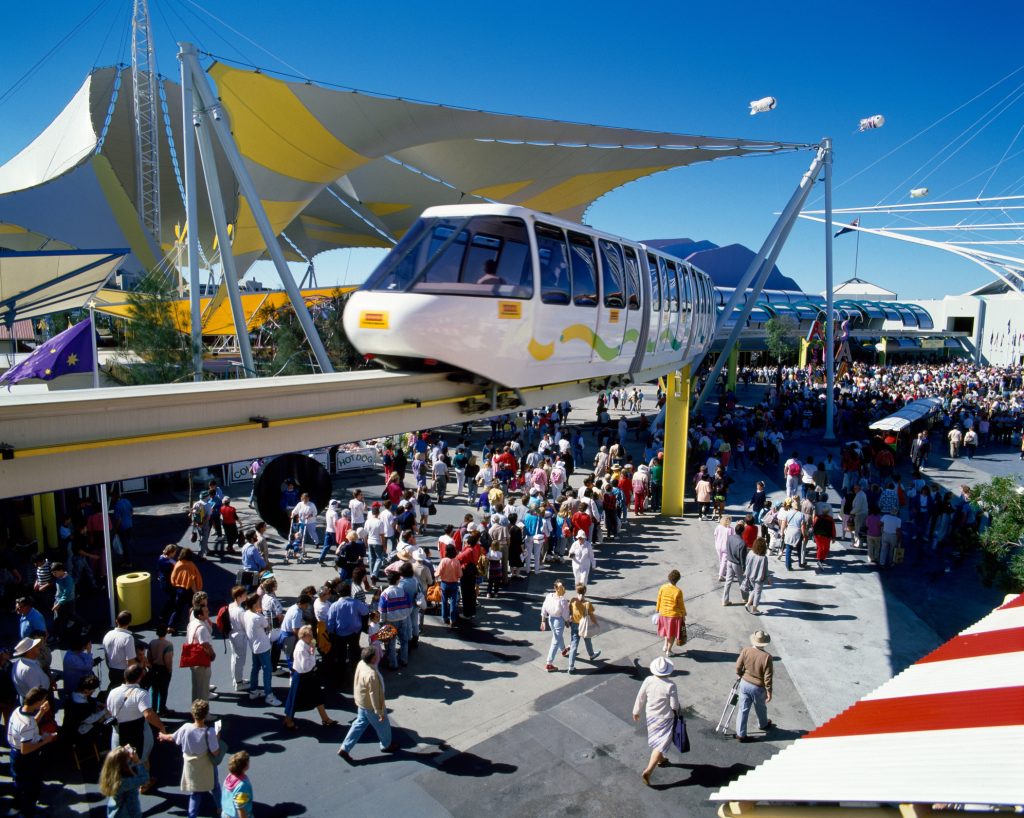
Mike Jensen (b. 1943), Crowds beneath the monorail at the Brisbane Expo, Brisbane 1988, A6135, K22/7/88/99.
Photographer Mike Jensen moved from Denmark to Australia in 1966 and became a darkroom developer at the Australian News and Information Bureau in Canberra. He worked his way up to chief photographer and travelled extensively throughout rural Australia, as well as snapping this great shot of the Brisbane Expo 1988.
“Expo 88 attracted more than 15 million visitors with an average of 100,000 visitors a day and turned the eyes of the world and Australia’s on Queensland,” says Emily. “This image really captures the colour and excitement of the of the Expo.”
“It also captures the sun sails – of course as Australians we are used to having to protect ourselves from the sun – their use at the Expo became iconic and they were incorporated into the Expo’s logo.”
THE ESSENTIALS
What: Focus: Australian government photographers
When: Showing until 10 June 2024. Monday to Friday: 9 am to 5 pm, Saturday to Sunday: 10 am to 4 pm. Free guided tours will run every Sunday at 11 am to 11:30 am from 3 December. Bookings are required.
Where: National Archives, National Office, Kings Avenue, Parkes
Website: naa.gov.au/visit-us/events-and-exhibitions/focus-australian-government-photographers
Feature image: Jim Fitzpatrick (1917–2005), Seeking relief from the heat at the North Sydney Olympic Pool 1956, NAA: A1200, L19920 (cropped)