Know My Name Curator’s top picks
Posted on
The National Gallery of Australia’s current exhibition, Know My Name: Australian Women Artists 1900 to Now, showcases the nation’s incredible artists.
Dr Deborah Hart, head curator of Australian Art and Elspeth Pitt, Curator, Australian Painting & Sculpture, are co-curators of the exhibition and provide an overview of their picks in this diverse exhibition that will have you heading back in mid 2021 when more works go on display.
DEBORAH HART’S PICKS
Fiona Hall, Tender, 2003-06
Fiona Hall’s practice is about making and materiality—the impact people, particularly colonial cultures, have had on the environment and natural habitats.
Here, Hall plays with the idea of tender—as in currency—but also tenderness, with shredded bank notes that have been woven into exquisite, intricate bird’s nests.
The work has this double meaning, as well as just being breathtaking to look at, as you analyse the incredible architecture of the nests, you can see the wonder of nature.
Judy Watson, Waanyi people, canyon, 1997
When Waanyi woman Judy Watson creates, she considers the marginalisation of her people, environmental issues, matrilineal connections, and her deep connection to place and ancestors.
At nearly six metres tall, you can see and feel the powerful presence of this large scale work from a distance as you enter the exhibition—it takes you right into this idea of a canyon enveloped in luminosity, and embodies the artist’s profound respect for Country.
Rosemary Laing, various works, flight research and bulletproofglass series, 1999-2002
It has been a dream to bring Rosemary Laing’s iconic images from her flight research and bulletproofglass series together for the exhibition, where Laing has captured the bride literally in mid‑air, seeming to defy the laws of gravity—and by implication—any strictures of her marital status.
These photographic images were not digitally manipulated. Instead the artist worked with a stunt woman to create these performative works. The uncanny freedom of the woman levitating above the landscape shifts our understanding of space, time, and relationships.
Hung at various heights up the wall, Laing worked with us on the installation, so that the display made it feel as though the brides are really unfettered and flying in the space.
ELSPETH PITT’S PICKS
Jo Lloyd, Archive the archive, 2020
Archive the archive is inspired by the life and work of Philippa Cullen, a performance artist, dancer and choreographer who sought to generate sound through the movement of the body using early electronica and theremin, a musical instrument controlled without physical contact.
Despite the originality of her art, Cullen is now little known, having died prematurely at the age of 25 in the mid-1970s.
Frances Budden Phoenix, Get your abortion laws off our bodies, c. 1977 – 1980
A pioneering feminist and gay rights activist, Frances (Budden) Phoenix was one of several artists who sought to retrieve, teach and elevate the domestic crafts of lace and doyley making during the 1970s and 1980s.
She often embedded political messages in her work, challenging the idea of craft as a purely decorative form.
Julie Rrap, Persona and shadow series, 1984
During the 1980s Julie Rrap began a major group of works based on 19th and 20th Century art history. In Persona and shadow she reworks paintings by Norwegian artist Edvard Munch that portray physical and psychological states.
Placing an image of herself within the painting, Rrap ‘shadows’ Munch’s subjects: sister, siren, pubescent girl, artist, Christ, Madonna, Pietà, sleeping woman and old woman.
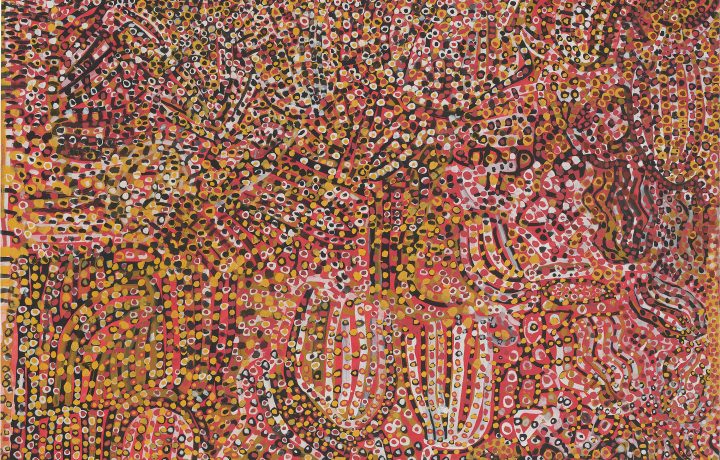
Feature image: Excerpt, Emily Kam Kngwarray (Anmatyerr people), Ntange Dreaming 1989, National Gallery of Australia, Canberra, Purchased 1989 © Emily Kam Kngwarray/Copyright Agency