Bangarra’s Dark Emu: seeds of the past

Posted on
History isn’t just something written down. The past doesn’t end—it becomes the ground we walk on, and shapes the landscape we move through.
The Bangarra Dance Theatre knows history, learning and storytelling go hand in hand. For almost 30 years they have brought First Australians’ traditions and history to the stage, sharing stories through movement rather than words.
Bangarra’s latest production Dark Emu melds historical techniques, recreating a non-fiction work by academic Bruce Pascoe on farming techniques dating back tens of thousands of years.
Pascoe’s award-winning 2014 Dark Emu: Black Seeds showed farming Australia’s continent dated back tens of thousands of years and challenged the long-held, and incorrect, view that Indigenous people existed solely as hunter-gathers.

Credit: Daniel Boud.
Bangarra choreographer, Yolande Brown, was lent a copy of Dark Emu by a neighbour and was immediately fascinated by a subject she had heard very little about.
“My first thought was that this has to be taught in schools,” Yolanda says.
She read about thousands of years of planting and harvesting grains, of bread being made well before Europeans arrived on the continent, of well-constructed dams, weirs and villages, and of surplus food being stored to feed communities in the future. As Pascoe’s research showed, early white explorers had observed this for themselves, but the history that was taught to generations of Australians first ignored, and then forgot, these achievements.
“I told Stephen Page (Bangarra’s Artistic Director) about the book, and told him he had to read it. He was already starting to think about what would be Bangarra’s next show, and then serendipitously he ran into Uncle Bruce Pascoe, so it was coming at him from all sides, planting the idea that this would be our new work.”
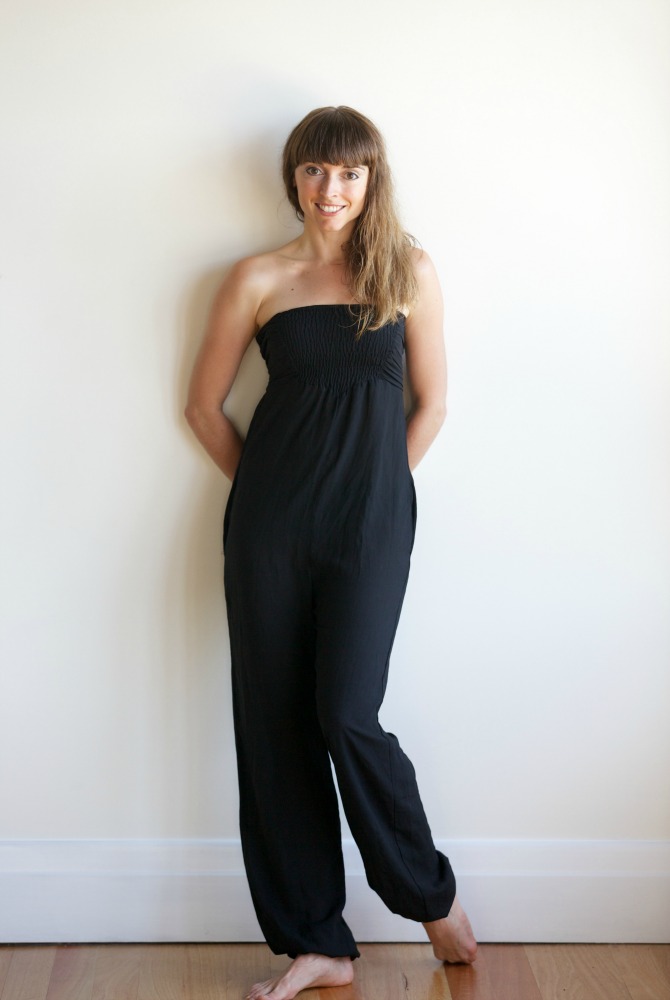
Yolande Brown. Credit: Greg Barrett.
Fittingly, since she was involved in planting that seed, Yolanda worked with Stephen Page and Daniel Riley on the choreography. Having been with Bangarra for 20 years as a dancer, this would be her second choreography for the company.
The challenge was turning a non-fiction book into a physical interpretation.
“We worked with Alanna Valentine, a wonderful wordsmith, and she was pivotal in bringing the words alive,” Yolande explains.
Dark Emu is divided into three parts, and the first was created by the three choreographers together with the company’s dancers.
“The dancers contribute so much, they are so much more than paint on the canvas,” Yolanda says.
“We only had seven weeks to construct the entire show, it had to be done quickly.
“We splintered off after the opening section, but it was important that each section work organically. There is an alchemy to creating a work, our cultural consultants share their biographical stories and everything comes together—costumes and set design are just as important.”
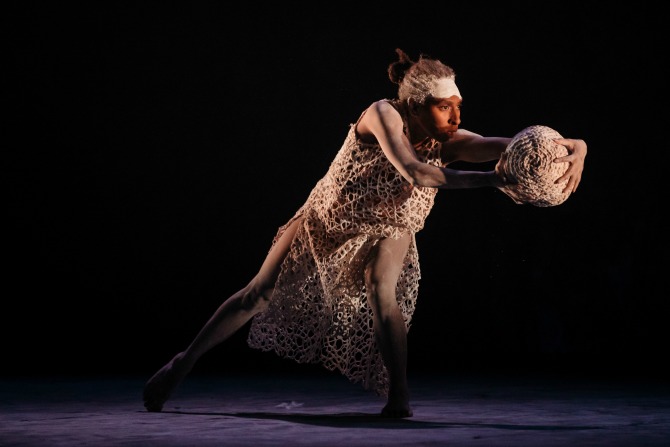
Credit: Daniel Boud.
For Yolanda, the design process was part of a historical tradition that is itself thousands of years old.
“First Nation people learnt everything orally and through dance. History is passed on through movement and they learnt encyclopaedias worth of knowledge. Everyone learns differently, and it is healthy to learn through our bodies.”
She reflects on the irony of the history of Indigenous agriculture only being validated once it has been written down.
“I look back through our black history, it’s taken thousands of generations to build complex economic and social structures.”
As a performance, Dark Emu is a journey through that evolution. “In each of the three sections there is a form of assault, of change and finding a way through each challenge,” Yolanda says.
Being able to bring this story to life is important to her.
“My grandmother wasn’t encouraged to be proud of her heritage—we’ve come a long way in being able to acknowledge this history. People shouldn’t be afraid to ask questions, as long as they are asked respectfully and with sincerity. Having a cuppa and getting to know someone is a great start.”
Yolanda is of the Kunja Nation in central Queensland. “The challenge of being a 21st-century Indigenous woman is that I haven’t spent enough time on my own country and I want to connect to it. The only times in recent years that I’ve been able to travel have coincided with the wet season there, a time when the land becomes inaccessible.
“I have a young son and, in a year or two, I’d like to take him back to Country and be there during the big wet season. It’s when the people let the land do what it needs to do, cleanse and rest.”
the essentials
What: Dark Emu by Bangarra Dance Theatre
Where: Canberra Theatre Centre
When: 26–28 July
How much: $39–$59
Book online: canberratheatrecentre.com.au/show/dark-emu
This is a sponsored editorial. For more information on sponsored editorials, click here.
Feature image credit: Daniel Boud


Leave a Reply