From Cell to Cosmos: Working together to craft science
Posted on
Glass artist Elizabeth Kelly has a fascination with shape and scale that sends her delving into the structural secrets of the natural world.
How do shells form perfect Fibonacci curves? Why are virus spores spherical? She investigates these questions like an architect, seeking out shapes that fit together as puzzle pieces to help her reconstruct their magic, to turn science into artful and collaborative craft. She’s particularly entranced by the dynamic triangular shape of spikes, which showcase the beauty of light through coloured glass. Everything she makes is distinctive in its combination of clear, glowing colour and thoughtful design.
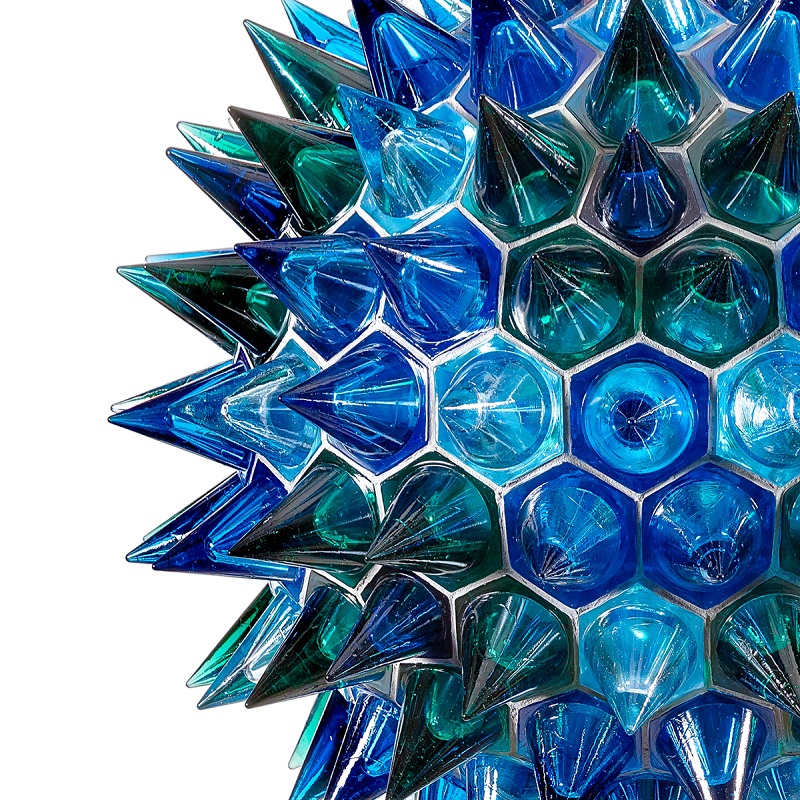
Her latest offering is a series of large-scale spiked spheres in jewelled colours with names like Oceania, Dusky and Sargasso. They look like fantastic space hardware; a young boy visiting them at Craft ACT decided that they were planets and spent ages making up stories about them. The real story is one of sustained research and working with new technologies that were developing alongside the artworks.

Her process always starts with questing desire: how can a microscopic pollen grain become a large-scale sculpture in glass? She had travelled around the world on a Churchill Scholarship to research architecture, and the solution was to work in small interlocking modules, akin to bricks. Working with spherical geometry was something else altogether, and after approaching a variety of specialists – mathematicians, geneticists, engineers – she found the perfect collaborator in Dr Ralph Sutherland, from the ANU Research School of Astronomy and Astrophysics (RSAA). His engineer son Rodger does some glass work, so the three of them brainstormed Kelly’s vision with pen, paper and then open-source software.
Together they developed a module shape that Kelly could produce in various colours over time between paid jobs – the production work and commissions that underwrite the heart’s desire – and when there were enough pieces to start experimenting with the construction, technology had caught up with their ideas. Dr Sutherland would build custom 3D printers as they were needed, to print structural components for Kelly’s glass pieces. 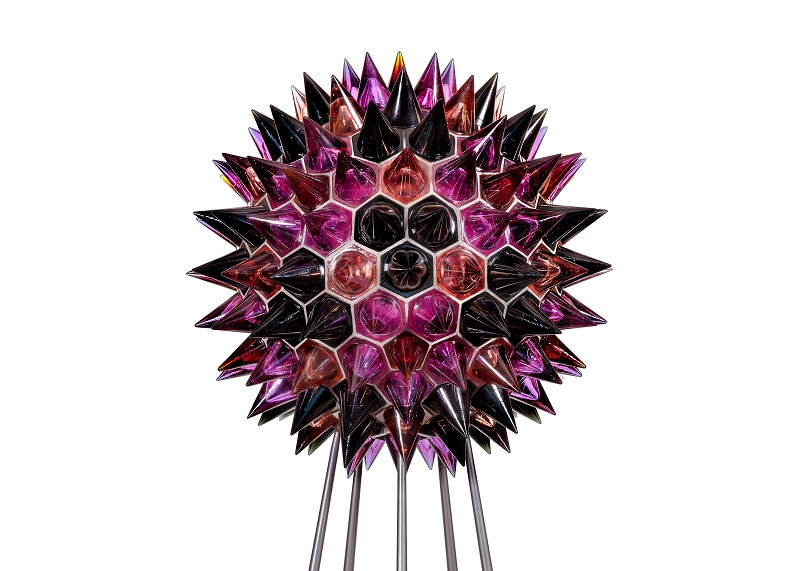
Kelly’s work is beautiful, but also important research for the architectural use of glass. “As an artist,” she says, “I could not have completed this work without the co-operation of either the scientist or engineer, but conversely, neither of them would have thought to manifest objects such as these. It has been an extraordinary collaborative process and demonstrates a great willingness across fields to explore, with curiosity.”
If you’d like to hear more about the collaboration, Kelly and Sutherland are giving a joint gallery floor talk to help celebrate National Science Week, on 17 August at 12:30. Elizabeth Kelly’s Macrocosmia is on show at Craft ACT until 25 August.
Header image: Elizabeth Kelly. Oceanic Sphere, detail, 2018. Pressed glass, steel. 185 x 75cm. Photo by Steve Keough.
Body images: Elizabeth Kelly, Red Whorl, 2016. Cast coldworked and assembled glass and Elizabeth Kelly. Dusky Sphere, 2018. Pressed glass, steel. 185 x 75cm. Photos by Steve Keough.

Leave a Reply