It’s Dickson. But not as you know it
Posted on
Big changes are transforming Dickson into the city’s second CBD.
Did you know that Canberra’s original airport once filled the space where the Dickson library now stands?
As Canberra has grown over the last one hundred years, the airstrip has given way to a low-rise Dickson shopping village and surrounding commercial thoroughfares of Woolley and Cape Streets.
But now Dickson is stepping it up.
Major government and commercial investment will see it explode in size and amenity to rival Civic as a hub for work, food and play. The light rail, meanwhile, will once again reinstate the suburb as a travel and transport hub – albeit without aircraft this time.
The new $225 million DKSN joint development by the Doma Group and Englobo, announced late last year, will anchor the transformation.
Other prominent developers, such as John Russell and the Morris Property Group, have recently completed residential developments to cater for – and grow – the inner-city population.
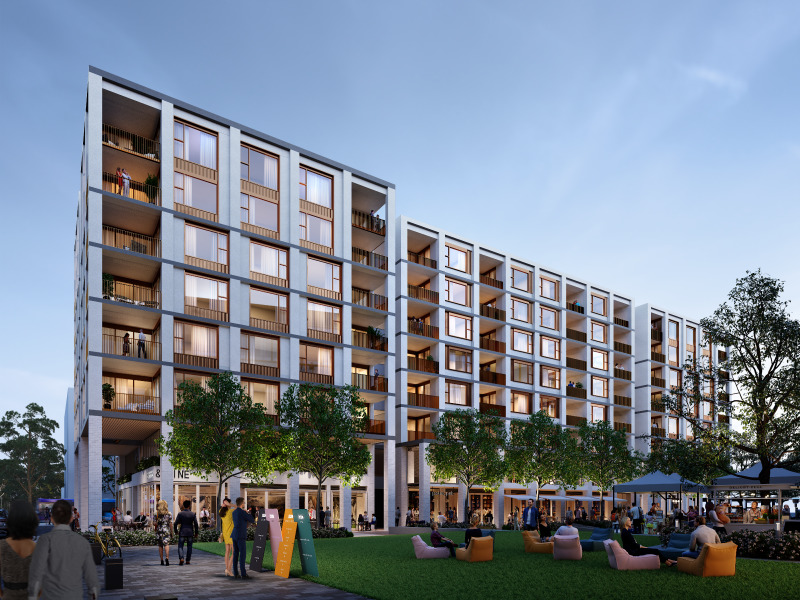
DKSN stands apart because of its scale and scope. It not only includes 300 residential apartments on the site of the former Motor Vehicle registry, but it promises everything from a 90-place childcare centre, medical centre, gym, gastropub, shops, mini-mart, and a cosmopolitan, Melbourne laneway-inspired Eat Street which is drawing the interest of some of the city’s hottest hospitality names.
Designed by leading Australian architects Bates Smart, the three major buildings will be connected by a landscaped “Civic Plaza”.
But what will drive business and commercial activity across the entire development is a 13,200 square metre ACT Government office building housing an estimated 1200 public servants each day, with a ground floor Access Canberra and Suburban Land Agency shopfront operating off the public transport interchange.
Securing that 9-5 working population over the span of a 20-year lease is a major drawcard for Doma and Englobo committing to the area and, in addition to the significant private sector office space on the site, almost assures commercial viability for those businesses operating within the new space.
According to Doma’s managing director Jure Domazet, “people make every development a successful one. Ensuring that people engage with a development is the riskiest part of any project, so in this sense, that risk has been alleviated and it’s what makes this project so attractive”.

Meanwhile, ACT Chief Minister Andrew Barr said it was about time Dickson enjoyed a substantial regeneration.
As a resident of the suburb for the past 11 years, Andrew loves the character of Dickson but is also pleased to see it getting a major makeover.
“It needs it. It was looking tired. People were being drawn away to Ainslie and Braddon. I’m confident that we’ll definitely see Dickson evolve over the coming years, but it will still retain the history and character of the place that so many Canberrans are fond of,” he said.
“The new development in Dickson and the inner north more broadly is a natural progression for what has always been a thriving area of Canberra. The government’s plan through our City and Gateway Strategy is to keep that energy going as Canberra’s population grows.”
He also noted that Dickson remained “more affordable than other inner north suburbs. On a practical level, it has a wide range of retail services, recreation and community facilities and there are plenty of cafes, restaurants, bars nearby also.”
Like many Canberrans, Andrew loves the multicultural flavour of the area.
This is never more evident than on Woolley Street, which has housed a mini Chinatown for almost three decades and is considered the epicentre of ethnic cuisine for the city.

DKSN will further elevate the suburb’s foodie credentials with an edgy food precinct in which more than 20 new eateries will line up along a cosmopolitan laneway strip that will remind many of Sydney’s Spice Alley.
Meanwhile, the firm in charge of presenting the new face of DKSN to the buying public is Coordinate, the same ad agency which has created the CBR brand for the city.
They have come up with a campaign which plays up the edgy and diverse culture of the suburb.
Coordinate partner Warren Apps recalls Dickson as an old stomping ground from the days he went to Lyneham High, and in later years when honey chicken and Mongolian lamb were on high rotation in his Woolley Street ordering preferences.
“Even as a child (hanging out at family events inside a tram at the Dickson Tradies) I remember sensing that Dickson was different from anywhere else in town – even back then it had a certain ‘vibe’ that didn’t reach other parts of Canberra until many years later.”
Despite the suburb’s history and very much working-class roots, Warren believes light rail will trigger a rebirth for the suburb as the “new Braddon”, drawing a new hipster and creative class into the fold.
“We know that Dickson will undergo a renaissance in the coming years and our challenge on this project is to give people a sense of what that might look and feel like when it comes to the ambitious DKSN project but also Dickson more generally.
“What we’ve seen happen to Braddon over recent years will happen in Dickson. People with interesting and innovative ideas will move in and create places that see the place become a genuine destination.”
Englobo chairman and joint development partner John Susa has a nostalgic love of the area due to the amount of time he spent hanging in ‘Dicko’ while a student at Daramalan College.
Englobo joined Doma to deliver the project despite earlier missing out on the bid itself – such was John’s enthusiasm to see it come to fruition. The two companies also have a successful collaborative history after developing much of the initial footprint of the Kingston Foreshore across five neighbouring developments surrounding Kingston Harbour.
John is drawn to Dickson (and DKSN) because he sees it as Canberra’s “first intermodal transport project” and a legacy development for the entire city.

Likening it to the way in which the cluster of skyscrapers in North Sydney provides a counterpoint to the Sydney CBD, Dickson will be similarly imposing. Its transport infrastructure will be considerable as it acts as a huge hub for light rail and bus commuters, as well as those who cycle to either the Australian National University, Australian Catholic University and University of Canberra, or walk to work in the city.
According to Transport Canberra, there will be two rapid routes to Dickson, including via the light rail from Gungahlin to the city and the Rapid 9 from Watson to Belconnen via Dickson. Additionally, five different local routes will connect the suburb with the city, inner north and Belconnen. Bike share options will harness the bike path network, or residents can take the ten-minute stroll to the city via numerous footpaths.
According to Transport Minister Meegan Fitzharris, “the city centre is proposed to house up to 10 per cent of the ACT’s population growth over the next 20 years – accommodating an anticipated total population of over 600,000 by 2050”. The lines between Civic proper and Dickson town centre – just 4.2 kilometres apart – will likely merge by that stage.
While it is difficult to calculate the exact number of commuters jumping off the light rail at the Dickson stop when it commences this year, it is likely to be in the thousands. Forward estimates of light rail patronage are more than 15,000 passengers a day in 2021 between Gungahlin and Civic, up to 20,000 in 2031.
John Susa believes Dickson will be redefined by the light rail and the suburb will be radically different in a decade.
“This really is a legacy project that will see us helping create a new city centre of activity,” he said.
“It really will be a massive transformation.”


Leave a Reply