Well-behaved women never make history – the National Library and She Shapes History are fixing that
Posted on
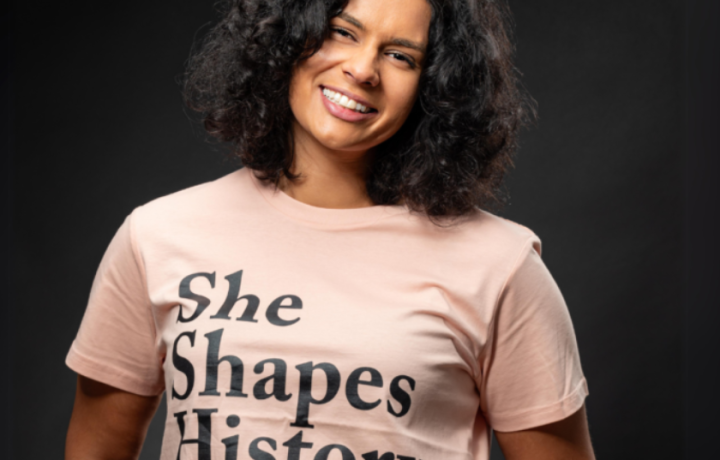
Five years ago, Sita Sargeant asked a question that set the country on fire and changed her life completely: Where are the women in the story of Australia?
It was a simple question with a not-so-simple answer, but one she was determined to draw out and prove that women from all backgrounds have shaped the history of the nation – even if you didn’t know they were there.
The founder and CEO of the She Shapes History walking tours and the author of She Shapes History: Guided Walks and Stories About Great Australian Women, Sita’s work has literally taken her all over Australia – from Canberra to Coober Pedy – earning her the title of 2026 ACT Young Australian of the Year.
Now hosting tours in Melbourne, Sydney, Wollongong and even New York, even as she speaks to HerCanberra from a café in Carlton, Sita admits she will always be one of Canberra’s biggest advocates – which is why she’s so excited about partnering with one of the city’s most beloved institutions: the National Library of Australia.
Following the launch of She Shapes History: Guided Walks and Stories About Great Australian Women in 2025 at the National Library, Sita says she couldn’t help but reflect on how the lack of recognition and knowledge of women’s historical contribution is a “huge national issue”.
Inspired by her research for the book and her love for the work the National Library does, Sita put forward an idea for a collaboration that will explore the unique stories sometimes overlooked by cultural institutions.
“I ended up pitching them this idea for a series that would be like She Shapes History at the National Library of Australia…it didn’t hit me how big it would end up getting,” she says with a laugh.
“I love the National Library. It’s the largest reference library in Australia; it holds so much, and I think that barely anyone knows what’s actually in there. This series is all about digging out those stories.”
Bringing together a series of events, research guides, and digital storytelling projects alongside Library curators and special guests, Sita and her team will uncover the often-under-recognised women’s stories in Australia’s history.
Each talk will be grounded in a question and a topic, from the history of sex work to queer women, women in STEM, women with disabilities and the histories of First Nations, East Asian, African, and South Asian women. The idea is to show that there’s so much more to Australian history than the public has been told.
“What I’m hoping to get out of it is opening up sections of the library for people and making them realise that different types of stories were there,” explains Sita.
“For instance, the talk in September is really diving into this idea that well-behaved women never make history, and what records the National Library holds that enable us to find those women.”
“Next year, we’re going deep into Australia’s civil rights movement, our queer history, and the history of the White Australia Policy and how it’s shaped our sense of national identity.”
Held each quarter over four years, Sita will be moderating and MCing each talk, bringing together three women who have engaged in different ways with the library and their collection to discuss the topic.
The series kicks off with Why didn’t anyone tell me Australian history was actually interesting? on Saturday 13 June. During the inaugural event, Sita will be joined by filmmaker and historian Santilla Chingaipe, Wiradjuri nurse and researcher Jacinta Mackay, and Chennai-born, Canberra-raised researcher and content creator Harini Rangarajan.
“You often end up seeing the same circuit of people talking, so I wanted to get at least one or two people for every event that would not usually have a platform like this, but is someone who is super switched on, knows their shit, and has a lot of interesting things to say.”
“It’s people who I think would be able to really have an interesting conversation about that topic, bring different perspectives to it and probably bring perspectives that might challenge each other. I’m really stoked about the first one…they’re three very different people who each give us access to a different aspect of Australian history.”
Hoping that audience members will leave feeling excited about Australian history, Sita says she strongly believes that to move forward as a country, the community needs to examine the past and “look at the stories that we tell about ourselves”.
“There’s so much more that gives us access to a better tomorrow,” she says.
“I’m hoping that people can use it to reimagine what’s possible for the future and imagine a different national identity for ourselves – one that’s a bit more accurate and shaped by everyone, and not just the select few who have been holding the pen up until this point.”
So, where are the women in the story of Australia? It turns out, everywhere.
And if Sita has learnt anything in the last five years of telling their stories, it’s that there is optimism and hope in Australia’s history – and in its future.
“Australia is a small enough country that anyone can shape history here. If you’re relentless enough, you can make a genuine difference in this country,” says Sita.
“There is more recognition that women have not been recognised [in history], and I think we’ve contributed a bit to that, alongside a lot of other people. It’s amazing that institutions like the National Library of Australia, five years on, are getting involved and saying, ‘We want to commit and make this one of our big cornerstones of our programming.’
“The fact that Australia’s largest reference library is going, ‘We are going to commit a solid chunk of resources to activating women’s stories’ – I don’t think that’s insignificant.”
THE ESSENTIALS
What: Why didn’t anyone tell me Australian history was actually interesting?
When: Saturday 13 June, 10.30 am – 12.30 pm
Where: National Library of Australia, Parkes Place West, Canberra
Tickets + more information: library.gov.au