Not investing yet? Here’s what standing still is really costing you
Posted on
The topic of investing is coming up everywhere; in conversation, on social media, in the news.
It’s easy to feel behind when really, it’s just a decision you haven’t made yet. For many Canberrans still sitting on the sidelines, the real cost isn’t what you don’t know; it’s the time inflation and compounding are quietly spending without you.
You’ll have seen it somewhere: a headline about the share market, a tax time reminder about investment deductions, a colleague mentioning their portfolio like it’s just part of life now. And there’s that quiet voice: should I be doing something? Am I the only one who isn’t?
You’re not. And feeling unsure isn’t the same as being behind.
Why invest, when everything already feels tight?
Here’s the one honest reason it’s worth thinking about, and it isn’t FOMO. It’s inflation.
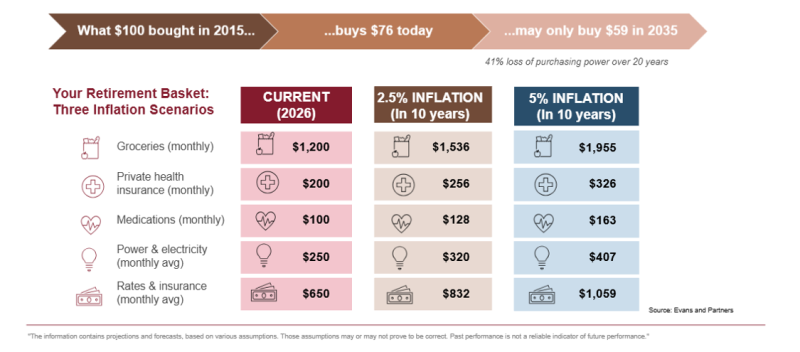
Money sitting still doesn’t stay the same size; it quietly shrinks. The same dollar buys a little less each year, so cash doing nothing in an everyday account is slowly losing ground, whether you’re watching it or not. Doing “nothing” isn’t neutral. It’s a slow leak.
It’s easier to see in real numbers than in the abstract. The chart below shows what $100 today is projected to be worth in a decade if inflation keeps tracking near its recent average – not because the number itself changes, but because what it can actually buy keeps shrinking. That’s the cost of leaving money sitting still.
The flip side is compounding. When your money earns a return, and that return earns a return too, growth starts building on itself. Given enough time, small amounts started early tend to outrun larger amounts started late. Which is exactly why “later, when things settle down” is such an expensive instinct. The one ingredient compounding actually needs is time, and it’s the one thing you can’t buy back.
Before going further, build a buffer
Investing doesn’t mean skipping the basics. A buffer comes first, whether that’s saved in an offset account against your mortgage or a straightforward savings account if you don’t have one.
If you’ve got a home loan, every dollar sitting in an offset reduces the balance you’re charged interest on. With many loans currently well above six per cent, that’s a guaranteed, tax-free return with no market risk and instant access if you need it. No share and no term deposit can promise you that. Building it up also frees up breathing room, and eventually surplus, for the next step.
Where to start?
Your tax refund is a natural kick-starter. It might land sometime in the next four to five months, depending on when you lodge, and it’s tempting to treat it as free money, gone by the weekend. Directing even part of it toward an investment gives your plan a genuine head start, rather than a false one.
A pay rise is the other one to watch. The trick isn’t the size of the rise, it’s what you do with it. Setting aside that increase every single pay and contributing it regularly is precisely the kind of steady, unglamorous habit compounding rewards most, because it’s consistency over time that does the heavy lifting, not the size of any one contribution.
Now, what do you actually put that money into? Picking an individual share and hoping it’s the right one is basically a gamble.
The safer, more sensible approach is to spread your risk across many companies at once, rather than betting everything on one. This is what diversification means in practice, and one common way people do it is through an ETF(short for exchange-traded fund). Rather than buying shares in a single company, an ETF pools your money with everyone else’s and spreads it across a whole basket of companies or assets in one purchase, often tracking something like the broader share market. It trades on the stock exchange just like an individual share, so you buy and sell it the same way, but you end up owning a small slice of dozens or even hundreds of companies instead of just one.
But whatever you choose, risk is part of the deal. Investing outside super means your balance will move, sometimes up, sometimes down, and there’ll be periods where it feels uncomfortable to watch. That’s not a sign something’s gone wrong; it’s the trade-off for the growth you’re chasing. Before you start, it’s worth being honest with yourself about how much of that movement you can sit with without wanting to pull everything out at the worst possible time.
Don’t forget taxes
Investing gets a little more complex the moment tax enters the picture, and this year it did. Legislation passed in June 2026 replaced the 50 per cent capital gains tax discount with a system based on indexation, and introduced a minimum tax on capital gains, changes that apply to gains made from 1 July 2027 onward. It’s law now, not just talk, so it’s worth understanding how it applies to whatever you’re investing in before you commit.
If all this still sounds like more than you want to take on, there’s a simpler path. If you’re comfortable locking funds away for a long time, super is worth considering as your starting point instead. It’s already invested on your behalf, you already have a fund set up, so there’s no extra admin, no new account to manage, and no additional tax return complexity to think about. You’re simply directing more toward something that’s already working for you.
None of these are the only options, and none of them need to happen all at once. There are usually a lot of moving parts to your finances already, your income, your savings, whatever debt you’re paying down, so bringing something new like investing into that mix is worth working through carefully. Getting the setup right from the start will cost you far less than untangling the wrong choice a few years down the track.
This article was prepared by Evans and Partners Pty Ltd (ABN 85 125 338 785, AFSL 318075) (“Evans and Partners”), a wholly owned subsidiary of E&P Financial Group Limited (ABN 54 609 913 457).
The information is general in nature and prepared without considering your objectives, financial situation or needs. You should seek professional advice before acting. Past performance is not a reliable indicator of future performance. The article may include forward-looking statements based on assumptions. Actual returns will vary and will also depend on investment structure. Neither E&P Financial Group nor its related entities make any representation as to the accuracy or likelihood of fulfilment of the forward-looking statements or any of the assumptions upon which they are based.
Our Financial Services Guide, which sets out our services, remuneration and potential conflicts, is available at www.eandp.com.au or on request free of charge.