Breast Cancer Awareness Month: “I had a mastectomy at 17”
Posted on
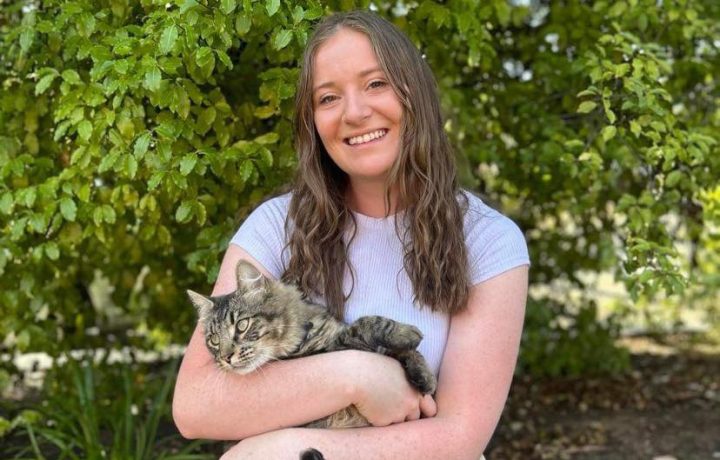
October is Breast Cancer Awareness Month and for 31 days, the impact of breast cancer is brought to the forefront of national conversation. Here we share a local woman’s story of having a radical mastectomy at the age of 17.
When Jodie Kirkness was diagnosed with a high-grade malignant Phyllodes tumour and was told she would need a radical mastectomy at the age of 17, she only cried once.
She shut her bedroom door—her mind overflowing with information—and let all the fear, pain, and anger out before wiping her eyes and deciding that no one would know unless they absolutely needed to.
Working, studying, and playing high-grade soccer, Jodie was a vivacious teenager, and she was determined that she would go on as if nothing had changed.
In fact, it was only by chance that she received her diagnosis in the first place.
“I was dating my first boyfriend and I said to my mum that I wanted to get onto the pill, so she booked me in with the doctor…at the same time I felt a bit of a lump in my breast, and I thought it was weird but my best friend at the time said to me it was probably just a muscle tear,” she says.
“I decided to vaguely mention it to the GP…she felt it and she said it was actually quite large, about half the size of a tennis ball.”
From there, everything changed. Deciding to hold off on getting a biopsy until AST trials had finished, in the space of two weeks, the lump grew from 2cm to 8cm. And it kept growing as the biopsy revealed an unusual leaf-shaped tumour.
“They told me that it was a Phyllodes tumour and that I shouldn’t worry—90 per cent of the time it’s benign but they sent me to a specialist anyway,” says Jodie.
“I remember thinking during that week my breast was really taut and swollen.”
Starting in the connective tissue of the breast (instead of the ducts or glands) Phyllodes tumours are normally not cancerous, often found in women in their 40s. However, Jodie’s was malignant, and by the time her left breast, pectoralis major, and part of her pectoralis minor were removed, it had completely taken over her chest wall—measuring 11cm.
“I didn’t even tell my teachers…I probably should have said something sooner,” she says.
“I didn’t want to miss anything. When they offered for me to do my radiation in Melbourne I said no because I would have been up there for six weeks straight and missed a lot of school.”
After completing five weeks of radiation, for 12 months Jodie lived with an open wound. It would be another three years before her chest was reconstructed.
Now seven years cancer-free, Jodie says it’s hard to look back on her journey—especially as she remembers how embarrassed she was to tell anyone about what she was going through.
“A lot of people just want to keep acting like everything is normal.”
February 15 marks International Childhood Cancer Day—a global collaborative campaign to raise awareness about cancer for children and adolescents with cancer. And while cancer in young Australians is rare, for people like Jodie, the impacts on their physical and mental health are long-lasting.
“Looking back, I probably should have taken it a bit easy, I don’t think I did myself any favours but I think a lot of people just want to keep acting like everything is normal,” she says.
“You feel near invincible when you’re that young, you feel like you can keep going but then it would be 40-degree heat in pre-season, and I would be burnt with radiation…that probably wasn’t the best idea.”
Dating, going out with friends, graduating Year 12, and starting a journalism degree at the University of Canberra, it wasn’t until 2019 that Jodie finally began the process of having her chest reconstructed using tissue expanders and—finally—an implant.
Spending a month recovering in the Peter MacCallum Cancer Centre in Melbourne with her close friend, Jess, by her side the whole time, she says one of the big things that often come up for younger people diagnosed with cancer is how to be comfortable in your own body.
“You’ll often see places like Canteen running sessions for it because you’re going to have scars and burns. It can be really difficult,” she says.
“When you’re really young, cancer also puts you in a really vulnerable position with people who may not have your best interests at heart.”
For Jodie—at the time—her mastectomy felt like the end of the world. And even worse, possibly the end of her new relationship.
“I didn’t even comprehend that he might be okay with it because at least you’re alive right? But I wasn’t comfortable wearing swimmers, I’d wear a shirt in the pool instead,” she says.
“I remember when I did go to nationals for soccer, it would be very awkward. I don’t think I even told my coach what was going on, she just knew she had to keep an eye on me…we were doing hot and cold showers and everyone was wondering where I was…I would refuse to tell them why I wouldn’t do it.”
Now as Jodie feels more comfortable with her scars—and her story—she does believe that her perspective on living life might have been different if she had connected with someone going through a similar experience.
“My outlook on it was to get it done and don’t tell anyone, but I think if I had a younger person—even if they were my age now—telling me it’s nothing to be ashamed of, it would have helped me greatly in reaching out to my friends,” she says.
“Your own personal story is one of the most powerful things you can share.”
Now aged 24, Jodie is carving out a career in health and advocacy.
With previous experience at the Cancer Council ACT and currently working at Women’s Health Matters, she hopes that as she shares her story and supports organisations close to her heart, she can be the person she needed when she was 17.
“I’d like to share my story to help others and offer support where I can which is why I’m helping out Bosom Buddies right now,” Jodie says.
“This might be the journalism degree coming through, but I think your own personal story is one of the most powerful things you can share with people going through a similar experience.”
And while she might never know what caused the tumour—although genetic testing has revealed a history of blood-borne cancers on her dad’s side of the family, including leukemia which took the life of her half-sister when she was also 17—for Jodie, it was the strong support network of doctors and nurses from the Peter MacCallum Cancer Centre, her family (especially her aunt Kerrie), Jess and her current partner Ben that have helped her through the treatment and ongoing scans.
She doesn’t want to be known as a survivor, but for anyone going through cancer, Jodie hopes that her story can provide some comfort that eventually things will be okay. And that it’s normal to be afraid.
“Just open up to people and own your diagnosis. I hate the term ‘I’m battling cancer, I’m a survivor.’ It’s about going through your journey…be your best health advocate, because no one else is going to do it for you.”