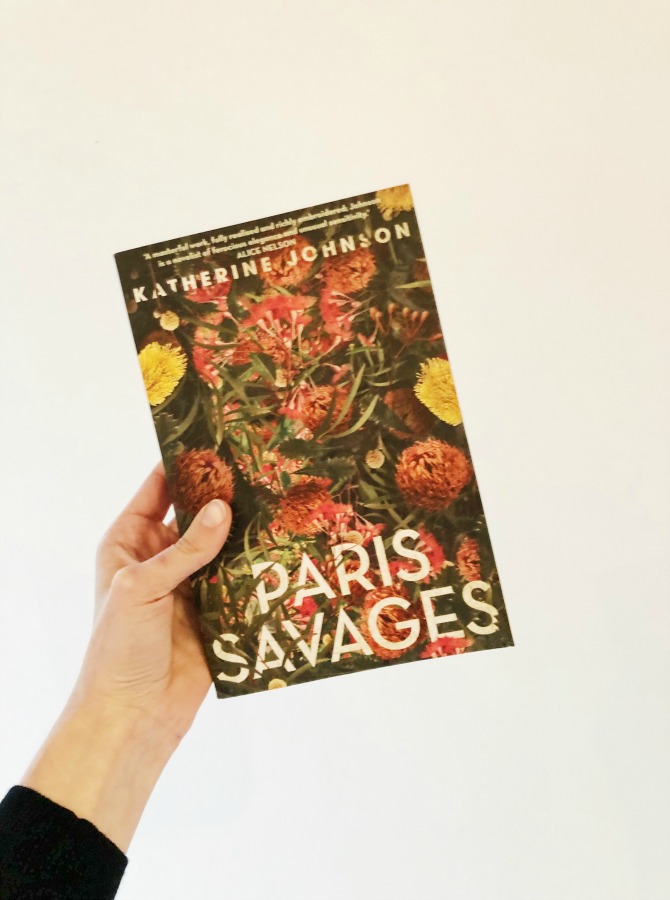
Review: Paris Savages

Posted on
“There are many humorous things in the world; among them, the white man’s notion that he is less savage than the other savages” – Mark Twain.
Paris Savages by Katherine Johnson brought Twain’s concept home to me quite strongly. Literature set in one’s own country has a certain reverberant resonance in that respect.
Paris Savages is set in the 1880s and tells the story of three Badtjala people (traditional owners of K’gari or Fraser Island) named Bonny, Jurano and Dorondera.
Bonny is willful, fierce and intelligent. Jurano is a wise and loyal larrikin. Dorondera, Jurano’s niece, is bright and curious.
Bonny, Jurano and Dorondera have befriended a German settler, Louis Müller, a former engineer who fled his life in Germany after a bridge collapse and the ensuing deaths for which he was considered responsible.
Louis is living on K’gari with his wife, Christel, a passionate, empathetic and open-minded woman and his fifteen-year-old daughter, Hilda, who has come to feel a deep connection to K’gari and its people.
The Müllers have lived amongst the Badtjala learning their language, dances, medicine and history. They have come to appreciate the way of life on K’gari and Christel and Hilda question why more is not being done to preserve the culture and more importantly the lives of the Badtjala people.
After Christel’s sudden and early death (both in her own lifetime and in the narrative–no spoilers here), Louis and Hilda decide to return to Germany accompanied by Bonny, Jurano and Dorondera at the invitation of Herr Hagenback, a ‘pioneer of anthropozoological exhibitions’. Hagenback promises to show the Badjatala naturally and to display their culture.
In agreeing to travel to Europe, the Badtjala under Bonny’s leadership are motivated by a desire to visit the Queen of England and inform her about the treatment of the Badtjala in the Australian state named for her and in the service of her majesty.
Upon their arrival in Europe, Hilda discovers that her father has not been entirely honest about his ability to control the actions of Hagenback, the scientists and the European curiosity culture with respect to the Badtjala.
Bonny, Jurano and Dorendera are prevented from speaking German and living indoors, forced constantly to entertain the alleged sophisticates and perform the version of their culture the Europeans would find most diverting.
They are poked, prodded, rendered in cast and have their personal dignity violated by purported scientific or anthropological experts.
I found this the most personally challenging and powerful aspect of the book. I have always revered European culture – its history, traditions, languages and neutrality.
I was appalled at the mistreatment of the Badtjala in the name of science or, worse, amusement. This story (and it is true albeit fictionalised) is a wrenching example of the corrosive nature of curiosity.
I found myself wishing also that Hilda had done more to protect her friends but had to remind myself that for an adolescent woman in the 19th century she in fact exhibited great bravery by calling out prejudice and inappropriate behaviour whenever she could. I shared her frustration with, and eventual disdain for, her father, who either stood idly by or became complicit in the mistreatment.
Paris Savages is primarily told from Hilda’s point of view through a mix of diary entries and third-person narrative. It is, however, interspersed with the mental meanderings of an amorphous, nascent and (up to a point) anonymous ghost.
The novel’s cleverness lies in the use of these multi-perspective techniques to tell a relatively unknown and true story about Indigenous Australians without appropriating it.
It is evocatively written and has at its core a fascinating recount of a reality about which we could all afford to learn more.
Paris Savages will be published in October by Ventura Press, to which I am grateful for kindly sending me a review copy.

Leave a Reply