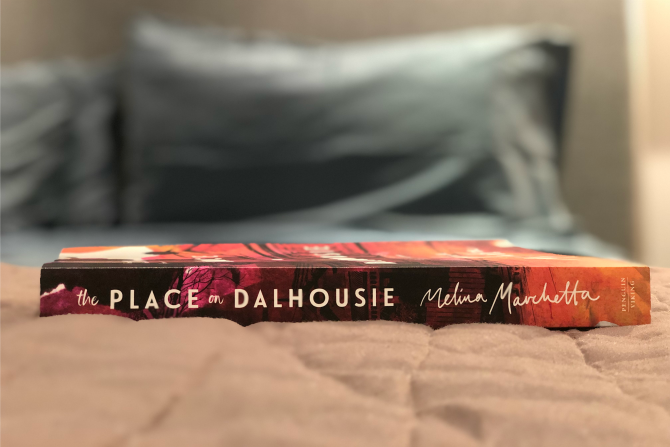
Review: The Place on Dalhousie
Posted on
As a teenager, like most teenagers, I felt as if no one understood me.
The exception was Melina Marchetta, whose books Looking for Alibrandi and Saving Francesca spoke to me. I honestly felt as though she’d written them just for me. My adolescent self-obsession may have been to blame for that.
A decade and a half later, I like to think I’m (a little) less self-obsessed, and nowhere near as moody or pimpled. I’ve changed in many ways but there remains one constant: Melina Marchetta’s writing still speaks to me. The Place on Dalhousie (published on 2 April 2019) has proven that.
It starts in a Queensland pub with a beer – an auspicious start. There’s been an almost biblical flood and, amidst the chaos, Rosie Gennaro, who is temporarily working up north, meets a bearded volunteer in orange overalls – ‘SES Jesus’ as she mentally refers to him thereby adding to the biblical vibe of it all. He takes Rosie back to his room at the pub and a one-fortnight stand thus begins. Rosie is outwardly tough but there’s a fragile chaos within her that SES Jesus quiets with his incessant chat.
Fast forward two years and Rosie has returned to the life in Sydney that she’d once fled. She has her baby, Toto, the father of whom is unknown, in tow. (‘Toto in tow’. That has a nice ring to it. In toto.) She is living on Dalhousie in a once rundown house that her father, Seb, assiduously transformed into a home for Rosie and her mother. Rosie now begrudgingly co-habits it with Seb’s second wife, Martha, who he married less than a year after Rosie’s mother died and who she passionately detests.
Re-enter SES Jesus – also known as Jimmy Hailer, a name that will be familiar to Marchetta fans. Jimmy was a side character in ‘Saving Francesca’, a lost puppy dog of a guy without family or friends. His desperate desire to belong is a theme that Marchetta picks up again in The Place on Dalhousie – a prime example of which is the fact that he bought his Monaro because its previous owner, a guy with an accent, told him: “Buy the car, you’ll find your family”.
Jimmy, as it turns out, is Toto’s mystery dad or so Rosie says. Although fearful of the unexpected responsibility of fatherhood, Jimmy wants to do the right thing, and becomes a co-parent whenever he can get back to Sydney around his FLIFLO schedule. “Toto, I’ve a feeling we’re not in Kansas anymore.”
What follows is a beautiful story about the redemptive power of friendship and family that is sure to touch your heart, as it did mine. It proves that Marchetta (like her target audience) has grown and can bring her characteristic empathy to a book for and about adults.
In particular, I admired how robustly defined her middle-aged female characters were – a demographic that does not feature often enough in contemporary literature. Martha and her own once-upon-a-time school friends (now her netball team) were as likeable and multi-faceted as Jimmy’s own St Sebastian’s crew.
Speaking of, if you liked Saving Francesca and The Piper’s Son, you will undoubtedly love this book. Many of our favourite characters return and play their role (some bigger than others) in the man Jimmy is and the father he will become. Even if this is your first Marchetta novel, it can be read as a stand-alone. I promise you will find much within its pages. I defy you not to feel all the feels.
I gave The Place on Dalhousie five out of five stolen Monaros.

Leave a Reply