Bold Types, Australia’s trailblazing women journalists
Posted on
You probably know and value the journalism of Australian women such as Leigh Sales, Lisa Millar, Annabel Crabb, Fran Kelly, Katharine Murphy and Sarah Ferguson.
But have you heard Anna Blackwell, Alice Henry, Stella Allen, Francis Taylor or Janet Mitchell?
They are the pioneers of women in media across Australia, reporting from over a century ago—from overseas postings, war zones and in newsrooms which were the exclusive domain of men.
Veteran journalist Dr Patricia Clarke has meticulously compiled their stories in a new publication by the National Library of Australia, Bold Types: How Australia’s First Women Journalists Blazed a Trail, which tells the story of women journalists in Australia covering the period from 1860 to the end of World War II.
Dr Clarke is herself a trailblazer, having been the only woman on the Melbourne staff at the Australian News and Information Bureau in the early 1950s. In a detailed epilogue, Patricia shares stories of her own life and career in the days of crowded newsrooms, clattering typewriters, and overflowing cigarette trays.

Patricia Clarke in the late 1950s when she was a journalist with the Australian News and Information Bureau in Canberra. Image courtesy of Patricia Clarke.
She is now a historian, who has written extensively on women in Australian history and the history of journalism.
In Bold Types, Dr Clarke recounts the chequered journey of women journalists in the fight for gender equality, singling out a number of independent, adventurous women who ventured far and wide in search of news, relevance and equality.
They include Anna Blackwell, who in 1860 was appointed the Paris Correspondent for the Sydney Morning Herald and whose reportage consisted of handwritten dispatches sent by boat.
Edith Dickenson was appointed to report on the Boer War for the Adelaide Advertiser as the only woman accredited in the field.
Stella Allen’s journalistic career began in New Zealand where male journalists refused her entry to the Parliamentary Press Gallery in Wellington.
Each of the 13 women’s story illustrates tenacity and determination against a prevailing background of patriarchy.
Guardian Australia political reporter Amy Remeikis, provides a forward to the book, in which she reflects on the struggles and achievements of her early counterparts as well as the current working environment for women journalists.
“There is no Avani Dias or Isabella Higgins or Zoe Daniel (in her incarnation as a foreign correspondent) without Janet Mitchell, who watched as Japanese troops marched into the Chinese province of Manzhou (Manchuria), capturing the moment many now see as a precursor to the Second World War in letters to her family, which she later turned into a series of broadcasts for the ABC upon her return to Australia.
“Maxine McKew, Pru Goward and now Daniel are part of a long line of women journalists who saw an opportunity to better create change by joining politics, instead of just reporting on it, which owes a debt of gratitude to Alice Henry, a woman who resigned her rather constricting position in Australian journalism to fight for women’s suffrage, not just in Australia, but in the United States.
“There is no Lenore Taylor, Michelle Grattan, Gay Alcorn, Lisa Wilkinson or Lisa Davies without Jennie Scott Griffiths, the first female editor of a weekly women’s paper. Scott Griffiths had already worked as the ‘unacknowledged, unpaid’ editor of the Fiji Times when it had been under her husband’s stewardship. In 1915, she was able to put her name to her editorship of the Woman’s Weekly—two years after she had been given the job,” writes Amy.
“But the more things change, the more they stay the same. For every step—or shove—forward, there have been just as many steps—and shoves—back.
“The boys’ club may not be as acceptable today, but it still exists. It dwells in the editors’ and chief editors’ rooms, in the boardrooms of media organisations, the rarefied places where women still do not have access (The Australia Club, which counts the most influential powerbrokers among its membership, remains stubbornly male-only in 2022), the golf clubs, whisky bars and country pubs. Men by and large still hold the most powerful positions in Australian media, are promoted faster, paid better and offered more opportunities than their women counterparts, who still have to work twice as hard to receive even half the credit.”
Bold Types: How Australia’s First Women Journalists Blazed a Trail can be purchased here.
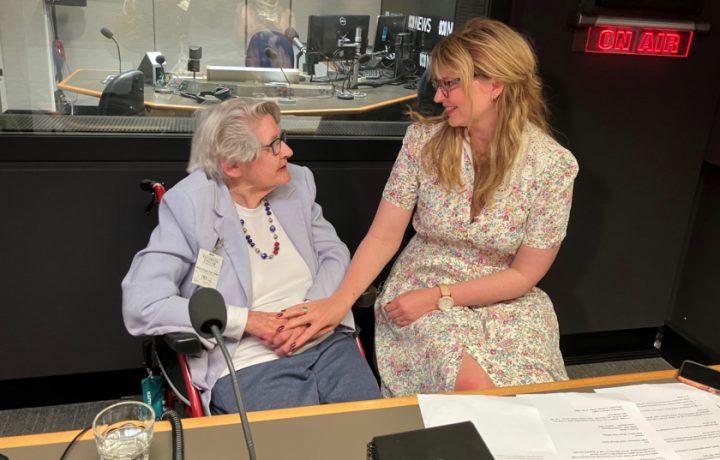
Main image: Dr Patricia Clarke and Amy Remeikis, courtesy of the National Library of Australia.