Why you can’t miss The Appleton Ladies’ Potato Race
Posted on
If, like me, you’re desperate to shake off the 2020 blues with a good laugh, don’t miss The Appleton Ladies’ Potato Race at the Canberra Theatre in early June.
This brilliant, warm-hearted and frankly hilarious play is by my friend, the fabulous playwright and journalist, Melanie Tait.
The story—inspired by real events—goes like this. Appleton is a is a small country town that is being forced to evolve as newcomers move in—folk from the city with money, treechangers and refugees.
Things get real when new GP Penny Anderson realises that the famous Appleton Potato Race awards $1000 prize money for the men, and a just $200 for the women. Not good enough!
But when Penny tries to make change, all hell breaks loose. She inadvertently sets off a culture war.
But enough from me! I asked Melanie a few questions about her play—and I’m sharing the answers with you now. She’s very fond of Canberra, so we started there.
How long did you live in Canberra and between what years?
I lived in Canberra for about five years—from 2010 to 2015 and would still be there if I had’ve had the right job. I’m constantly being pulled back to Canberra—my birthday is even Canberra Day!
When I moved back from Tasmania a couple of years back, I considered making it a move back to Canberra, but my family is mostly in Sydney and I want to be close to them. Am hoping one of them gets a job in Canberra, so I can go there too.

Melanie Tait.
What do you love about writing plays? When did you write your first play?
The actual writing of plays I find quite arduous, and stressful, as in spite of the really terrific reception my plays have had from audiences, I still struggle from a lot of procrastination and imposter syndrome. What I love about writing plays, and indeed, why I keep writing them is twofold.
Firstly, I love working in the room with a bunch of talented actors and seeing it take life—working out what works, what doesn’t, and discussing the ideas of the play before it reaches an audience.
Secondly, being in an audience that gets your play (laughs at the right times, cries at the right times, gasps when you want them too) is a buzz better than sex, drugs or rock’n’roll, I’m sure of it. I’ll keep going back for that as long as people are interested in doing my plays.
If you were telling someone at a dinner party what Appleton Ladies Potato Race is about, what would you say?
Okay, so this isn’t sexy, but: it’s about the gender pay gap. After decades away, Penny comes back to her hometown to be the local GP and discovers that the legendary potato race pays men $1000 for first prize, and women $200 for first prize.
She decides to change this, and the town goes into meltdown. The play is told through five very different (women) characters on varying sides of the debate. And, it’s a comedy, would you believe?

Amber McMahon (Nikki), Sharon Millerchip (Penny) and Valerie Bader in The Appleton Ladies’ Potato Race. Photo by Phil Erbacher.
The play was inspired by a real story. Tell us about that.
It happened to me! I’m from Robertson, NSW, the potato capital of the world. I love the potato race, which is held every year at our local show and have long dreamed about going in it.
This one day a few years ago I went on the website to dream about it and noticed the discrepancy in the prize money. A friend and I got talking about it—and decided we should raise the money to make it equal.
I, naively, thought this would make me into a feminist hero in my hometown: it made me into a bit of a pariah and was actually one of the worst experiences of my life.
We raised the money, the race is equal now, but it caused a cultural meltdown in Robbo I’m still not quite over. So I wrote a play about all those feelings!
When I saw Appleton Ladies in Sydney in 2019, I laughed so hard my stomach hurt. How hard is it to get the humour right and make a play funny?
You know, it’s something that is both easy and hard for me. Sometimes the jokes flow out really easily, yet with some parts, I’ll labour for a year to get the right joke and right rhythm for a moment in the play. There are still two moments in TALPR that need better jokes that I just don’t seem to be able to work out.
I think being funny is an essential part of the toolkit of being a playwright. It’s how we can really, eventually, get the audience to invest in the more poignant moments.
Life, even when it’s incredibly tough, always has humour in it—it’s arrogant for a playwright to not ever lighten the load for her audience. It’s something I hope to get better and better at as I keep writing.
You touch on some very heavy themes—like racism and sexism—but with an extremely light hand. Why have you taken this approach?
It goes with what I said above. As an audience member myself, I want to always be on the edge of surprise, I also want to try and see the humanity of every character on stage. In life, there are rarely good guys and bad guys. We’re all complex, trying our best every day and I want my work to reflect that complexity.
I also want to draw an audience in without preaching to them—which is hard, because issues like sexism and racism are completely terrible, and it’s hard not to be polemic and didactic about them.
I also write what I’d like to see. I don’t want to be yelled at for 90 minutes, or told what to think. I want to figure out where I sit on an issue myself.
Some of my most formative political moments have come from being in a theatre, and they’ve never come from a writer who’s been telling me what to think—they’ve been from writers who’ve presented a number of views through different characters with real humanity—and that’s what I try to do.
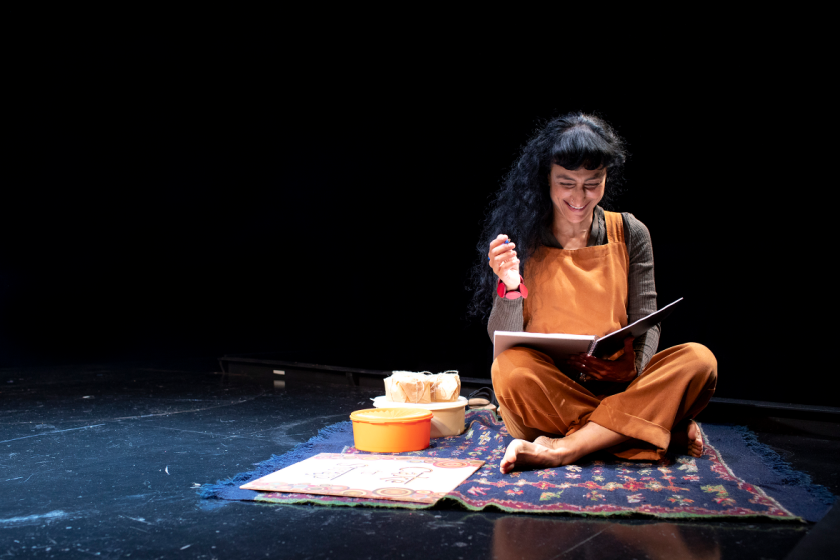
Sapidah Kian (Rania) in The Appleton Ladies’ Potato Race. Photo by Phil Erbacher.
TALPR has an all-female cast, is this deliberate?
Absolutely it is. One thing I noticed, during the actual potato race battle in real life was that it was women doing all the work on the Robertson Show. Women running the show, the treasury, the events, the potato race…everything. And, when we look around our own lives, even though men are still the majority of CEOS, board members, politicians etc, who actually runs day to day life? Women.
Women are raising the money for charities, running their homes, working a bunch of jobs, remembering when the doctor’s appointments are etc.
I also wanted to comment a little on how the patriarchy damages men in small rural towns, too. We only ever hear about the men of Appleton—and they struggle too.
Also, from a practical level, there aren’t enough great roles for women in theatre over 30 and under 80. I wanted to give the world five.
THE ESSENTIALS
What: The Appleton Ladies’ Potato Race
When: 3-5 June 2021
Where: Canberra Theatre Centre
Tickets: canberratheatrecentre.com.au/show/the-appleton-ladies-potato-race
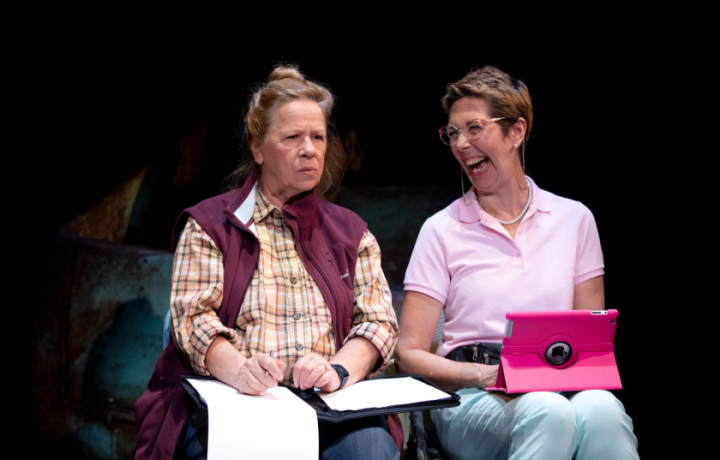
Feature image: Valerie Bader (Bev) and Merridy Eastman (Barb) in The Appleton Ladies’ Potato Race. Photo by Phil Erbacher.

