How I Got Here: Martina Hoffmann of Canberra Bee Collective

Posted on
Admit it, we’ve all been there—stalking social media and LinkedIn profiles, trying desperately to figure out how the hell someone got their dream job.
It seems impossible and yet there they are, living out your career fantasy (minus the itchy business suit). It might seem hard to believe, but once upon a time, they were also fantasising about their future career, and with some hard work, they made it.
Welcome to How I Got Here, HerCanberra’s series that reveals everything you wanted to know about the secrets of career success. This week, we meet Martina Hoffmann of Canberra Bee Collective to celebrate World Bee Day 2024.
Existential crisis time: Who are you and what do you do?
My name is Martina Hoffmann and I run Canberra Bee Collective. This involves live honey bee removals, selling backyard honey, bees and beekeeping equipment and providing hive inspection and mentoring services. I’m also currently experimenting with beeswax candles.
Let’s go back to when you were a kid, have you always dreamed of working in this industry?
I remember, as a kid, being fascinated by a colony of wild/feral honey bees living in a tree hollow near my house. I loved watching them fly back and forth but was too scared to get very close. So no, I didn’t really consider working with bees – in fact I didn’t even realise ‘bee wrangler’ was a job! Instead, I studied statistics at ANU and worked as a programmer and stats tutor for many years.
I had sporadic exposure to honey bees during this time: a talk about backyard beekeeping; a chance to don a suit and observe an inspection. Then a few years ago, I heard about the Flow Hive – a neat Australian invention that makes harvesting honey a breeze.
Drawn to the idea of having my own hive, I started reading up about honey bees. The more I discovered, the more interested I became. For example, it amazed me to learn that these awesome little pollinators communicate. They do this through something called the waggle dance.
After a fair bit of research, I ordered a hive and bees and signed up for a course at the Canberra Region Beekeepers Association. To anyone considering getting a backyard hive, I recommend getting some hands-on experience to prepare you for the reality of caring for your own bees. Having a beekeeping buddy or mentor helps too!
Tell us about when you were first starting out, what set a fire in your belly to get here and how did you do it?
About a year after I got my backyard hive, I was walking past Dickson Pool when I noticed that the air ahead of me was filled with a big cloud of honey bees. This is what we beekeepers refer to as a swarm. In spring and early summer when a hive/nest becomes too crowded, about half the bees will leave with the queen bee to find a new home (the remaining bees will raise a replacement queen).
The first step of this journey involves clustering on a temporary landing spot – often a nearby tree branch – from where scouts are sent out to find a suitable nesting site. Bees are generally quite gentle when they’re swarming as they’re not defending a nest, but it’s best not to disturb them unless you know what you’re doing – they can still sting!
It was a magical experience watching the swarm settle on a nearby bush and I rushed home to grab my suit. With a bit of patience, a friend and I caught the swarm and put them into a hive. After that, I was hooked. I helped another friend get a colony of bees out of a possum box. Next, I rehomed some bees from a water meter.
For me, there’s something satisfying and addictive about removals. The way the bees sparkle like gold under light. The smell of the honey and the comb. You can only coax bees – it’s tricky to bend them to your will and it’s best not to rush them. Many of their behaviours are predictable and yet they often surprise.
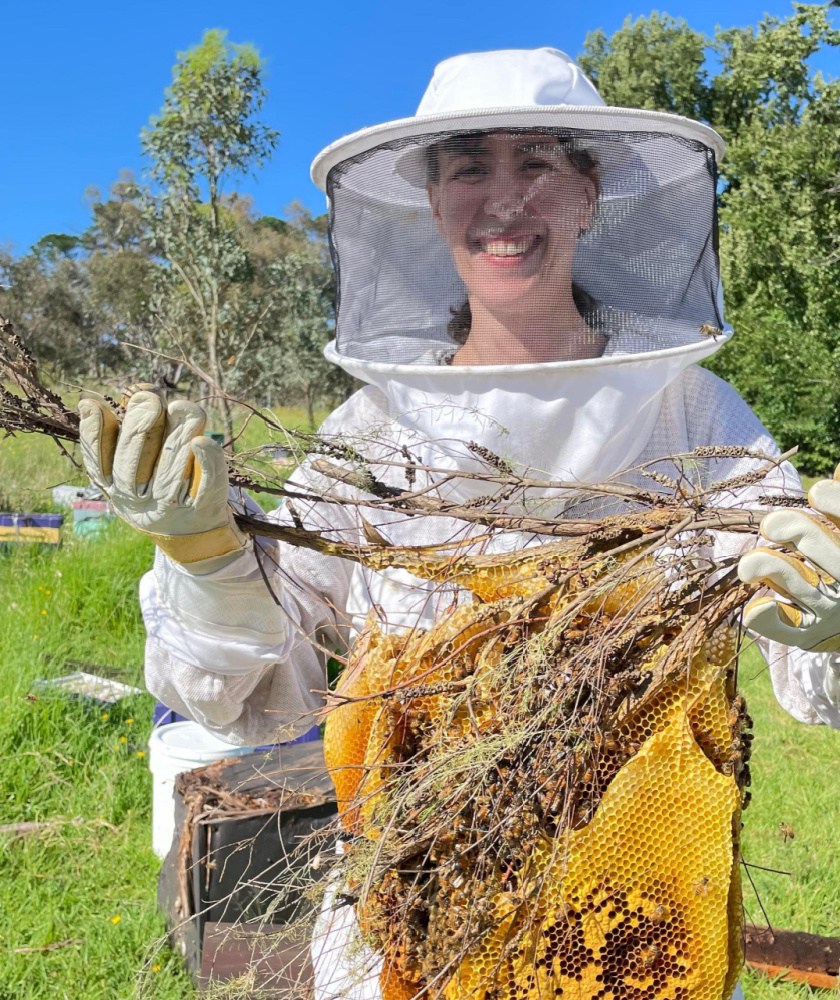
Martina with a tree branch colony.
Recall a time when you wanted to chuck it all in; what did you tell yourself when it got too hard?
Having a beehive in your backyard and catching the occasional swarm is one thing; taking on large rehoming jobs is a different kettle of fish.
I was undertaking these removals being entirely self-taught and at some point I took on a job that I really wasn’t qualified to do. A homeowner had stored a bedframe outside with a tarp thrown over the top. A swarm had moved in but now the owner was selling and needed the bees gone. I didn’t totally realise what I was dealing with until I’d removed the tarp. Generally, the longer you leave a swarm to do its thing, the more comb there is. The bees had been living in this bedframe for over two years and the nest was massive.
There’s a belief among beekeepers that bees can sense your mood, that a calm beekeeper equals calm bees. So, despite being faced with 50,000 stinging insects, I fought down the instinct to run and got to work. Removing an established colony involves cutting out the comb and putting it into wooden frames. I placed the frames into a hive and then brushed/scooped in as many bees as I could. This process took many hours and I had sweat rolling down my back. Beesuits can get pretty stuffy in hot weather!
As the day drew on, returning foragers gathered on the bedframe. I brushed them into the hive, but they kept escaping and flying back to the bed, even though I’d removed the comb. Herding bees is a bit like gathering so many grains of sand and the tools (and knowledge) I had just weren’t up to the job. There were confused bees everywhere and some became agitated, buzzing angrily near my face. I moved twenty metres away and they followed me and stung me on the neck while I was drinking water.
With evening closing in, I took the hive, comb and around two-thirds of the bees home. I felt terrible. I barely slept, thinking about the bees still on the bedframe, who would die without my help. I realised I’d gotten myself into this mess and promised myself that if I found a way out, I wouldn’t stress myself (or a colony of bees!) this much again.
After some more research, I ended up building a bee vacuum. This involved modifying an existing vacuum cleaner so that the bees aren’t injured when they’re sucked up. There was some trial and error but two days later, I returned to the bedframe and vacuumed up the remaining foragers before reuniting them with the rest of the colony. I slept a lot better that night.

The bedframe.
What was your biggest break?
After the bedframe removal, I admitted to myself that I had gotten in way over my head and still had a lot to learn. I mulled on it and then got up the guts to ask local pro bee removalist Dermot AsIs Sha’Non if I could assist him on a job. Dermot is one of very few beekeepers (if not the only one!) in Canberra offering regular live honey bee removal services, and has been doing so for over twelve years.
To my surprise, he said yes! We tackled a big compost bin removal together and then a few tree hollow jobs and it’s just gone up from there. There’s a new challenge every week. It’s awesome working with Dermot, he has an absolute wealth of knowledge but doesn’t take himself too seriously. On the job, I generally wear a triple layer mesh full suit and thick cowskin gloves; meanwhile, Dermot has turned up before in a t-shirt and no shoes! I’m still learning to read temperament; many colonies are quite gentle but then you get others which will chase you down the street.
Dermot has been an awesome mentor to me and his encouragement has really helped build my confidence. We each have our own jobs and clients now but share an apiary and often tackle larger removals together. I’ve learnt heaps and knowing that I can always ask him for advice or help on a job is incredibly reassuring.
What’s the best piece of advice you’ve ever received?
My friend (ex-Canberran novelist Anna Snoekstra) said something to me about how it’s better to get into a new industry from the inside out rather than the other way around. Find out who’s doing what you want to do, and see if there’s a space for you to assist and build.

An open hive. Image courtesy of Gold Street Press.
What is it about your industry that you love and what makes you want to pull your hair out?
I love the variety that comes with working with bees: no two days and no two seasons are the same. I also really enjoy engaging with hobby beekeepers. It’s interesting to witness different setups and methods and gratifying to assist in building/rebuilding confidence if required.
However, I have on occassion felt dismissed, as a young female beekeeper. There’s unfortunately a culture of dogmatic gatekeeping in certain corners of what is a relatively male-dominated industry. We’re lucky in Canberra to have some highly experienced beekeepers bringing a friendly, supportive and non-judgemental approach, such as Dermot and also Parliament House’s head beekeeper/bee advocate Cormac Farrell.
Further afield, Beechworth Honey co-founder/director Jodie Goldsworthy and American author/bee educator Hilary Kearney are inspiring.
Where do you see yourself in five years?
Hopefully still working with bees and learning about bees!
I’ve got a few ideas for bee-related products that I’d love to develop. I’ve been lucky to collaborate with some awesome local businesses already – shoutout to design/photography studio Gold Street Press – and have got a couple more exciting projects in the works.
I’d also like to learn more about Australia’s 2000+ native bee species and think about how I can support them. Unlike the bees I work with (European honey bees – an introduced species), Australian native bees are largely solitary and several are unfortunately on the decline.
What advice would you give your past self?
Keep showing up. Fight that inner voice saying that you’re not good enough and just put yourself out there. Have a little more self-confidence! But also understand that you can’t and don’t have to do everything yourself. Find people you want to collaborate with and just go for it. The worst they can say is no.
Want more bee content in your life or interested in becoming a beekeeper?
Contact: cbrbeecollective@gmail.com or check out cbrbc.com.au and @cbr_bees
Feature image: Gold Street Press